




Every self-storage facility runs on some sort of software (even the ones still running on a spreadsheet and a wall of paper lien notices). The only question is whether that software is working for the operator or against them.
Self-storage management software is the system of record that runs a facility: the units, the tenants, the rent, the payments, the gate, and the website that sells the units. The industry calls it FMS, or Facility Management Software. You'll also hear PMS, for Property Management System. Same job, different lineage. This guide explains what the category is, what the system actually does, and how to tell a modern platform from one built for an era that ended two decades ago.
What is Self-Storage Management Software?
Self-storage management software is the operating system for a storage business. It holds the rent roll, charges the cards, opens the gate, lists the units online, and tells the owner what the facility is actually worth this month. One system, one source of truth.
For most of the industry's history, that system was a patchwork: a back-office PC running desktop software, a separate website nobody updated, a card terminal at the counter, and a spreadsheet to reconcile the gaps. It worked, in the sense that the doors stayed open. It also leaked: rent that went uncollected, leads that went unanswered, hours that went to data entry instead of the business.
What is FMS? (Facility Management Software)
FMS stands for Facility Management Software. It's the term the self-storage industry uses for its core operating system. Move-ins and move-outs, billing, tenant communication, reporting, and the integrations that connect to the gate and the locks, all are generally handled by an FMS of some variety.
The "facility" framing is deliberate. It points at the physical reality of the business: units that fill and empty, a gate that opens and closes, a counter where someone signs a lease. FMS is where that physical operation meets its digital record. When a tenant moves in online at 11:00PM, the FMS is what assigns the unit, signs the lease, charges the card, and grants the gate code without anyone on staff lifting a finger.
You'll see "FMS" on vendor websites, in RFPs, and in every hallway conversation at an SSA show. If you operate storage, it's the acronym that describes the most important software you buy.
What is PMS in storage? (Property Management Software)
PMS stands for Property Management System or Property Management Software, used interchangeably. In self-storage, FMS and PMS describe the same thing: the platform that runs the facility.
The difference is lineage, not function. PMS is the term borrowed from real estate and hospitality. It’s the same word a hotel uses for the system that manages rooms and reservations, and the same idea a multifamily operator uses for leases and units. Storage-native vendors tend to say FMS because "facility" fits the business better than "property." Operators who came from real estate often say PMS out of habit.
If you've ever wondered whether FMS and PMS are two different products you need to buy separately, they're not. Fair question, though. It's the kind of thing the industry never bothered to standardize.
FMS vs. PMS: Is There a Difference?
Mostly a naming difference, with a slight shift in emphasis. FMS leans toward operations and the on-site reality—the units, the gate, the move-ins. PMS leans toward the property and the asset view—the lease, the occupancy, the value of the real estate. In practice, a good self-storage platform does both, and the two terms point at the same software.
Term | Stands for | Origin | Emphasis | Who uses the word |
FMS | Facility Management Software | Self-storage native | On-site operations | Storage vendors, operators |
PMS | Property Management System | Real estate / hospitality | Property & asset view | Real-estate-minded operators |
So when a vendor says FMS and an investor says PMS, they're describing the same purchase. Don't let the acronyms send you shopping for two systems.
What Self-Storage Software Actually Does
The category is easy to define and hard to do well. Here's what a complete self-storage management system handles.
Tenant Management and the Rent Roll
This is the core: every unit, every lease, every tenant, and the status of each. Who's moved in, who's moving out, what's vacant, what's overdue. The rent roll is the single source of truth for occupancy, and occupancy is the number the whole business runs on.
Billing, Autopay, and Collections
Storage runs on recurring rent, which means it runs on collections. The software charges cards on schedule, enrolls tenants in autopay, and works the delinquency ladder when a payment fails. This is where revenue can quietly leak.
The operators who do it well treat collections as a sequence, not a switch. Jonas Duckett of Store It Quick runs a tiered cadence: "At 5 days late they get a late fee notice. At 15 days late, they get a lockout fee notice... and then at 22 days late, they get the lien fee."
The early messages aren't threats, but good will conversations: "Hey, we don't know what's going on in your life. Call us and let us know. We'll work with you." As Duckett puts it, "customer retention is going to make you more money than a couple late fees." Good software runs that sequence automatically, in the operator's own words.
Embedded Payments
Self-storage revenue runs on credit cards, with some estimating as many as 70-80% of payments being card-based. That makes payment processing not a feature but a core part of how the business moves money and increasingly, how the software earns its keep.
The detail that matters: older platforms often couldn't tell a credit card from a debit card at the moment of processing. So when an operator added a surcharge to offset card fees, the system charged every card, which is legally fraught for debit. Modern processing can read card type at transaction time and surcharge credit cards only. One Cubby operator's card mix ran about 62% debit and 31% credit; applying the fee to credit alone meant a "3% fee" actually netted closer to 0.66% of gross sales. The plumbing is invisible to tenants and decisive for the operator.
Website, Listings, and Online Move-Ins
The software is also the storefront. It powers the website, syncs units to marketplaces, and (the part that's still underrated) lets a renter move in online without a phone call or a counter visit.
The bar now is the rest of the internet. "We hated being on a storage website where a customer wants to rent a unit and we make them fill out like a 30-form questionnaire,” says Faraz Hemani of Iron Storage. “The customer's just trying to rent like a $60 storage unit, right? We don't buy anything online that way."
The fix is one-click simple, and it shows up in the numbers. When Prestige Storage put a modern storefront in front of renters, online move-ins rose 200%, and abandoned-cart leads called within five minutes closed at over 70%.
Access Control and Gate Integration
The software talks to the physical gate and the smart locks. Move in, and the gate code activates. Fall far enough behind, and access suspends. Move out, and it's revoked, all automatically, no trip to the keypad.
Reporting and NOI Visibility
Owners don't check the software to admire it. They check it for the numbers: occupancy, collections, the trend line on revenue. A real reporting layer rolls those up across a portfolio so an operator can see one facility or sixty in the same view.
This is where the patchwork era hurt most. Before Cubby, Prestige Storage ran five different software systems across a growing portfolio. Controller Tyler Annon: "As we grew from 15 to 30 to 45 to 60 properties, we were drowning. It became unbearable." Real-time competitive rate data at that scale was simply impossible. Without a unified view across the portfolio, there was simply no way to get an accurate view of the business.
Call Handling and AI
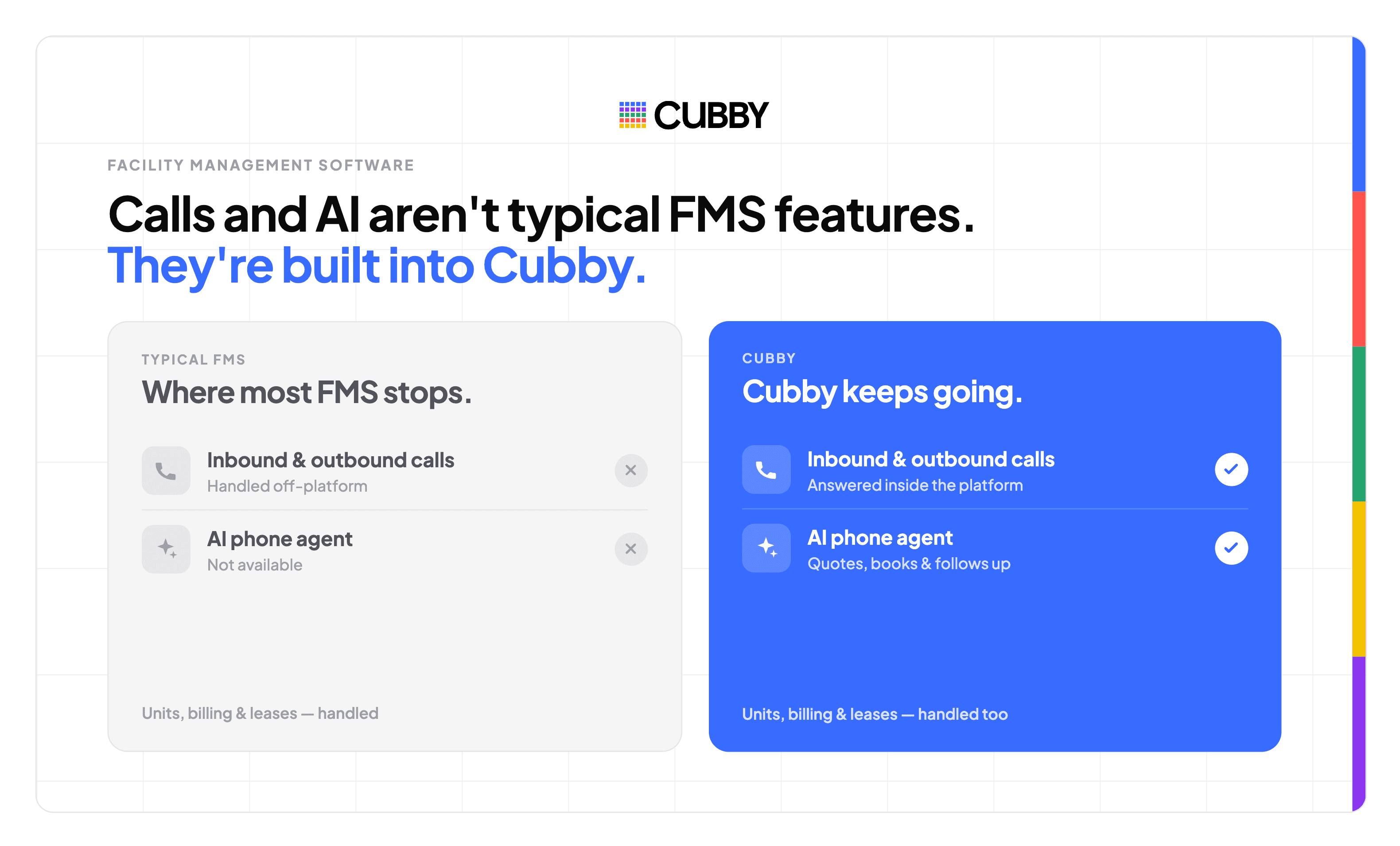
The phone is still where a lot of storage rentals begin, and for years, those calls vanished the moment they ended. Unlogged, unattributed, tied to no record. A lead would call, never rent, and leave no trace. That's the gap most facility management software never closed: the phone stayed outside the system.
Cubby treats the call as part of the record. AI answers when the team can't. Every call is recorded, transcribed, and attached to the tenant profile automatically. A lead doesn't fall through, and a manager can finally coach from what was actually said, not from memory.
Who Uses Self-Storage Management Systems?
The category spans the whole market, and the need changes shape as the portfolio grows.
A single-facility owner-operator wants the software to be the staff it can't afford—answering leads, chasing payments, opening the gate at midnight.
A multi-facility operator wants standardization—the same process running identically across every site. Faraz Hemani of Iron Storage calls it the key to scaling: "I need—as much as possible without sacrificing quality at a site—to have standardization."
Third-party managers and REIT-scale portfolios want all of that plus portfolio-level reporting and the ability to run dozens of facilities without dozens of logins. The software that fits a 200-unit single-site won't necessarily carry 60 properties, and the gap between those two is where a lot of operators get stuck.
Cloud-Based vs. Legacy On-Premise Software
The real dividing line in the industry today isn't between vendors. It's between eras.
Much of the installed base runs on software built for an offline world, with online booking bolted on after the fact. Legacy on-premise systems carry real costs that don't show up on the invoice: manual reconciliation, data stranded on a single back-office computer, integrations that break, and the dread of a multi-hour outage taking the website down on the first of the month. The friction of leaving is part of the design: payment tokens that don't transfer, export fees on the way out, years of occupancy history that's hard to take with you.
Cloud-native platforms invert that. The data lives where the operator can reach it, the website is the product rather than an add-on, and the integrations are an open ecosystem instead of a walled garden. None of this is magic, it's just software built this decade, for how renters and operators actually behave now.
How to Choose a Self-Storage Management System
The category is crowded, and most demos look fine for the first ten minutes. A few questions cut through it:
How does it handle payments? Card-on-file, autopay enrollment, and critically, whether it can surcharge credit cards without illegally surcharging debit. Ask what your real effective rate will be, not the headline percentage.
How hard is it to leave? Ask about data export and payment-token migration before you sign, not after. A vendor confident in the product doesn't need to trap you in it.
What does it actually automate? Lead follow-up, the delinquency ladder, gate access, move-outs. If staff still do it by hand, the software isn't doing its job.
Does the AI drive an outcome? Not "does it have AI." What does it resolve, and is it trained on your connected data or guessing in the dark?
Will it scale with the portfolio? The system that fits one site should still fit when there are forty.
Ask any vendor these. The right software for your business is the one whose honest answers hold up.
The best self-storage software is the one you stop thinking about, because it's quietly doing the work—collecting the rent, answering the lead, opening the gate. That's the whole job. Everything else is the name you give it.
As a provider of self-storage FMS software, we obviously have a bias—but we do feel Cubby makes the best FMS in the business.
Here's the case. For years, the industry settled for software it had to fight: a stack of tools bolted together over a decade, none of them talking to each other, none built for how storage actually runs today. We started over. Cubby is AI-native and built as a single platform: revenue management, facility operations, calls, comms, and e-commerce, all working off the same data.
In practice, that's pricing that moves with demand, a phone line that answers and logs itself, online move-ins that actually close, and a team that spends the day operating instead of reconciling.
FAQ
Is self-storage software the same as a CRM?
No. A CRM manages relationships and pipeline; an FMS runs the entire facility, including units, leases, payments, gate, and reporting. Good FMS platforms include lead and contact management, so they cover much of what a storage operator would otherwise need a CRM for.
Do I need separate software for my website and my facility management?
Not anymore. Modern platforms power the website, online move-ins, and the back-office operations from one system, so the units a renter sees are the units the rent roll knows about. Stitching together a separate website and FMS is the old pattern and the source of most reconciliation headaches.
Can self-storage software handle multiple facilities?
Yes. That's a core use case for any serious platform. The thing to verify is portfolio-level reporting and whether the system was actually built to roll up many sites, or just bolts single-site instances together.
How much does self-storage management software cost?
It varies by platform and model. The bigger cost to scrutinize is often payment processing. Since most revenue runs on card, a fraction of a percent on processing can matter more than the software subscription itself. Compare effective payment rates, not just the monthly fee.


