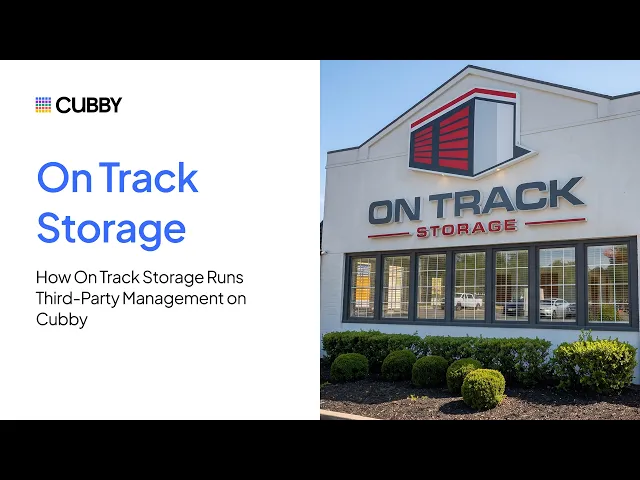
Rob DuBroc did not plan on storage. He worked in software for years, wanted out of the 9-to-5, and started flipping houses on the way to what he assumed would be a career in multifamily real estate. Then he found self-storage. His first property was a 121-unit, 21,000-square-foot facility in Pleasanton, Kansas, listed by a local realtor.
Seven years later, On Track Storage owns 43 properties and about 5,500 units. It manages a good deal more than that. Through its third-party management arm, the team runs more than 75 facilities and 10,000 units for owners across eleven states and Canada, all from an operations hub in Kentucky.
The pitch to those owners is simple. “We won’t manage your facility unless you’re on Cubby,” says DuBroc. “The only way for us to benefit from economies of scale is for one login that has every single facility.” New clients get an onboarding specialist who takes them from proposal to live, and most of them notice very little. “They just fill out the basic forms. There’s an application for Stripe and then off to the races.”
Chase Crittenden, On Track’s COO, has been in storage most of his life. He started coming to work with his dad at the Kentucky portfolio as a kid, left for a couple of years, came back, and stayed on when DuBroc bought the business in 2024. He now runs people, process and the local office, and takes the escalations. “Mainly it’s a lot of behind-the-scenes stuff that people don’t even know goes on in the storage world,” he says.
Forty-Two Logins and a Dry-Erase Board
DuBroc has run facilities on three other FMS systems.
Then came the 2024 acquisition: 42 locations in Kentucky, most of them on legacy software. The previous management used a location code to switch between facilities, and you had to log in under that code to see availability. “We have 31 locations in a small area, and if I don’t have an RV spot over here, then I’ve got one a half mile up the road,” says DuBroc. “I now have to log out of the FMS, log in with a new location code and check the other location.” The reporting was good. Everything else was hard to run at scale.
The day-to-day showed it. Delinquency was tracked in a boardroom on dry-erase boards, one line per unit. Staff ran reports, copied the overlock list onto a clipboard, and the maintenance crew drove the rounds across 42 locations with a sheet of paper. Crittenden spent his days inside that machine, “just trying to bulldoze and get stuff done,” says DuBroc, “because it was time-consuming to get all that stuff out.”
Answering a Call from Florida, From Kentucky
The hub in Kentucky answers for facilities in Florida, Montana, Georgia and Canada. Cubby Calls is what makes that feel local. When an existing tenant calls, the rep’s screen opens to that tenant’s account. When an unknown number calls, it opens a new-lead form already pointed at the right facility, based on the tracking number they dialed.
“We can answer the phone as if we’re at the facility in Florida, but my rep is here in Kentucky,” says DuBroc. The alternative is the conversation every multi-site operator knows. “Which facility are you calling for? And then they’re bumbling around through the FMS. You said you were in where? Atlanta? Which one in Atlanta? We have six in Atlanta.”
The numbers since then, from On Track’s own Cubby data:
Phone inquiries convert at 77%. Of 2,810 phone leads logged since the move, 2,156 became rentals.
Missed calls fell from 36% to 11%. Before On Track turned on Comms AI, roughly a third of inbound calls went unanswered or to voicemail. Since December 2025, when the voice AI agent went live across the portfolio, 89% of inbound calls have been answered. The agent (the team calls her Patty) handles 45% of answered calls start to finish and greets most of the rest before handing them to a rep.
Abandoned checkouts get a call or text in 11 minutes. When a shopper drops out of online checkout, Cubby creates a lead. On Track follows up on 77% of them, with a median first touch of 11 minutes and 30% inside 5 minutes. Sixty-one percent of those abandoned checkouts still end in a rental.

About one rental in five is completed self-serve on the website. The rest close through the Kentucky team, most of them by phone, which is how On Track wants it.
The piece DuBroc keeps coming back to is the record. Every call is recorded, transcribed and scored, and the notes land on the customer’s account where any rep can see them. “You ghost us for two months, then you get your auction notice and now you’re mad,” he says. “Cubby gives us a complete history of every call, all the call notes.” Calls are also scored by factors like efficiency, friendliness, and problem solving. Scores are visible to the whole team. “If I got a 65, I’m probably going, gosh, I need to do better next time.”
The agent is teachable, too. Mimi, one of On Track’s customer support representatives, noticed three locations without exit keypads were generating stuck-at-the-gate calls, so she added a Knowledge entry telling callers at those sites to pull closer to the gate to trigger the sensor.
New hires learn two pieces of software: Cubby and Slack. “Almost everything lives in Cubby,” says DuBroc.
Fifteen Minutes a Week on Street Rates
On Track prices by occupancy at the price-group level, and it has hundreds of price groups across the portfolio. “It’s impossible to do that manually,” says DuBroc, so the team leans on Cubby’s Revenue Management recommendations. Most weeks the suggestions nudge a rate up a dollar or down two. “It tends to help us find equilibrium.” What used to be a multi-hour review once a month is now about 15 minutes every week.
The bigger shift is where Crittendon’s time goes. He works in Cubby all day, often with several facilities open in separate tabs, and he is one of the early adopters of Cubby Canvas, which lets an operator ask questions of their own data and build the views they want on top of it. So far that has meant pulling numbers by asking instead of running reports. Next is a missed-calls dashboard on a big screen at the front of the office, so the team sees the metric that matters most to them all day long.
“Every operator is a little bit different and they’re going to run their business specific to themselves,” says Crittendon. “This allows us to utilize Cubby but also put our own spin on it.” Before, he says, the team spent hours downloading reports and uploading them elsewhere to get answers they can now get by asking, because the data is already there.
DuBroc frames the payoff the way he frames everything, at a 6 cap. “Every new dollar is actually worth $16 in our valuation,” he says. “And then every dollar saved, it’s also worth $16.” With the day-to-day handled, he and Crittendon spend their conversations on the two things that move that number: revenue and cost. “We have more strategic conversations now than before. We’re a lot more profitable because we’re able to focus on what moves the needle.”

What’s Next
Over the next two to three years On Track plans to buy another 15 to 20 facilities and keep adding third-party clients, typically owners with three or more facilities who want an operating partner rather than a call center. Part of that pitch is consolidating the third-party tools most operators bolted onto legacy software, which usually saves them money before the management fee is even discussed.
Asked to finish the sentence “Before Cubby, we… Now we…,” DuBroc took a minute. “Before Cubby, the team was scared of technology. After Cubby, they’ve embraced it.”
On Track Storage owns 43 self-storage facilities and manages more than 75 across the United States and Canada, with an operations hub in Kentucky.