
Back
Back
Content
Building Relational Capital To Drive Growth in Self-Storage with Mark Poole of Liberty Investment Properties
Building Relational Capital To Drive Growth in Self-Storage with Mark Poole of Liberty Investment Properties
Cubby Team
・
Share:



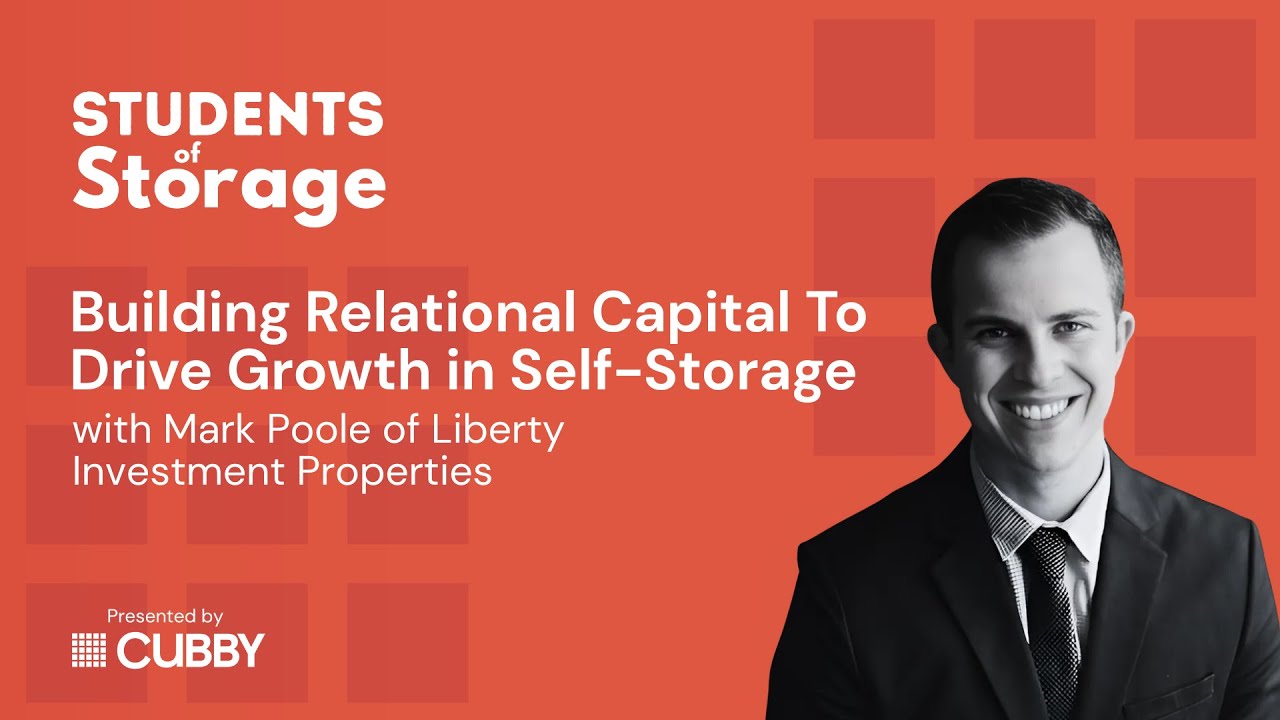
In this episode, we’re joined by Mark Poole, VP of Operations of Liberty Investment Properties. Mark is a seasoned leader with over 13 years at the helm of operations, development, and growth strategy in self-storage and hospitality. He shares insights into the value of relational capital and how self-storage operations are evolving. Mark also discusses how to scale, adapt, and innovate in a dynamic market, emphasizing the importance of speed, relationships, and hyperlocal marketing.
Key Takeaways:
(01:47) Curiosity and continuous learning help drive long-term success in the storage industry.
(02:41) Strong professional relationships serve as a foundation for growth and collaboration.
(03:50) Early exposure to industry collaboration can shape a more open business mindset.
(05:58) Shifting market conditions influence development versus acquisition decisions.
(08:25) Fast and seamless lead conversion plays a critical role in portfolio performance.
(11:11) Every customer interaction can have a long-term financial impact.
(15:22) Hyperlocal strategies are more effective than broad national campaigns.
(17:03) Grassroots referral programs can outperform traditional marketing spend.
(21:20) Technology continues to unlock new efficiencies in remote facility management.
Transcript
Hey everybody, thanks for joining Students of Storage here with me today.
I've got Michael Brevda, my co-host, and as a guest, we've got Mark P of Liberty Investment Properties.
How are you? Good to see you guys. Good to see you. Good to see you, Mark.
Awesome. So, my name is Mark Pool with Liberty Investment Properties here in Orlando. We've been in the business for about 35 years, and I've been with the company for about 13 years. We've done everything from development to operations to third-party management, consulting, a little bit of everything.
So right now we're looking for growth and we're excited about what's ahead of us.
Tell me a little more about your time at Liberty and what brought you there. Yeah, absolutely. Well, lucky — I was in the car business for about seven years, and I was going to Florida State, and had to get a summer job, and it all started off there, worked my way through the car business, it was really fun, I learned a ton, but I was tired of the hours — I didn't mind working hard, but I didn't want to work on that schedule.
So I ended up reaching out to contacts in Orlando, and I'd heard about the Michaelson family and a little bit about Liberty, but I really didn't know what they were doing or up to, and a few conversations later I was very fortunate to join the team. When I joined, we had about nine storage facilities, and I jumped right in — I was asking a ton of questions, trying to figure out what the business was about, I was obviously very new to it, and that questioning has really never stopped.
I think there's always been an opportunity to figure out more, figure out better ways to do things — whether with our own internal team, hey, are we doing the best thing here, are we the best operator, the best developer — to working with others outside or inside the industry, hey, how are you guys doing things, what helps you stand apart, what tools are you using. So I've always been very curious, but Liberty afforded me the opportunity to get in, ask a ton of questions, and we've done some really incredible things. Again, I've been here about 13 years, but Liberty's been doing self storage and hospitality for just over 35 years.
So it's been a really amazing group, and I'm excited for what's ahead. Yeah, that's awesome. Adam Michaelson is a well-known name amongst the industry — what would you say is your favorite part of having a chance to work with him, and what's been your biggest takeaway? Yeah, well, it's a multigenerational business — his father was in the self storage business, so the Michaelson name definitely flows through, very familiar with a lot of folks in the industry. I would say it comes down to just relationships.
We like to say we're building relational capital, and that's our way of saying we like to have a lot of friends in the industry, and some enemies or "fremies" or whatever it might be. But we've really poured our hearts and souls into the industry, giving back on that side, and kind of painting a destiny of where do we want to grow and how can we develop that. So we've kept a lot of relationships close and developed a ton of relationships, but building relational capital has really been one of the go-to things.
It's always going to help you, and in this industry it's a really unique setting — we like to say "coopetition" is our fancy word for cooperation with our competition, right? And so we have a lot of coopetition with folks in the industry, and just giving back and working with them and asking questions and learning from each other really helps rise all ships. Totally. Yeah. Is there an example of one of those relationships that has stuck with you from the onset, 13 years ago? Yeah, no, that's a great question.
I'd say two weeks in, I was, you know, kind of taken by Adam Michaelson, and he's like, "Hey, let's go talk to this operator," and I was two weeks in and so confused, because it was a local operator, a storage facility, and I was like, this is the enemy — why are we talking to the enemy?
Well, it turns out it was Simply Self Storage, based out of Orlando — they've obviously sold since then — but I met a gentleman named Carrie, and he was very open, and we started chatting, and I was like, golly, why is he telling me so much stuff about the industry, and helping me — and again, it was only two weeks in, and that's really stuck with me. So today, Carrie is an incredible friend — he's part of a lot of other groups I spend time with, communicating.
He's always been super valuable, and just having great conversations. So that really tipped me off to, hey, this is an industry where you can learn from others, and if you spend time and focus on this and grow it with good intention, then it's only going to help serve you in the long run. So I've been very fortunate to have some incredible friendships for over a decade, and to this day it still comes in super handy, it's really incredible to have that.
So that whole relational capital thing that started with the Michaelson family kind of saying, "Hey, we're going to be in this for the long run," has really stuck with me and been very impactful in my career. Yeah. Well, awesome — I've met so many amazing people, yourself included, over the past two years, so I appreciate that story, always interested in hearing more.
Yeah, I think one thing I'm curious about with regard to folks looking to grow a portfolio — you mentioned when you came on board you had about nine, scaled up to 30-plus at one point, and then rinsed and repeated — what advice can you give in the current environment?
Yeah, so I'd say for folks getting into the industry, or trying to grow in the industry, again it goes back to that relational capital. Meet as many people as you can — whether vendors, owners, operators, managers — the more touch points you have with folks in different areas, especially areas you're not very familiar with, you'll be really impressed with how often and how much folks will share with you.
So I'd say, if you're not doing that, get to some of the shows, get to networking events with a goal of trying to meet as many people as you can, and then find ways to connect with people directly online — LinkedIn has been a phenomenal way of reaching folks and touching base with people as well. So Mark, Liberty has a super interesting background and story, I'd love to hear more about that — how it came to be and how they got into self storage, if you could.
Yeah, absolutely. So Liberty is a really unique setting — it's kind of a family office and family business, and our founders, Mike and Melissa Michaelson, were the ones who started everything, back in about 1990. They acquired, or developed, maybe their first self storage facility — it was before my time here in Orlando — but began to catch great things with that and grow it, and ended up getting connected with a group called Shurgard Self Storage.
So if you're in Florida, driving around the Orlando area, and you see a bunch of lighthouses in front of a self storage facility that's now Public Storage colors — those used to be Shurgard Self Storage facilities, and many of those with the lighthouse were developed by our group here in Orlando. So as I drive by those, I'm reminded of that. We've got a really rich history — we ended up building, I think, about 42 different locations with Shurgard.
Before there was a change in that whole thing, and so we developed a brand called My Neighborhood Storage Center, with a focus on being hyper-local. Today we still operate that brand — that was about 2005 or 2006 when we first started that. Today the My Neighborhood Storage Center facilities, we only have three — we've got another big handful, approximately nine, with a group called Storables, which we're running virtually, so that's a pretty unique setup as well.
And then today we also have a couple with a REIT as well — that's another big thing that's changed for us. That's awesome, really appreciate you giving us some background there. I know one topic on a lot of folks' minds is lead conversion — obviously driving traffic to your website is super important, but I know you've done a couple unique things with regard to improving conversion, making sure you're capitalizing on the traffic that is coming there. That's right.
Well, activity is extremely important — that's one of the big things I'm looking at daily. From a portfolio management standpoint, we're trying to track the activity, put a lot of effort into our lease-up properties, and we do have a lot of lease-up properties at this moment. So paying attention to that is important. The industry has shifted quite a bit — as I kind of alluded to, with 2020 highs and how COVID really accelerated and improved our business in a lot of ways.
It also created efficiencies, but maybe not the best — some efficiencies, like, "Hey, let's just eliminate all managers," maybe that's not the way, right — there are certain ways you can be strategic about it. But I'd also say in today's world, pricing has come down, it's been challenging, it's been an environment where it used to be, "Hey, we want the right customer at the right time at the right price," and now it's kind of, "We just need customers." So there's this challenge, right?
And you'll hear a lot of folks talking about, are we at the bottom on pricing? So there's a lot of things you can do, but the whole lead conversion thing — we talked about this with Matt Inker at the show — was talking about the value of these leads. And I think people fail to realize that this business we're in is a subscription model. It's just like Netflix — it's month-to-month, right, you can cancel anytime. The challenge in storage is it's just harder to get your stuff out of a 10x20, right?
So this month-to-month lease is highly valuable — if that's a $150 or $200 unit, well, they're staying with you for 12 to 18 months or somewhere in there.
So when we have a lead come our way, it's critical for our business.
And I think in the past we've gotten a little relaxed on that — we weren't getting name and number, weren't capturing every lead like our life depended on it.
And that's really the mindset now.
So I'd say in this environment where we're seeing prices go down, we're seeing increased marketing effort, we're still seeing some supply that's moved into markets — you just have to really make sure you're following up with every single lead and capturing it. So whether it's pre-leasing, creating that excitement and sharing that with your team as well — that's another thing we talked about, sharing the value of these leads.
And a customer comes in, even if they rent a 5x5 unit for a cheap rate, that's still highly valuable — they could stay three years, and by the way it's a very high rate per square foot value too, right? So there are some things to think about, and sharing that with your team is really effective and helpful. Awesome, appreciate that. Is there anything you watch out for, or metrics you set with regard to how quickly you want somebody to respond?
Obviously, are you monitoring if it's under five minutes, do you notice a difference — if it goes over 10, what the drop-off rate is?
Yeah, no, that's a great point. Cubby's done an amazing job of creating an opportunity where we capture that lead and get in touch with it as quickly as we can. As soon as we can get it in, there are ways we can highlight that and bring it to our team's attention. That's been an area we've been working on, because speed is relevant in all the things we do.
We want fast lease-up, fast response to customers. So speed is really important to our organization.
The other thing I'd say, in relation to things to watch out for, is stalling. You certainly don't want a lead stalling and sitting there for three days — they're going to make a decision without you, right?
They're going to go ahead and make a decision if they don't hear from you.
But from a performance standpoint and operating perspective, we also don't want stalls there — we don't want to be stuck at 70% occupancy. We don't want to see 10x10s with 14 vacant and just staying that way.
You've got to see some traction. So we use reports like a move-in/move-out report as kind of a traction report — here's what's happening, here's where the leads are coming in,
here's how occupancy is growing. And being aware of stalls — if you see any stalls in your business, that's an area where you need to take action.
Michael, do you have anything you'd like to hop in with?
Yeah, switching gears to something a little adjacent — lead conversion is important, but lead generation is of course always important too. There's lots of talk around SEO and PPC and other digital advertising forums. Would love to hear if there are any creative ad or lead-gen tactics that have worked well for you, either digitally or —
I've heard some pretty creative stories from other operators about physical campaigns, flyers, billboards, etc. — would love to hear your thoughts on how you're going about generating more leads versus just taking what's coming to you and pouncing on those. Yeah, no, it's a good question, a broad question, hard question. Marketing in self storage is very difficult. I used to come to the table with a ton of marketing ideas and excitement, but the more I've thought about it and dug into it, I realized it's very hard. It's not like a cool pair of sunglasses, where I can convince you it's a cool new thing at a great deal — it's a needs-based business.
I've sat in many rooms where I've said, "How many of you need self storage right now?" And very few raise their hand.
How many do you need? How many of you have storage units? Very few raise their hand. So even if I gave away a storage unit to someone — if I gave you guys one — well, number one, if it's not near you, if it was you'd be renting, but it's not near you. And do you need it, right? So I think about marketing in a pretty specific pattern.
Number one, it's a need, right, and number two, it's location — I'd guess many Americans are inherently lazy, and you want the closest thing on the way to work or on the way home. So it's need, it's location, it's features and benefits. Well, guess what — my 10x10 is probably the same as your 10x10, and there's not much more I've got than you do, maybe some covered loading areas that might help. So it's need, location, features and benefits,
and then it's price, because people are going to say, "Okay, well that's a movement" — that would get my attention if it's a 20% discount. And then finally it's customer service, because customer service is really one of the last touch points in this industry. And again that goes back to getting away with certain things — I'd imagine a lot of folks have said, "Well, we don't really need staff, we can do everything from our phone." Well, maybe there are areas you can do that, but as long as you're not giving up on the customer service side and messing that up, then that'll be okay.
So when it comes to marketing, we try to think through everything through that lens. There's no reason for me to be doing targeted ads for all of Florida.
Absolutely not. But if I've got a downtown Orlando location, I want to know that area's three-mile ring — who are the realtors, where are the apartments, where are the moving companies in that area, what's going to drive business to me. So we like to say we target the neighborhoods, not the nation. If you look at the REITs and how they ran it, they're looking at a large-scale growth operation, trying to maximize brand value.
Truth is, there's value in that, but there's also a lot of people not loyal to storage brands. I kind of look at it like car rentals —
I don't care what I get as far as the car rental, I don't care which company it is, I just want the one that's most effective and price-convenient for me. So I think some people look at the industry as a commodity, some don't — that's a big argument both ways, but at the end of the day, you really just have to maximize your visibility in your hyper-local market.
And that's the area we try to spend our time in.
Talk to us more about how you're tracking and optimizing for lead source — how are you telling what ad campaigns are working or not, and once you figure that out, how are you adjusting accordingly? Yeah, that's another challenging one. A lot of times marketing has been hinged on the manager and what the manager said, because that's the only input we've gotten.
Back in the old days, with our previous software, it would say, "Here's your marketing report," and tell you some basic stuff — location was pretty good, you could see where they live or where they're coming from.
But then it would get down to gender, and say male, female, unknown — and 23% of our customers were "unknown gender." I'm like, well, this marketing report is throwing it out the window — how do I know our managers weren't just pencil-whipping that and saying, "Oh, it was a drive-by," or "Oh, they saw it on Facebook," or whatever. So
it's hard. So what are the things you can actually do today from a marketing perspective, and what are the cost-effective ways — I'd say referral program is one that keeps coming back and top of mind — we've probably done the best on just a local, hyper-local referral program, and really Amazon has made that easier for us — I can text an Amazon gift card in two seconds, right, and even as little as $25 seems to
be better than a $50 rent credit or some gift card that might be in the mail. Instant gratification at a low rate for a quick thank-you has been phenomenal. So we've spent a little extra time going to apartments around our areas and trying to befriend some of the leasing agents — hey, you walk in with a couple cards, "Hey, I've got this facility, and sorry we did a terrible job introducing ourselves to you, but we're trying to ramp this up, and we'd love to
partner with you, and if you can send leads to us, put your name and phone number or email on the back of this, we'll text you an Amazon gift card, 50 bucks to those guys." And that's been huge — we see enough of them come through that it's very effective. So again, going back to relational capital, whether it's in the industry or leasing agents out there trying to help you in your little neighborhoods — those all come back and help you in the long run. Yeah, super smart. My background before storage was more on the residential side, so I always love talking about that side of it as well, whether it's technology or lead-gen techniques. I think there are a lot of things to be learned from adjacent industries to self storage that might do certain things better than we do at this juncture. So yeah.
Absolutely. Totally. Mark, one question I'm always curious to hear — what do you feel self storage, whether tech or resources available, is still missing to this day, that maybe has been applicable in other industries, that you'd like to see, or can't believe isn't there? Yeah.
Yeah, I don't — well, we've made so many improvements honestly, a lot of the low-hanging fruit has been picked up. The leasing process, going back to my car rental example — I was traveling, could have been when I first started, and pretty quickly you can get a rental car — it's really amazing that you check in, check out, they hand you a really expensive vehicle, and it's fast, faster than it took to rent a storage unit, and I just thought that's insane, right?
Wawa is another example — you go up to the place, quickly put in your order, boom boom boom, it's ready to go, it was so fast. So I think in this environment, speed is really important. From a consumer level, you want the most frictionless experience you can possibly have. And if you think about the whole lead generation thing — if a customer decides to take the effort to go online, check you out, call, take action on their to-do list, we want it to be so simple.
How many times have you paid a little more on Amazon because you know you don't have to worry about it, right? I do it all the time, unfortunately — "Oh, it's just easier if I get on Amazon, I know it's going to be more expensive, but I'm going to do it." And again, it's just because of speed and the frictionless process of that. So I'm impressed with the way we've gone. I think, pointing back to software and what Cubby's been doing — ease of use, speed and efficiency, those areas have really helped shape the part of our businesses that were lacking.
But those are areas for sure that have helped the speed of that. When I think about other things in the industry — obviously we were early adopters of tenant insurance, that was another big area where a decade ago we were like, "Hey, let's go ahead and get insurance," and I was so new at the time I was like, sounds great, let's make it mandatory. I was saying the word "mandatory" and realized that's an off-site word — it should be a requirement of the lease, that sounds a lot better.
And fortunately we started that a decade ago, because even just last Saturday I got a phone call that we had ankle-deep water in one of our climate control buildings, from a sprinkler malfunction. So there's just some things like that.
We've had two fires at our properties, which have been pretty painful. So having good tenant insurance set up and available, taking the initiative to get that set up — luckily in that scenario we had 88% tenant insurance penetration, so we were saved from that. Again it goes back to doing the right things and strategically thinking about your business, to excel it on the front end but also protect it on the back end. So going back to your original question, Michael, I think we've done a good job.
I've seen some of those areas improve — revenue management systems, our software has all improved, speed has been a priority. I definitely think probably some camera and access stuff is probably the future. I'm really encouraged about the new security cameras out there — I kind of tell my kids nowadays, assume you're on camera everywhere you go, right? That's going to be the future. So when you're at a facility, just assume you're on camera, and I hope that's the case, because we can protect our business with that.
We can manage it a little better from afar if we need to. So some things like that are really interesting. But I'm excited about the future. I think it's a simple business that we've overcomplicated in a lot of ways, but at the end of the day there's still a lot of opportunities for vendors of all sorts to improve our business. Great answer. Awesome. Well, thanks again for the time today, Mark. Are you going to be in Las Vegas next week for ISS? I will, yep. That'll be awesome, look forward to seeing you then.
Thank you for listening to Students of Storage. Links to any of the resources we chatted about in the episode can be found in the show notes.
If you enjoyed the show, please leave a five-star review and subscribe so you don't miss out on any future episodes. Hope to see you back here soon.
In this episode, we’re joined by Mark Poole, VP of Operations of Liberty Investment Properties. Mark is a seasoned leader with over 13 years at the helm of operations, development, and growth strategy in self-storage and hospitality. He shares insights into the value of relational capital and how self-storage operations are evolving. Mark also discusses how to scale, adapt, and innovate in a dynamic market, emphasizing the importance of speed, relationships, and hyperlocal marketing.
Key Takeaways:
(01:47) Curiosity and continuous learning help drive long-term success in the storage industry.
(02:41) Strong professional relationships serve as a foundation for growth and collaboration.
(03:50) Early exposure to industry collaboration can shape a more open business mindset.
(05:58) Shifting market conditions influence development versus acquisition decisions.
(08:25) Fast and seamless lead conversion plays a critical role in portfolio performance.
(11:11) Every customer interaction can have a long-term financial impact.
(15:22) Hyperlocal strategies are more effective than broad national campaigns.
(17:03) Grassroots referral programs can outperform traditional marketing spend.
(21:20) Technology continues to unlock new efficiencies in remote facility management.
Transcript
Hey everybody, thanks for joining Students of Storage here with me today.
I've got Michael Brevda, my co-host, and as a guest, we've got Mark P of Liberty Investment Properties.
How are you? Good to see you guys. Good to see you. Good to see you, Mark.
Awesome. So, my name is Mark Pool with Liberty Investment Properties here in Orlando. We've been in the business for about 35 years, and I've been with the company for about 13 years. We've done everything from development to operations to third-party management, consulting, a little bit of everything.
So right now we're looking for growth and we're excited about what's ahead of us.
Tell me a little more about your time at Liberty and what brought you there. Yeah, absolutely. Well, lucky — I was in the car business for about seven years, and I was going to Florida State, and had to get a summer job, and it all started off there, worked my way through the car business, it was really fun, I learned a ton, but I was tired of the hours — I didn't mind working hard, but I didn't want to work on that schedule.
So I ended up reaching out to contacts in Orlando, and I'd heard about the Michaelson family and a little bit about Liberty, but I really didn't know what they were doing or up to, and a few conversations later I was very fortunate to join the team. When I joined, we had about nine storage facilities, and I jumped right in — I was asking a ton of questions, trying to figure out what the business was about, I was obviously very new to it, and that questioning has really never stopped.
I think there's always been an opportunity to figure out more, figure out better ways to do things — whether with our own internal team, hey, are we doing the best thing here, are we the best operator, the best developer — to working with others outside or inside the industry, hey, how are you guys doing things, what helps you stand apart, what tools are you using. So I've always been very curious, but Liberty afforded me the opportunity to get in, ask a ton of questions, and we've done some really incredible things. Again, I've been here about 13 years, but Liberty's been doing self storage and hospitality for just over 35 years.
So it's been a really amazing group, and I'm excited for what's ahead. Yeah, that's awesome. Adam Michaelson is a well-known name amongst the industry — what would you say is your favorite part of having a chance to work with him, and what's been your biggest takeaway? Yeah, well, it's a multigenerational business — his father was in the self storage business, so the Michaelson name definitely flows through, very familiar with a lot of folks in the industry. I would say it comes down to just relationships.
We like to say we're building relational capital, and that's our way of saying we like to have a lot of friends in the industry, and some enemies or "fremies" or whatever it might be. But we've really poured our hearts and souls into the industry, giving back on that side, and kind of painting a destiny of where do we want to grow and how can we develop that. So we've kept a lot of relationships close and developed a ton of relationships, but building relational capital has really been one of the go-to things.
It's always going to help you, and in this industry it's a really unique setting — we like to say "coopetition" is our fancy word for cooperation with our competition, right? And so we have a lot of coopetition with folks in the industry, and just giving back and working with them and asking questions and learning from each other really helps rise all ships. Totally. Yeah. Is there an example of one of those relationships that has stuck with you from the onset, 13 years ago? Yeah, no, that's a great question.
I'd say two weeks in, I was, you know, kind of taken by Adam Michaelson, and he's like, "Hey, let's go talk to this operator," and I was two weeks in and so confused, because it was a local operator, a storage facility, and I was like, this is the enemy — why are we talking to the enemy?
Well, it turns out it was Simply Self Storage, based out of Orlando — they've obviously sold since then — but I met a gentleman named Carrie, and he was very open, and we started chatting, and I was like, golly, why is he telling me so much stuff about the industry, and helping me — and again, it was only two weeks in, and that's really stuck with me. So today, Carrie is an incredible friend — he's part of a lot of other groups I spend time with, communicating.
He's always been super valuable, and just having great conversations. So that really tipped me off to, hey, this is an industry where you can learn from others, and if you spend time and focus on this and grow it with good intention, then it's only going to help serve you in the long run. So I've been very fortunate to have some incredible friendships for over a decade, and to this day it still comes in super handy, it's really incredible to have that.
So that whole relational capital thing that started with the Michaelson family kind of saying, "Hey, we're going to be in this for the long run," has really stuck with me and been very impactful in my career. Yeah. Well, awesome — I've met so many amazing people, yourself included, over the past two years, so I appreciate that story, always interested in hearing more.
Yeah, I think one thing I'm curious about with regard to folks looking to grow a portfolio — you mentioned when you came on board you had about nine, scaled up to 30-plus at one point, and then rinsed and repeated — what advice can you give in the current environment?
Yeah, so I'd say for folks getting into the industry, or trying to grow in the industry, again it goes back to that relational capital. Meet as many people as you can — whether vendors, owners, operators, managers — the more touch points you have with folks in different areas, especially areas you're not very familiar with, you'll be really impressed with how often and how much folks will share with you.
So I'd say, if you're not doing that, get to some of the shows, get to networking events with a goal of trying to meet as many people as you can, and then find ways to connect with people directly online — LinkedIn has been a phenomenal way of reaching folks and touching base with people as well. So Mark, Liberty has a super interesting background and story, I'd love to hear more about that — how it came to be and how they got into self storage, if you could.
Yeah, absolutely. So Liberty is a really unique setting — it's kind of a family office and family business, and our founders, Mike and Melissa Michaelson, were the ones who started everything, back in about 1990. They acquired, or developed, maybe their first self storage facility — it was before my time here in Orlando — but began to catch great things with that and grow it, and ended up getting connected with a group called Shurgard Self Storage.
So if you're in Florida, driving around the Orlando area, and you see a bunch of lighthouses in front of a self storage facility that's now Public Storage colors — those used to be Shurgard Self Storage facilities, and many of those with the lighthouse were developed by our group here in Orlando. So as I drive by those, I'm reminded of that. We've got a really rich history — we ended up building, I think, about 42 different locations with Shurgard.
Before there was a change in that whole thing, and so we developed a brand called My Neighborhood Storage Center, with a focus on being hyper-local. Today we still operate that brand — that was about 2005 or 2006 when we first started that. Today the My Neighborhood Storage Center facilities, we only have three — we've got another big handful, approximately nine, with a group called Storables, which we're running virtually, so that's a pretty unique setup as well.
And then today we also have a couple with a REIT as well — that's another big thing that's changed for us. That's awesome, really appreciate you giving us some background there. I know one topic on a lot of folks' minds is lead conversion — obviously driving traffic to your website is super important, but I know you've done a couple unique things with regard to improving conversion, making sure you're capitalizing on the traffic that is coming there. That's right.
Well, activity is extremely important — that's one of the big things I'm looking at daily. From a portfolio management standpoint, we're trying to track the activity, put a lot of effort into our lease-up properties, and we do have a lot of lease-up properties at this moment. So paying attention to that is important. The industry has shifted quite a bit — as I kind of alluded to, with 2020 highs and how COVID really accelerated and improved our business in a lot of ways.
It also created efficiencies, but maybe not the best — some efficiencies, like, "Hey, let's just eliminate all managers," maybe that's not the way, right — there are certain ways you can be strategic about it. But I'd also say in today's world, pricing has come down, it's been challenging, it's been an environment where it used to be, "Hey, we want the right customer at the right time at the right price," and now it's kind of, "We just need customers." So there's this challenge, right?
And you'll hear a lot of folks talking about, are we at the bottom on pricing? So there's a lot of things you can do, but the whole lead conversion thing — we talked about this with Matt Inker at the show — was talking about the value of these leads. And I think people fail to realize that this business we're in is a subscription model. It's just like Netflix — it's month-to-month, right, you can cancel anytime. The challenge in storage is it's just harder to get your stuff out of a 10x20, right?
So this month-to-month lease is highly valuable — if that's a $150 or $200 unit, well, they're staying with you for 12 to 18 months or somewhere in there.
So when we have a lead come our way, it's critical for our business.
And I think in the past we've gotten a little relaxed on that — we weren't getting name and number, weren't capturing every lead like our life depended on it.
And that's really the mindset now.
So I'd say in this environment where we're seeing prices go down, we're seeing increased marketing effort, we're still seeing some supply that's moved into markets — you just have to really make sure you're following up with every single lead and capturing it. So whether it's pre-leasing, creating that excitement and sharing that with your team as well — that's another thing we talked about, sharing the value of these leads.
And a customer comes in, even if they rent a 5x5 unit for a cheap rate, that's still highly valuable — they could stay three years, and by the way it's a very high rate per square foot value too, right? So there are some things to think about, and sharing that with your team is really effective and helpful. Awesome, appreciate that. Is there anything you watch out for, or metrics you set with regard to how quickly you want somebody to respond?
Obviously, are you monitoring if it's under five minutes, do you notice a difference — if it goes over 10, what the drop-off rate is?
Yeah, no, that's a great point. Cubby's done an amazing job of creating an opportunity where we capture that lead and get in touch with it as quickly as we can. As soon as we can get it in, there are ways we can highlight that and bring it to our team's attention. That's been an area we've been working on, because speed is relevant in all the things we do.
We want fast lease-up, fast response to customers. So speed is really important to our organization.
The other thing I'd say, in relation to things to watch out for, is stalling. You certainly don't want a lead stalling and sitting there for three days — they're going to make a decision without you, right?
They're going to go ahead and make a decision if they don't hear from you.
But from a performance standpoint and operating perspective, we also don't want stalls there — we don't want to be stuck at 70% occupancy. We don't want to see 10x10s with 14 vacant and just staying that way.
You've got to see some traction. So we use reports like a move-in/move-out report as kind of a traction report — here's what's happening, here's where the leads are coming in,
here's how occupancy is growing. And being aware of stalls — if you see any stalls in your business, that's an area where you need to take action.
Michael, do you have anything you'd like to hop in with?
Yeah, switching gears to something a little adjacent — lead conversion is important, but lead generation is of course always important too. There's lots of talk around SEO and PPC and other digital advertising forums. Would love to hear if there are any creative ad or lead-gen tactics that have worked well for you, either digitally or —
I've heard some pretty creative stories from other operators about physical campaigns, flyers, billboards, etc. — would love to hear your thoughts on how you're going about generating more leads versus just taking what's coming to you and pouncing on those. Yeah, no, it's a good question, a broad question, hard question. Marketing in self storage is very difficult. I used to come to the table with a ton of marketing ideas and excitement, but the more I've thought about it and dug into it, I realized it's very hard. It's not like a cool pair of sunglasses, where I can convince you it's a cool new thing at a great deal — it's a needs-based business.
I've sat in many rooms where I've said, "How many of you need self storage right now?" And very few raise their hand.
How many do you need? How many of you have storage units? Very few raise their hand. So even if I gave away a storage unit to someone — if I gave you guys one — well, number one, if it's not near you, if it was you'd be renting, but it's not near you. And do you need it, right? So I think about marketing in a pretty specific pattern.
Number one, it's a need, right, and number two, it's location — I'd guess many Americans are inherently lazy, and you want the closest thing on the way to work or on the way home. So it's need, it's location, it's features and benefits. Well, guess what — my 10x10 is probably the same as your 10x10, and there's not much more I've got than you do, maybe some covered loading areas that might help. So it's need, location, features and benefits,
and then it's price, because people are going to say, "Okay, well that's a movement" — that would get my attention if it's a 20% discount. And then finally it's customer service, because customer service is really one of the last touch points in this industry. And again that goes back to getting away with certain things — I'd imagine a lot of folks have said, "Well, we don't really need staff, we can do everything from our phone." Well, maybe there are areas you can do that, but as long as you're not giving up on the customer service side and messing that up, then that'll be okay.
So when it comes to marketing, we try to think through everything through that lens. There's no reason for me to be doing targeted ads for all of Florida.
Absolutely not. But if I've got a downtown Orlando location, I want to know that area's three-mile ring — who are the realtors, where are the apartments, where are the moving companies in that area, what's going to drive business to me. So we like to say we target the neighborhoods, not the nation. If you look at the REITs and how they ran it, they're looking at a large-scale growth operation, trying to maximize brand value.
Truth is, there's value in that, but there's also a lot of people not loyal to storage brands. I kind of look at it like car rentals —
I don't care what I get as far as the car rental, I don't care which company it is, I just want the one that's most effective and price-convenient for me. So I think some people look at the industry as a commodity, some don't — that's a big argument both ways, but at the end of the day, you really just have to maximize your visibility in your hyper-local market.
And that's the area we try to spend our time in.
Talk to us more about how you're tracking and optimizing for lead source — how are you telling what ad campaigns are working or not, and once you figure that out, how are you adjusting accordingly? Yeah, that's another challenging one. A lot of times marketing has been hinged on the manager and what the manager said, because that's the only input we've gotten.
Back in the old days, with our previous software, it would say, "Here's your marketing report," and tell you some basic stuff — location was pretty good, you could see where they live or where they're coming from.
But then it would get down to gender, and say male, female, unknown — and 23% of our customers were "unknown gender." I'm like, well, this marketing report is throwing it out the window — how do I know our managers weren't just pencil-whipping that and saying, "Oh, it was a drive-by," or "Oh, they saw it on Facebook," or whatever. So
it's hard. So what are the things you can actually do today from a marketing perspective, and what are the cost-effective ways — I'd say referral program is one that keeps coming back and top of mind — we've probably done the best on just a local, hyper-local referral program, and really Amazon has made that easier for us — I can text an Amazon gift card in two seconds, right, and even as little as $25 seems to
be better than a $50 rent credit or some gift card that might be in the mail. Instant gratification at a low rate for a quick thank-you has been phenomenal. So we've spent a little extra time going to apartments around our areas and trying to befriend some of the leasing agents — hey, you walk in with a couple cards, "Hey, I've got this facility, and sorry we did a terrible job introducing ourselves to you, but we're trying to ramp this up, and we'd love to
partner with you, and if you can send leads to us, put your name and phone number or email on the back of this, we'll text you an Amazon gift card, 50 bucks to those guys." And that's been huge — we see enough of them come through that it's very effective. So again, going back to relational capital, whether it's in the industry or leasing agents out there trying to help you in your little neighborhoods — those all come back and help you in the long run. Yeah, super smart. My background before storage was more on the residential side, so I always love talking about that side of it as well, whether it's technology or lead-gen techniques. I think there are a lot of things to be learned from adjacent industries to self storage that might do certain things better than we do at this juncture. So yeah.
Absolutely. Totally. Mark, one question I'm always curious to hear — what do you feel self storage, whether tech or resources available, is still missing to this day, that maybe has been applicable in other industries, that you'd like to see, or can't believe isn't there? Yeah.
Yeah, I don't — well, we've made so many improvements honestly, a lot of the low-hanging fruit has been picked up. The leasing process, going back to my car rental example — I was traveling, could have been when I first started, and pretty quickly you can get a rental car — it's really amazing that you check in, check out, they hand you a really expensive vehicle, and it's fast, faster than it took to rent a storage unit, and I just thought that's insane, right?
Wawa is another example — you go up to the place, quickly put in your order, boom boom boom, it's ready to go, it was so fast. So I think in this environment, speed is really important. From a consumer level, you want the most frictionless experience you can possibly have. And if you think about the whole lead generation thing — if a customer decides to take the effort to go online, check you out, call, take action on their to-do list, we want it to be so simple.
How many times have you paid a little more on Amazon because you know you don't have to worry about it, right? I do it all the time, unfortunately — "Oh, it's just easier if I get on Amazon, I know it's going to be more expensive, but I'm going to do it." And again, it's just because of speed and the frictionless process of that. So I'm impressed with the way we've gone. I think, pointing back to software and what Cubby's been doing — ease of use, speed and efficiency, those areas have really helped shape the part of our businesses that were lacking.
But those are areas for sure that have helped the speed of that. When I think about other things in the industry — obviously we were early adopters of tenant insurance, that was another big area where a decade ago we were like, "Hey, let's go ahead and get insurance," and I was so new at the time I was like, sounds great, let's make it mandatory. I was saying the word "mandatory" and realized that's an off-site word — it should be a requirement of the lease, that sounds a lot better.
And fortunately we started that a decade ago, because even just last Saturday I got a phone call that we had ankle-deep water in one of our climate control buildings, from a sprinkler malfunction. So there's just some things like that.
We've had two fires at our properties, which have been pretty painful. So having good tenant insurance set up and available, taking the initiative to get that set up — luckily in that scenario we had 88% tenant insurance penetration, so we were saved from that. Again it goes back to doing the right things and strategically thinking about your business, to excel it on the front end but also protect it on the back end. So going back to your original question, Michael, I think we've done a good job.
I've seen some of those areas improve — revenue management systems, our software has all improved, speed has been a priority. I definitely think probably some camera and access stuff is probably the future. I'm really encouraged about the new security cameras out there — I kind of tell my kids nowadays, assume you're on camera everywhere you go, right? That's going to be the future. So when you're at a facility, just assume you're on camera, and I hope that's the case, because we can protect our business with that.
We can manage it a little better from afar if we need to. So some things like that are really interesting. But I'm excited about the future. I think it's a simple business that we've overcomplicated in a lot of ways, but at the end of the day there's still a lot of opportunities for vendors of all sorts to improve our business. Great answer. Awesome. Well, thanks again for the time today, Mark. Are you going to be in Las Vegas next week for ISS? I will, yep. That'll be awesome, look forward to seeing you then.
Thank you for listening to Students of Storage. Links to any of the resources we chatted about in the episode can be found in the show notes.
If you enjoyed the show, please leave a five-star review and subscribe so you don't miss out on any future episodes. Hope to see you back here soon.
Latest
Content
From Oil Prices to Storage Units: Building a Business You Control with Karl Graham of Luminus Capital
Cubby Team
・
Read More
Content
The Real Legal Risks for Self-Storage Operators with Jeff Greenberger of Late2Lien
Cubby Team
・
Read More
Content
From Reviews to Rentals: Turning Google Reviews Into Real Growth with Kale Leavitt of StorageReach
Cubby Team
・
Read More