
Back
Back
Content
Building Soldiers, Not Staff: Culture and Growth with Frank Certo of The Storage Mall
Building Soldiers, Not Staff: Culture and Growth with Frank Certo of The Storage Mall
Cubby Team
・
Share:



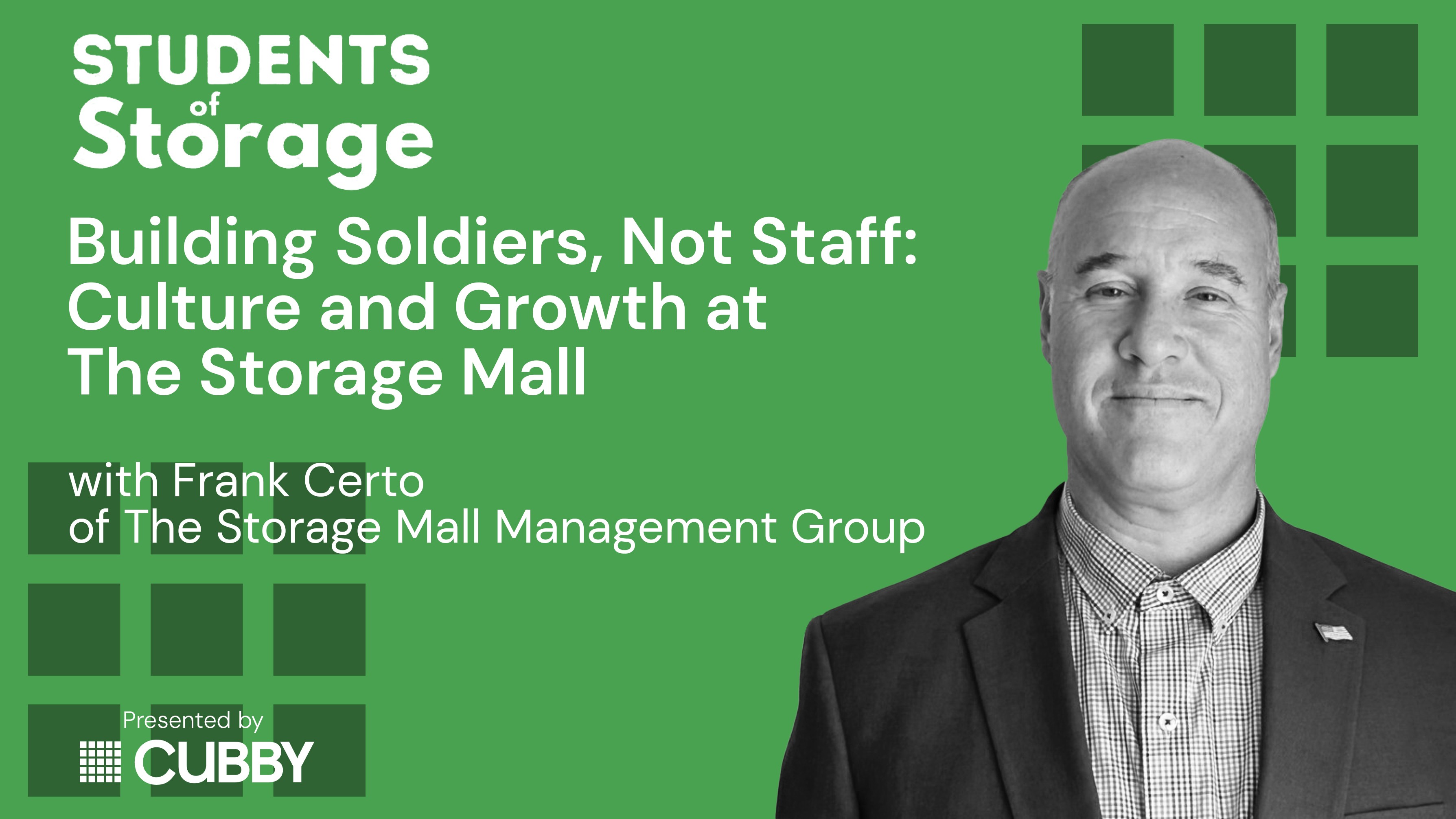
Frank Certo, COO of The Storage Mall, shares how leadership, consistency, and culture drive performance across one of the fastest-growing third-party management companies in self-storage. From hockey coach to sales trainer to operations leader, Frank brings decades of experience building high-performing teams that think like owners.
He discusses the evolution of The Storage Mall, which has grown to more than 60 managed properties since 2022, and breaks down the three pillars that guide their operation—Customer Experience, Revenue Management, and Compliance. Frank also unpacks how empowering managers, developing culture, and creating consistency across every customer touchpoint translate into stronger results and happier tenants.
Key Takeaways:
(01:40) From hockey rinks to self-storage: Frank’s career journey.
(08:37) Lessons from Guardian Storage and early industry relationships.
(17:23) Launching The Storage Mall and scaling quickly through partnership.
(20:19) Business Development of The Storage Mall with Alex Herbs
(25:00) What makes The Storage Mall Different - Defining the Why
(28:09) Retaining and developing top talent through strong culture.
(32:45) Building Operations: The Customer Journey and Beyond
(38:21) Consistency across Website, Phone, and Property Experience
(40:58) Empowering managers to act like owners.
(44:55) Shifts in industry strategy—from occupancy to revenue performance.
Transcript
Hello, my name is Matt Engfer. I'm the co-founder and CEO of Cubby.
We're the self storage platform that makes growth simple. We make facility management, call center management, and revenue management software for operators across the storage industry.
And you are listening to Students of Storage, our new podcast. Today we are joined by Frank Stoerto, who's the SVP of Operations over at The Storage Mall, and has a wealth of knowledge and experience that we're going to dive into today through his career story, how he's running his business, how they're growing that business. Looking forward to diving in with Frank, and thanks for joining. Hey Frank, thanks for joining us on Students of Storage.
Yeah, happy, pleasure to have you.
Yeah, happy to be here.
Awesome to be here. Excited. Awesome.
Thank you so much. I figured let's just dive right in. Let's start with your story. Tell the people your story, from your career — how did you start out, how'd you get into storage, how'd you wind up where you are? Take us through the journey from the start, and then we'll dig into what you're doing today at The Storage Mall.
Yeah, for sure. So I started, I guess, in my career after college — I went to grad school.
I'm from Pittsburgh.
And went to school in eastern Ohio, graduated there, went to grad school in Pittsburgh, [snorts] and I got involved — although I graduated with this idea that I would be in sports and work in sports.
I interned in sports, I was a hockey guy, a hockey player in high school and college, involved in things like that, and coached high school hockey. And so I thought it would be great to work for a hockey team. I interned for one in Cleveland at the time, and it was a lot of fun, but found out the industry was a little different than what I thought. Not everybody gets to sit in the locker room and listen to the coach — that's not what everybody did.
Most guys are selling tickets [laughter], and that wasn't that exciting. But I eventually did get into sales, and I ran a sales company for about eight or so years — operated, started in Pittsburgh, in sales training and sales management. Eventually opened up an office in Westchester, New York, White Plains, and operated all around that tri-state area — Connecticut, upper New Jersey, the five boroughs, a little bit of upstate.
And when I got married, it was like, all right, this is really taking up a ton of time. I was working six days a week, in the office early, staying late, really grinding away, talking to folks. And we were doing business-to-business sales, so it was nothing super glamorous — I wasn't selling rocket ships or high-tech equipment. We were an outsource marketing company hired to do new customer acquisition.
So we were cold calling — the first time you ever heard of us, we're getting you signed up. So I did that for a while, and that really taught me a lot, because it's something I wasn't super confident about and didn't really ever see myself doing.
I basically got into it because I had no other options after a while — you have to stop playing and grow up. So I had to get into that. And eventually I moved my office back to Pittsburgh, and I had a partner there. So again, when I got married it became very labor-intensive, and I thought, okay, I should be able to do something. So I divested my share of it and bumped into a guy who was an operations manager at the time for a local storage operator in Pittsburgh.
He happened to have a recruiting background and had been in sales in his lifetime, so he respected my background, and we got to talking, and spent about eight weeks on different conversations, frankly. And he said, "Listen, we're a small company, but we're really growing, we got a great idea, very progressive owner. We would really need a guy like you in our operation. I don't know where, but somewhere." He said, "Do you know anything about storage?" I said, "No, never used storage, don't know anything about it."
"The one thing I can tell you, though, is I've seen these buildings that have popped up, and I guess now I understand that's your company, and they seem to me to be really, really over the top for what I'd deem as storage — multi-story glass fixtures. I've never been in any of them, but I can't believe it's like a castle, you know what I mean. It's hard for me to believe that's a self storage property, but that's cool."
So anyway, after conversing with this guy back and forth, he basically told me that our company wants to launch a mobile storage product, and we don't really have anybody internally who wants to head it up. So what do you think? And I said, "I don't even know what it is, but sure, I'll do it."
Well, [laughter] I've built a business before, I've built teams — that's what I really had done before, and systems and these kinds of things. So what could it be? The only thing I had in my head for mobile storage was PODS.
Sure.
And this was different — it was more residential-oriented, a little bit more friendly that way, but it was honestly a very niche thing in the storage industry that was gaining momentum. We're talking early 2000s here. And it went from, "Hey, anybody at the national conferences interested in mobile storage, we have a little breakout room if you want to know more about it," [clears throat] and it eventually grew to its own conference.
It started as mobile storage, the MSSA, Mobile Self Storage Association.
And I was essentially building a silo. I got in, and found out we were going to sell it from the properties, the self storage properties we had at the time. I learned the software, I had to learn — I was everything. I built the boxes, I had to figure out how to source all the materials. I became the driver.
We had leased/owned a 50-foot tractor trailer rig with a Moffett on the back.
Awesome.
I had never even driven a stick shift car, and now I found myself — I went to trucking school, and I found myself driving a 10-speed, five-up, five-down, double-clutch, the whole thing. [clears throat] And I was making the deliveries, I was the warehouseman,
I was the sales trainer. And it was great — we did very well with it. The owner put all the effort into the right materials and got the right equipment, so he didn't skimp on any of it. But honestly, I think his initial thought on this strategy was, "I've got self storage properties, but there's a lot of space between them and customers out there I can't service." And I think he went home one day in his neighborhood and saw a mobile storage container sitting there, and thought, "Why isn't that mine?"
So that probably played into it as well.
But anyway, he thought this would be a great way for me to service all these areas where I don't have properties.
Unfortunately, the way it really played out was we were marketing it from the storage properties, and property managers added it to their toolbox as another product to sell. It was one of those things where folks who understood it really liked it, and probably 10-15% of our storage customers ended up choosing mobile storage. And over the years, you can imagine, I did that for a couple years.
I have all kinds of crazy stories about things that happened with the truck, places I got myself involved in, places I had to get stuck and back out of. My very first day, crossing one of the bridges in Pittsburgh, the back tandem locked up and the brakes caught fire on the trailer, and I went under the trailer to see what was going on, and the inside tandem exploded — the tire.
Oh my.
All that happened.
Gosh.
And so, it's one of those things where if you fear about things that might happen, and they end up all happening in the first week, and then you find out you survived it. But anyway, we got that to a point where I said to him, "Hey, we need a bigger — we need another truck, more boxes, another warehouse, or what do you want to do?" Because there was already momentum to where he thought, okay, maybe this was an impulse thing and not really where I want my business to go.
So we decided to find a local partner also growing in that industry, sold and divested all our stuff, and I transitioned over to running the self storage. At the time we had, like I said, 10 or 11 properties. We were just beginning to expand outside of Pittsburgh into the Front Range of Colorado.
And today the company's got 30 stores or something like that, and still a very strong operation. But I was with those guys for 10 or so years. In the meantime, I got involved in the state association. One thing I'll say — I was fortunate that the operation I worked with was very best-practices.
Very much in line with, let's find out who the top players are in the market, let's pick their brain, let's get with those guys, let's create little working groups where we can bring people together and learn things.
Almost every one of those people is still big in the industry — some even bigger than we ever thought they'd be — that were part of those initial groups. Really, they were large companies where the owners would get together, but so did the ops and marketing side of things. So I was fortunate, I built a ton of relationships, got a chance to speak, and the industry was not as big as it is today.
It was very common to walk down the aisles of the trade show and know almost everybody, and we had tried or were using almost every product there. One of the very biggest decisions we had to make — I'd say this was probably right around '08-'09 — now that we'd divested mobile storage, we had to go from using a software program that had mobile storage written into it — as an operator,
it's not even in the industry anymore, they tried to come in from some other industry and it worked for a little bit but then it didn't — and we had to decide who we're going to use going forward. And there was a big kind of battle internally with us, because the two leading providers at the time were SiteLink and Extra Space's kind of dumbed-down product, which was called CenterShift.
Mhm.
The owners of CenterShift and/or the Extra Space guys were sort of entertaining our owner, bringing him out to their offices, telling him how great it would be if he signed up with them. Actually, if you think about it today, we had like 12 stores, to be doing what they were doing for a 12-store operator — that goes to show, the Large Owners Council in the Self Storage Association, still to this day, to be in it, you have to have 10 stores — everybody has 10 stores. So that tells you back then what a large operator was.
Anyway, at the same time, we were coming at it from the perspective of the property manager, and really liked SiteLink. So we were working hard internally, with our own little factions, to debate against each other, and whatever — SiteLink won out, I think we chose that product because at the time it was just so super simple and user-friendly for our managers. It had a lot of capabilities our current one didn't have.
But the good thing is we got in at the ground floor as a power user with a software program very interested in hearing what we had to say and how we wanted it to go, and myself and some of these other operators in those working groups all used the product and helped shape it.
So from there, through the relationships I built, I worked with another operator in Pittsburgh, an interesting guy — before you made that move, the first operator you worked with in Pittsburgh, was that Store Express?
No, it was Guardian.
Okay, Guardian. Got it.
Mhm.
Okay.
Guardian.
Yeah.
So you've seen them grow for many years.
Yeah, I mean Guardian's a great group. As you know, I learned a lot from Stephen — he has his challenges in some places, which he'd probably object to, but I learned a lot from him for sure, and it was a great team. There are a lot of those, and you were there for like 12 years or so.
Yeah.
There are a lot of people I've brought along with me on my journey, because I really raised them from pups, if you will, in that industry. Some of them are still out there doing their thing in this industry, or our marketing director now is someone I hired as an assistant manager way back then. Some have gone on out of this industry, but are doing very well in other places, and I'm still in contact with a lot of the folks still there who've kept growing and doing things. So it was a good operation for sure. And it was really based on that,
I built a relationship with the owner of Store Express. He kind of knew me socially and then thought, wouldn't it be great to have me come in and help his operation. And he's a different guy, he has a different way of doing things in a lot of places. He's had a lot of success with his own — he has a gigantic niche of alternative storage use, and he's done
great with it. A lot of factories and redevelopments and things — yeah, he's done, and he has between art — these spaces where these art rooms and band practice rooms and contractor spacing, and they've put a lot of emphasis on those three things where they've conditioned the spaces in certain ways. It's a totally different business model, but not really. There are a lot of people who go, "Hey, you're crazy and doing a lot of goofy things," but he's really one of the only ones doing it.
I don't even see too many operators even trying to model after some of that. And frankly, especially in larger urban centers, it works, and it would be very good. And some large operators I've talked to who've met him say, "I don't want to hear anything about that, don't tell me anything about that," because they think it's crazy. And he is a little crazy.
Steve Mitnick is a little crazy, and he'd laugh and be the first one to say that if he were listening — and he may listen — but at the same time he was successful and is successful, and his operations continue to grow, and I spent some time there with him and helped him maybe institute a few best practices, which he's not a fan of, he doesn't like that word, he likes to do things differently. And ultimately I think we probably spent about as much time as we could professionally with each other. We got as much out of each other as we could, and that was it.
Yeah.
Yeah, there's room under the self storage tent for all different sorts, right, and all different thought processes and strategies. If you've thought of some crazy idea, chances are there's somebody out there trying to make it happen. Yeah.
Yeah.
That operation has a building on the east side of Pittsburgh that's so quirky and funky it has to be worked on by a roller coaster company. It was actually an innovation that never took off in storage, but essentially the entire building is automated, where you stand down almost like — you might see this in New York or in the city — where you stand at one station and, on a pin pad, call up your unit, and an electronic arm goes and grabs your box, brings it down, and presents it to you.
You do whatever work you have to do, and that's it — you never really enter the building.
Yeah.
There are a lot of moving parts, it needs to be serviced like crazy. He probably would have been better off if he'd just built a three-story self storage building there, but he did it and he loves it, and if you make too much fun of it, he comes after you. So [laughter] awesome. Awesome. Okay, so you got your foundation underneath you, you took an opportunity in mobile storage and turned it into what became a full-blown career in the self storage industry.
What happens next? Yeah, I think honestly why it worked is because it married what I'd been doing in sales.
I personally find myself putting a lot of time and effort into teaching and training and developing people, and the self storage industry is a simple business — that's the reason it's grown like it has, because it doesn't take real sophistication, but there are subtle nuances, and those subtle nuances are really what make the difference — the subtle complexities, and they are a little complex, and so
we've learned and investigated those throughout the years. But what happened next was, through relationships, especially in the storage association on the board there at PASA, I met a lot of great people in brokerage and in vending, and now growing self storage management, third-party management — something I've seen, I know Alyssa Quill, I've seen her grow that operation from before she owned SAM to now being part of it and seeing it grow. Pretty awesome.
And a relationship there introduced me to Pat Bailey, who has been a regional operator/owner-operator for many years, probably 15-20, maybe longer now — he's been involved in upstate New York, a former US Air pilot who wanted to
get into something that was going to give him more family time, so he bought storage. He had other things as well, kind of on the rental scene, and ran these properties, these 15 or so properties, up and down, sold some, bought some. With the knowledge he had, he did a pretty good job, innovated a little bit. He also, understandably, had some gaps, but at the same time had this idea that he wanted to develop a third-party platform.
He had started talking to a broker colleague of ours, and he pitched him on coming into the operation, and the guy said, "No, I'm doing really well at what I'm doing, but I do know a guy."
And this guy said to me, "Look, you need to go look at his stores and get them squared away — he's probably got some gaps that need to be filled, some best practices, and then you can begin to build this platform. I think he's barking up the right tree in terms of understanding what he can do for other owners, but he doesn't know a ton about the industry and how to build this thing."
So I did, and we spent about a year focused on his property, spent the next year really working on the platform, added a lot of layers to it, a lot of property management tactics and operational policies and procedures, got deep into marketing, that kind of thing.
And then it was, all right, the next step is we need some business development — we've got to go find somebody who can help us sell this. And we were in the process of doing this, and at the same time I kept hearing from colleagues about this kid, Alex Herbs, and I didn't know who Alex Herbs was.
Interestingly, on this side of it, I'd also heard — from years before I got in — that some of the systems set up, introductory systems, needed a little more sophistication but were operating in for The Storage Mall. "Oh, Alex did that. Oh, Alex helped them set that up. He had Alex do that." And I'm like, who the hell is Alex? I don't know who Alex is over here, nor do I know who Alex is over here.
Finally, the folks talking to me understood the connection between Alex and Pat, but I didn't. So I found that out, started talking to Alex, and he said, "I have a lot of relationships on the brokerage side and in being able to work the territories we're in. People are coming to me saying, 'Hey, you want to manage this? Our family's got a small portfolio,' but I don't have any operations help and I need it."
And he actually had me sit in on interviews of operations people with him.
Mhm.
At the same time, I'm interviewing salespeople over here. So I finally went to Pat and said, "Hey, what do you think?" And there was a family thing you had to work out a little bit, and they did. And here we go — now we have The Storage Mall Management Group. That brought the small portfolio that the Herbs family has, melded it in,
some of the customers Alex has — some of his contracts early on were maybe not great, but there's a half a dozen folks or more that continued, and we've grown it from there.
And this wasn't that long ago, right?
This all came together — when did it really start? Probably like early '22, late '21 is when we started to talk, and then probably early '22 is when we made it official, and then we went through the transition, and you find out that so much of the way Alex was running things, he'd learned from his uncle, so he'd mirrored over what Pat was doing, but it's funny — you get involved and go, okay, the way they have the software set up, there are a lot of settings that are different, and what we're able to do over here, we're not able to do over there.
He had a small team of people, didn't have a lot of experience hiring the right kind of people, so we had to weed through some of that and get it all together. But now we've grown to a point where we've got, I don't know, 60-some locations.
We've got three district managers, so we've got a couple big areas, and we've got a full marketing team going on and stuff.
So it's been fun, it's been great. It still comes down to teaching, training, developing people, in my way of thinking. We've been able to institute and think about best practices, and really upgrade and get involved in the types of systems we need for what we bring to the industry.
We're running properties same as a lot of others. We just talked about this today on our team call this morning — our focus on some of those subtle complexities, analyzing these properties and their performance, and really not just being happy maintaining but really growing these things and focusing on the KPIs, and digging in and teaching our people how to strategically and tactically go about it — that's really what separates us. That's why we gain performance.
There are times in this industry where everybody does well, and that's why this industry has grown — investors go, "I'm looking for a return, and this industry gives me a pretty good return almost all the time." There are times, which we're coming out of now, where it's been a little rocky, and you've got to really know what you're doing, because you get found out if you don't. And that's really where we shine. So it's been fun.
Awesome. Awesome. Yeah, very impressive.
I mean, you covered a lot there, but I think you undersell it — there aren't a lot of third-party management groups that have grown the way you guys have since 2021, 2022. Yeah.
Right, you could probably count on one hand the people who've picked up the number of stores you guys have.
Sounds like you have plenty of sales chops in-house, which is probably part of that. Yeah. But outside of that, what is it — why do people go with you if they're in a competitive process looking for a third-party manager?
Yeah.
I mean, look, here's the thing — sometimes [clears throat] we stress, and this is something Alex and his team continue to define — like, who are we? And I think just like so many other businesses, you've got to have your target audience and know your why. We've really learned it and focused on developing that. So we know the customer we're looking for and what we're looking to go after, and I think we've had a lot of success with that. Now, the other thing is we bring a hybrid approach to stuff.
Some of these properties out there — the newest wave is everybody wants to run things remotely, and there are management companies that believe in that, that's all they do. They're convincing that mid-size property that, "Oh, we can do this remotely and handle it for you, and you'll save money on this and that." I come from the other side of the tracks — I come from a staffed property, I believe in my people, I build soldiers.
We are a team that can't be beat. If I open a store across the street from you, I will beat you. Simple as that. Now, of course, I also have properties in my portfolio with 115 units where there's not supposed to be a person there.
So obviously we don't have a person there. And there are also properties — there are tweeners — where the owner has put technology and infrastructure into the property so it can function today very nicely without a person,
and the customer still finds a smooth experience and gets help where they need it, and education and support where they need it — but we have systems set up for that as well. So we're not definitively a manned operation, nor definitively an unmanned operation.
But look, I think what people get impressed with — the owners who've started working with us — is because we run these stores and think about these stores and train our managers to run these stores as if they were their own, and we don't have some far-off call center system that says, "Yeah, we'll catch all your calls, but we don't really know what's going on at your property." We're grinding.
You get us, you get our team — my marketing director spent 15 years in operations, ran properties, some of the biggest properties in some large metro centers, and she understands the business from a marketing standpoint and an operations standpoint. She melds that together.
Very rare. Myself and my ops team and my folks — we have district managers with close to 20 years experience as district managers working for all kinds of size companies. So we bring a lot of that expertise, and that said, we educate and train our people constantly.
So we're always grinding over the small things that'll benefit your property. I mean, that's why you hired me, I think — so I can grow the value of your property. That's what I thought I was here to do. So that's what we're doing.
Yeah. Cool, cool. How do you — I mean, you're talking about some of these people who've been with you for a long time.
And one of the things I notice is there's a lot of turnover in our industry. What I see with our customer base is that the folks who have less turnover outperform.
Yeah.
I think it's correlation and causation. But what is the secret for you, from just maintaining good people for years, as you've done at this point?
Yeah, I mean, I like to think [clears throat] I've developed some skills with team building over the years, because I started out so bad at it. My sales business was really about building a team. The sales side of what we did didn't take a master's degree to figure out. The trick was, it was hard.
And because it was hard, you needed a hard person, and you needed to figure out how to find a hard person, develop a hard person, and keep them motivated. We were very big-picture-oriented. I spent a lot of time training on the blocking and tackling. I had to spend a lot of time even personally figuring out how to work with people who weren't like me. I come from a sports background.
I've been a coach my whole life. You don't have to sugarcoat things for me — you can tell me right away what's going on, I respect that, that's good, that's fine, I don't get heartbroken over it.
Let's make it happen. That's not the way a lot of people are. I would take one step up and two steps back. I lost a lot of probably good people because I didn't know how to work with them. I brought all that experience over, and I'll be honest, working for a storage company is weird and different, but it doesn't necessarily present some of the same trials and hardships that being a salesperson out on the road all day does.
That said, once we created that big picture — and we did it in Pittsburgh with Guardian — we created a big picture there. Not only that, it was something people wanted to be a part of. It was something bigger than themselves. We kept feeding that, catering to it, training it, building it. And that's why so many of those stores rock and roll.
That's why so many of those people are either senior managers, district managers, regional managers — some own their own company, some have left and are big deals in other places — because we wouldn't let them get soft. We kept challenging them. And I think they respect the fact that I care.
Generally speaking, I care about your development. I feel like if you get better, the store will take care of itself. So we keep challenging you.
You sound like a hockey coach to me, you know?
Yeah.
That makes all the sense in the world. Of course, you create a team, get them to buy in, earn their respect the old-fashioned way, and the outcome takes care of itself when you have that kind of culture.
And there's no hurt feelings or anything — we're just trying to make it happen. That makes a ton of sense to me, and listening to you tell your story, of course that's how it shaped.
Yeah.
I believe highly in culture. [clears throat] I believe that, given the position I'm in — generally speaking, operations is the largest part of this industry, and mainly most of these companies, the ops side is where most of the people are — it's my responsibility to build culture. And I realize culture is not something you just say. I don't put together a fancy PowerPoint and say, "Here's our culture, it's on the wall if you ever want to see it." I have to live it. I have to be a great example of it every day.
Folks are always looking for the crack. I have to, and I demand that too, and train that into our leadership and all the way down. So look, over the years there have been some people who haven't found our culture great — that happens. But by and large, if you talk to folks who've been involved with teams — even short-term teams, like we had at Store Express, a team that was very tight, very sharp —
some of those people have gone on to become superstars in other places. So, awesome. So okay, you've built a team, you've built a culture, you've built entire departments and companies and portfolios. Let's dive now into how you build the operations and what's taking place within that team day to day.
And I want to do this in the order of the storage customer's journey.
I want to walk through marketing, how you win a customer, how you follow up with leads — does that happen in the store, in a call center, online — and take it from there. I want to understand how you price your units, how you run your facilities and deliver good customer service, how you keep collections down. But let's start at the beginning of that renter customer journey — how do you think you want your team to run these operations?
Yeah.
So, first of all, we look at it as there are three pillars that hold this whole operation up. Customer experience is one of them, revenue management is another — of course we've got to make money around here — and then compliance — the legal side, the collection side, the inventory status side, etc. So customer experience is maybe the entry point, but they all really work together.
Yeah.
And the customer experience, to me, makes sense that it starts at the very first thing that happens to you.
You're sitting on your couch and you notice a life event has happened, whatever that might be, a good one, a bad one, that's now potentially brought the need for a storage unit into your world. And the journey you then take from the very beginning — whether you go online and search for us, start thinking, "Hey, I think there's a place I drive by all the time,"
"I know a buddy who told me about a place," "I happen to work down the street from somewhere" — whatever it is, everything has to be consistent. So if somebody searches online and finds us and goes to our website, they look at our website and think — because you can tell these days, storage is a laggard industry, expectations get set in retail and hospitality, and people are used to that.
So when they go to a website today and can tell it was set up by somebody's cousin or some bozo who doesn't know what they're doing, they go, "I'm not sure about this — I don't know anything about this industry, but this website... maybe I should become a website guy because this thing's not so good." And we always say, how you do anything is how you do everything.
Yeah.
So if you've got a sloppy website, it's a signal that there's probably some other sloppy stuff. That's right. So we look at it and say, okay, the first impression they might have is this website. Then they pick up the phone based on the number there. And then the next impression is of a person they talk to — call center person, frontline manager, whoever. And everything has to match.
If they see consistency, where the professionalism of the website tells them they get good information quickly, and good research there — then they talk to somebody who sounds like they've got it all together, conscientious, professional — those two things match.
Then they show up at the property. If the property looks like it's in good shape and being managed and somebody's paying attention, it's a very transparent business — the customer can tell right away if you're paying attention, and they will reciprocate. If you're not paying attention, neither will they, or they will. So now we've got three different parts that can become consistent, and as long as you have that consistency, there's nothing that will make the customer go, "Huh, that doesn't make sense."
Now, there are places out there that are really faux in various ways and still get customers, because some people actually go, "I'm actually looking for the place where they don't pay attention, because I'm going to do some shady stuff at my unit." We're trying not to attract those customers. We want the discerning customer who has high care and concern for their items and is willing to pay for it. So, look, I don't have the buildings we had in Pittsburgh —
I don't have those buildings in a lot of our portfolio. We don't have 100,000-square-foot, five-story buildings with interior climate control, individual door alarms, carpeting, first-class concierge — no question, top-notch. I've got buildings that were built in 1991 that are just rows of drive-up. So, okay,
I've got a — but I can still be consistent in my presentation. So that's where the experience starts. It's a warm lead — people don't call around storage buildings because they're bored. The statistics tell us nine out of every 10 people looking for storage end up renting. If not from you, then who?
So we really try to put a lot of time and effort into our pipeline management, understanding the pipeline, managing the pipeline, all the protocols on follow-ups and closing sales, and our whole sales conversation.
It's highly relationship-oriented.
Highly consultative. It's designed to get to a solution. We don't focus on price — price is not the main object here. We focus on solutions. We weave our upselling opportunities right into it, in almost a way where the customer goes, "Makes sense to me, why wouldn't I?"
Let's double-click on that. Who's answering those phone calls? How do you split up whether it's an on-site manager or someone in your call center? And I want to learn more about how you've developed these policies — you say you train, train, train.
How much of it is relatively scripted and thought out beforehand, versus how much is trusted and pushed out to the edge of your employee base so they can make decisions to close a lead or whatever they need to do?
Well, so first off, when it comes to the phones, we have a lot of redundancy — everybody has to these days. So we have all the hours covered.
Whenever somebody's sitting on their couch at 2am after a hard night of pizza and drinking, thinking of a storage unit, we will answer the phone — somebody will, somehow. But the point is, we have redundancy in the phones. Look, to this day, I certainly have a team of people who are my own — our own call center. They're really focused on taking new sales calls, that's all they do. I can tell you we're probably one of the only companies of our size actually closing leads over the phone.
So my call center, they get graded on the ability to close phone calls over the phone. Close the whole deal. So you call them, and 10 minutes later you're a customer.
They don't take your name and number and throw the lead to somebody else. They don't send you a link to a website that you might go on and hopefully do this, and maybe we follow up with you. Does that happen sometimes? Yeah, because that's what the customer wants to do sometimes, but that's not our focus. And then, look, we do have some manned stores where customers come in.
These guys know how to invite somebody in, give them a tour, walk through the property. We cover that — the managers these days on-site do not handle as many sales calls as they used to, because we have this call center that really focuses on that, because that's all they do. And we look — 50% of our
move-ins come online, and so we put a lot of emphasis on working with our web partner and making things as easy as possible. And, you know, I have a software program right now that shall remain nameless, but it's not very good and I don't like it, and it doesn't do the best job I think it could — now, it would do a better job if I used their entry-level Rummy website, but I don't. So therefore, I have a great website that doesn't function as well as it should. But it functions pretty damn good.
So yeah, we do talk about it a lot and focus on it a lot. We look at all these channels, and everything has to be consistent. The key is consistency. The customer doesn't know — they only know what they're seeing and what they're told. If they see something that looks sharp and talk to a person who doesn't look sharp, it breaks the chain.
If they see something looks sharp, talk to somebody who looks sharp, show up at a property that doesn't look sharp — something's wrong here. So everything's got to work. And then when they become a customer and are allowed on location, and they can sit in the office and watch you work, and find out you never walk the property and there's garbage everywhere and you never fix the lights — now the customer experience is broken. So everything has to be consistent from the first moment that life experience happened all the way through move-out, which could be three years, who knows.
So our sales process isn't necessarily scripted. We do have a structure. I'm a big fan of personalities and letting these folks do that. I realize I'm not necessarily recruiting all hardcore salespeople to run my stores. We do want people with a good retail and sales background.
That said, everybody is different. I used to do sales training all the time with recent graduates in the marketing world, but they didn't know a thing about marketing. It's like, I don't know what school you just got a degree from, but I'd never send anybody there. That said, we do have a kind of structure, and we challenge them to stay in that structure and follow it. We do secret shopping and things. But I'll say one last thing — I empower my managers. I empower them to run that store as if their own.
I back their play, unless they burn the joint down. There's nothing we can't fix.
There's no mistake they could make with any one customer that's going to make or break that place. If they give away too much, or told a customer something they're not really supposed to give, or waive a fee — whatever, doesn't matter. We train them on the right way to handle things, but I don't want them to do it because I told them to. The trick is to get other people to do what you want them to do because they want to, not because you told them to. That's the real buy-in. They understand, they think like revenue managers.
They think like stewards of an asset. They're asset managers, is what they are. And they make decisions based on, "If this were my asset, what would I do?"
Yeah.
Yeah.
We see a certain type of operator we're working with with a similar philosophy, and if a pattern emerges where a manager has given away the store, that tips you off to the fact that maybe they don't have that same mentality as the revenue manager or the owner of that facility — then you can take corrective action and coach that person up.
But we just had Adam Gerald from American Self Storage on, and he was talking about the same thing — empowering his managers to close a deal or resolve a customer service issue, because nothing you're going to do in that moment is going to make or break the business, right? So just giving them the freedom.
Also, one of the things he did — one of the results he sees is tenure. People don't leave because they feel they have agency at the job and feel they have ownership over the outcomes, and I think that contributes to longevity, people sticking around for a long time. That's one great thing about property management — nobody went to school for it, and a lot of people say, "What the hell is property management," until they get in and find out the relationships they build are different than anywhere else, but also you get to see the fruits of your labor — it's just your place, you get to see that the decisions you make every day, a month from now, you see where they've taken you, and that's a lot of fun. And I agree totally with him, giving ownership to your team and the ability to make deals.
I'll say, look, I understood totally when the shift in this industry came from "let's just be really, really occupied and not worry about the money, because if you're full, that's the key." I remember so vividly the theme of one national conference was economic occupancy — what is economic occupancy?
And it was just the reality that revenue is actually what's most important around here. So you should fill your building, but do it in a good financial way. And I work with people all the time who've come from operators that will give away the farm, whatever it takes to get a yes. And I look at it and say, we need to teach our people to be good salespeople so they can get the customer, but they don't have to give away the farm.
Yeah. So when did you notice that change in the industry?
What year do you think?
I want to say it was probably around 2012, something like that. As we came out of that economic crisis of '08-'09, a lot of operators who didn't really have their ducks in a row got found out pretty quickly around that time. We had some investors who got in trouble in various things, some markets got in trouble. But then it became — what happened, coming out of that, is the industry saw a growth in demand, so all of a sudden having a property at 94, 95, or 96% wasn't that hard.
So now it became, let's find the optimal occupancy, which is probably around 92, so I can have rate strength and leverage but still have available units — and if you're at 97%, you're too full,
and that's something mom-and-pops still, to this day, go "huh" at. But think about this — when I first started in the industry, the first meeting I went to, "show of hands, who has a website" — and there were like some people. From that moment until 2020, the biggest companies in this industry didn't even let you rent online.
It took 20 years for Extra Space and Public Storage and all these companies to not only get websites but let you rent online. They were actively against it into the teens. It wasn't until 2020 that they finally had to.
That tells you where the industry is still behind everywhere else, which is a good thing, because you get to see what works and doesn't work. But it's tough, because customer expectations are such that they go, "What the hell?
What's this? Come on, what am I doing here?"
So, well, it seems like you guys have done a good job of closing that gap pretty quickly. You've grown fast — that's a testament to the fact that you're actually doing things the right way.
Yeah.
Yeah, we're there. The tough part about third parties sometimes is I can only convince the ownership group as much as I can try, on capital expenditure things, to get their properties up to speed. Obviously, when we were the owner-operator, it was our money, so we knew what we were doing in this case. I say, "Boy, I'd be able to really sell your property a little differently if you had more of this or more of that."
And they're slow, but they come along. But that's the thing — I can't guarantee the tech all the time. So our platform has to come with enough of it where we can fill in the gaps as best we can. For sure.
Awesome. Awesome. Well, I think there's a lot to learn from what you walked through. Thinking about you coaching up that team is going to ring in my ears for the next week or so. I'll have to remember that, maybe apply some of that to the team here at Cubby.
Mhm. Congratulations — I mean, you turned a mobile storage flyer into an entire career, and now a fast-growing third-party management company. Pretty rare. There are a lot of people who do good stuff in this industry, but not a lot
Yeah.
who have taken that ride. So congratulations. Thanks for jumping on.
It's been fun. I think, again, my focus on this and my philosophy — the systems part of it and structure and stuff like that is kind of inherent in me, but I'm very passionate about working with people, developing people, and I think that's been a lot of fun. Because of that, look, there are a lot of supervisors in the world, a lot of quote-unquote trainers in the world, and training generally, and recruiting, is a tough thing — it hasn't necessarily gotten a ton better everywhere.
And part of it is because people don't want to take the time to develop others and care about them and work with others. And I think that's what we've done. If you probably talked to and interviewed a lot of the teams we've had over the years, they'd tell you, "I didn't agree with everything all the time, but we were a team, and we were passionate about it."
I mean, we talk to owners who are unhappy or a little dissatisfied with their third-party managers regularly. I had a call like this yesterday, and a lot of the time it's just a matter of buy-in, and the teams working on their properties, and just the want not being there.
Yeah.
Yeah.
And the result kind of creeps up in the website, or the call center, or on-site — there's trash, something's breaking that consistency. It sounds like you guys have built a team that, by and large, checks the box, meets the bill, and obviously your customers are happy. So congratulations.
Yeah, thank you, and thank you so much for joining us. There's a lot to be taken from this, and I really appreciate you sharing.
Yeah, sounds good. I appreciate the opportunity. We had a lot of fun telling our story, and we'll keep working on it.
Thank you for listening to Students of Storage. Links to any resources mentioned in the episode can be found in the show notes. If you enjoyed the show, please leave a five-star review and subscribe so you don't miss out on any future episodes. Thanks and have a good one.
Frank Certo, COO of The Storage Mall, shares how leadership, consistency, and culture drive performance across one of the fastest-growing third-party management companies in self-storage. From hockey coach to sales trainer to operations leader, Frank brings decades of experience building high-performing teams that think like owners.
He discusses the evolution of The Storage Mall, which has grown to more than 60 managed properties since 2022, and breaks down the three pillars that guide their operation—Customer Experience, Revenue Management, and Compliance. Frank also unpacks how empowering managers, developing culture, and creating consistency across every customer touchpoint translate into stronger results and happier tenants.
Key Takeaways:
(01:40) From hockey rinks to self-storage: Frank’s career journey.
(08:37) Lessons from Guardian Storage and early industry relationships.
(17:23) Launching The Storage Mall and scaling quickly through partnership.
(20:19) Business Development of The Storage Mall with Alex Herbs
(25:00) What makes The Storage Mall Different - Defining the Why
(28:09) Retaining and developing top talent through strong culture.
(32:45) Building Operations: The Customer Journey and Beyond
(38:21) Consistency across Website, Phone, and Property Experience
(40:58) Empowering managers to act like owners.
(44:55) Shifts in industry strategy—from occupancy to revenue performance.
Transcript
Hello, my name is Matt Engfer. I'm the co-founder and CEO of Cubby.
We're the self storage platform that makes growth simple. We make facility management, call center management, and revenue management software for operators across the storage industry.
And you are listening to Students of Storage, our new podcast. Today we are joined by Frank Stoerto, who's the SVP of Operations over at The Storage Mall, and has a wealth of knowledge and experience that we're going to dive into today through his career story, how he's running his business, how they're growing that business. Looking forward to diving in with Frank, and thanks for joining. Hey Frank, thanks for joining us on Students of Storage.
Yeah, happy, pleasure to have you.
Yeah, happy to be here.
Awesome to be here. Excited. Awesome.
Thank you so much. I figured let's just dive right in. Let's start with your story. Tell the people your story, from your career — how did you start out, how'd you get into storage, how'd you wind up where you are? Take us through the journey from the start, and then we'll dig into what you're doing today at The Storage Mall.
Yeah, for sure. So I started, I guess, in my career after college — I went to grad school.
I'm from Pittsburgh.
And went to school in eastern Ohio, graduated there, went to grad school in Pittsburgh, [snorts] and I got involved — although I graduated with this idea that I would be in sports and work in sports.
I interned in sports, I was a hockey guy, a hockey player in high school and college, involved in things like that, and coached high school hockey. And so I thought it would be great to work for a hockey team. I interned for one in Cleveland at the time, and it was a lot of fun, but found out the industry was a little different than what I thought. Not everybody gets to sit in the locker room and listen to the coach — that's not what everybody did.
Most guys are selling tickets [laughter], and that wasn't that exciting. But I eventually did get into sales, and I ran a sales company for about eight or so years — operated, started in Pittsburgh, in sales training and sales management. Eventually opened up an office in Westchester, New York, White Plains, and operated all around that tri-state area — Connecticut, upper New Jersey, the five boroughs, a little bit of upstate.
And when I got married, it was like, all right, this is really taking up a ton of time. I was working six days a week, in the office early, staying late, really grinding away, talking to folks. And we were doing business-to-business sales, so it was nothing super glamorous — I wasn't selling rocket ships or high-tech equipment. We were an outsource marketing company hired to do new customer acquisition.
So we were cold calling — the first time you ever heard of us, we're getting you signed up. So I did that for a while, and that really taught me a lot, because it's something I wasn't super confident about and didn't really ever see myself doing.
I basically got into it because I had no other options after a while — you have to stop playing and grow up. So I had to get into that. And eventually I moved my office back to Pittsburgh, and I had a partner there. So again, when I got married it became very labor-intensive, and I thought, okay, I should be able to do something. So I divested my share of it and bumped into a guy who was an operations manager at the time for a local storage operator in Pittsburgh.
He happened to have a recruiting background and had been in sales in his lifetime, so he respected my background, and we got to talking, and spent about eight weeks on different conversations, frankly. And he said, "Listen, we're a small company, but we're really growing, we got a great idea, very progressive owner. We would really need a guy like you in our operation. I don't know where, but somewhere." He said, "Do you know anything about storage?" I said, "No, never used storage, don't know anything about it."
"The one thing I can tell you, though, is I've seen these buildings that have popped up, and I guess now I understand that's your company, and they seem to me to be really, really over the top for what I'd deem as storage — multi-story glass fixtures. I've never been in any of them, but I can't believe it's like a castle, you know what I mean. It's hard for me to believe that's a self storage property, but that's cool."
So anyway, after conversing with this guy back and forth, he basically told me that our company wants to launch a mobile storage product, and we don't really have anybody internally who wants to head it up. So what do you think? And I said, "I don't even know what it is, but sure, I'll do it."
Well, [laughter] I've built a business before, I've built teams — that's what I really had done before, and systems and these kinds of things. So what could it be? The only thing I had in my head for mobile storage was PODS.
Sure.
And this was different — it was more residential-oriented, a little bit more friendly that way, but it was honestly a very niche thing in the storage industry that was gaining momentum. We're talking early 2000s here. And it went from, "Hey, anybody at the national conferences interested in mobile storage, we have a little breakout room if you want to know more about it," [clears throat] and it eventually grew to its own conference.
It started as mobile storage, the MSSA, Mobile Self Storage Association.
And I was essentially building a silo. I got in, and found out we were going to sell it from the properties, the self storage properties we had at the time. I learned the software, I had to learn — I was everything. I built the boxes, I had to figure out how to source all the materials. I became the driver.
We had leased/owned a 50-foot tractor trailer rig with a Moffett on the back.
Awesome.
I had never even driven a stick shift car, and now I found myself — I went to trucking school, and I found myself driving a 10-speed, five-up, five-down, double-clutch, the whole thing. [clears throat] And I was making the deliveries, I was the warehouseman,
I was the sales trainer. And it was great — we did very well with it. The owner put all the effort into the right materials and got the right equipment, so he didn't skimp on any of it. But honestly, I think his initial thought on this strategy was, "I've got self storage properties, but there's a lot of space between them and customers out there I can't service." And I think he went home one day in his neighborhood and saw a mobile storage container sitting there, and thought, "Why isn't that mine?"
So that probably played into it as well.
But anyway, he thought this would be a great way for me to service all these areas where I don't have properties.
Unfortunately, the way it really played out was we were marketing it from the storage properties, and property managers added it to their toolbox as another product to sell. It was one of those things where folks who understood it really liked it, and probably 10-15% of our storage customers ended up choosing mobile storage. And over the years, you can imagine, I did that for a couple years.
I have all kinds of crazy stories about things that happened with the truck, places I got myself involved in, places I had to get stuck and back out of. My very first day, crossing one of the bridges in Pittsburgh, the back tandem locked up and the brakes caught fire on the trailer, and I went under the trailer to see what was going on, and the inside tandem exploded — the tire.
Oh my.
All that happened.
Gosh.
And so, it's one of those things where if you fear about things that might happen, and they end up all happening in the first week, and then you find out you survived it. But anyway, we got that to a point where I said to him, "Hey, we need a bigger — we need another truck, more boxes, another warehouse, or what do you want to do?" Because there was already momentum to where he thought, okay, maybe this was an impulse thing and not really where I want my business to go.
So we decided to find a local partner also growing in that industry, sold and divested all our stuff, and I transitioned over to running the self storage. At the time we had, like I said, 10 or 11 properties. We were just beginning to expand outside of Pittsburgh into the Front Range of Colorado.
And today the company's got 30 stores or something like that, and still a very strong operation. But I was with those guys for 10 or so years. In the meantime, I got involved in the state association. One thing I'll say — I was fortunate that the operation I worked with was very best-practices.
Very much in line with, let's find out who the top players are in the market, let's pick their brain, let's get with those guys, let's create little working groups where we can bring people together and learn things.
Almost every one of those people is still big in the industry — some even bigger than we ever thought they'd be — that were part of those initial groups. Really, they were large companies where the owners would get together, but so did the ops and marketing side of things. So I was fortunate, I built a ton of relationships, got a chance to speak, and the industry was not as big as it is today.
It was very common to walk down the aisles of the trade show and know almost everybody, and we had tried or were using almost every product there. One of the very biggest decisions we had to make — I'd say this was probably right around '08-'09 — now that we'd divested mobile storage, we had to go from using a software program that had mobile storage written into it — as an operator,
it's not even in the industry anymore, they tried to come in from some other industry and it worked for a little bit but then it didn't — and we had to decide who we're going to use going forward. And there was a big kind of battle internally with us, because the two leading providers at the time were SiteLink and Extra Space's kind of dumbed-down product, which was called CenterShift.
Mhm.
The owners of CenterShift and/or the Extra Space guys were sort of entertaining our owner, bringing him out to their offices, telling him how great it would be if he signed up with them. Actually, if you think about it today, we had like 12 stores, to be doing what they were doing for a 12-store operator — that goes to show, the Large Owners Council in the Self Storage Association, still to this day, to be in it, you have to have 10 stores — everybody has 10 stores. So that tells you back then what a large operator was.
Anyway, at the same time, we were coming at it from the perspective of the property manager, and really liked SiteLink. So we were working hard internally, with our own little factions, to debate against each other, and whatever — SiteLink won out, I think we chose that product because at the time it was just so super simple and user-friendly for our managers. It had a lot of capabilities our current one didn't have.
But the good thing is we got in at the ground floor as a power user with a software program very interested in hearing what we had to say and how we wanted it to go, and myself and some of these other operators in those working groups all used the product and helped shape it.
So from there, through the relationships I built, I worked with another operator in Pittsburgh, an interesting guy — before you made that move, the first operator you worked with in Pittsburgh, was that Store Express?
No, it was Guardian.
Okay, Guardian. Got it.
Mhm.
Okay.
Guardian.
Yeah.
So you've seen them grow for many years.
Yeah, I mean Guardian's a great group. As you know, I learned a lot from Stephen — he has his challenges in some places, which he'd probably object to, but I learned a lot from him for sure, and it was a great team. There are a lot of those, and you were there for like 12 years or so.
Yeah.
There are a lot of people I've brought along with me on my journey, because I really raised them from pups, if you will, in that industry. Some of them are still out there doing their thing in this industry, or our marketing director now is someone I hired as an assistant manager way back then. Some have gone on out of this industry, but are doing very well in other places, and I'm still in contact with a lot of the folks still there who've kept growing and doing things. So it was a good operation for sure. And it was really based on that,
I built a relationship with the owner of Store Express. He kind of knew me socially and then thought, wouldn't it be great to have me come in and help his operation. And he's a different guy, he has a different way of doing things in a lot of places. He's had a lot of success with his own — he has a gigantic niche of alternative storage use, and he's done
great with it. A lot of factories and redevelopments and things — yeah, he's done, and he has between art — these spaces where these art rooms and band practice rooms and contractor spacing, and they've put a lot of emphasis on those three things where they've conditioned the spaces in certain ways. It's a totally different business model, but not really. There are a lot of people who go, "Hey, you're crazy and doing a lot of goofy things," but he's really one of the only ones doing it.
I don't even see too many operators even trying to model after some of that. And frankly, especially in larger urban centers, it works, and it would be very good. And some large operators I've talked to who've met him say, "I don't want to hear anything about that, don't tell me anything about that," because they think it's crazy. And he is a little crazy.
Steve Mitnick is a little crazy, and he'd laugh and be the first one to say that if he were listening — and he may listen — but at the same time he was successful and is successful, and his operations continue to grow, and I spent some time there with him and helped him maybe institute a few best practices, which he's not a fan of, he doesn't like that word, he likes to do things differently. And ultimately I think we probably spent about as much time as we could professionally with each other. We got as much out of each other as we could, and that was it.
Yeah.
Yeah, there's room under the self storage tent for all different sorts, right, and all different thought processes and strategies. If you've thought of some crazy idea, chances are there's somebody out there trying to make it happen. Yeah.
Yeah.
That operation has a building on the east side of Pittsburgh that's so quirky and funky it has to be worked on by a roller coaster company. It was actually an innovation that never took off in storage, but essentially the entire building is automated, where you stand down almost like — you might see this in New York or in the city — where you stand at one station and, on a pin pad, call up your unit, and an electronic arm goes and grabs your box, brings it down, and presents it to you.
You do whatever work you have to do, and that's it — you never really enter the building.
Yeah.
There are a lot of moving parts, it needs to be serviced like crazy. He probably would have been better off if he'd just built a three-story self storage building there, but he did it and he loves it, and if you make too much fun of it, he comes after you. So [laughter] awesome. Awesome. Okay, so you got your foundation underneath you, you took an opportunity in mobile storage and turned it into what became a full-blown career in the self storage industry.
What happens next? Yeah, I think honestly why it worked is because it married what I'd been doing in sales.
I personally find myself putting a lot of time and effort into teaching and training and developing people, and the self storage industry is a simple business — that's the reason it's grown like it has, because it doesn't take real sophistication, but there are subtle nuances, and those subtle nuances are really what make the difference — the subtle complexities, and they are a little complex, and so
we've learned and investigated those throughout the years. But what happened next was, through relationships, especially in the storage association on the board there at PASA, I met a lot of great people in brokerage and in vending, and now growing self storage management, third-party management — something I've seen, I know Alyssa Quill, I've seen her grow that operation from before she owned SAM to now being part of it and seeing it grow. Pretty awesome.
And a relationship there introduced me to Pat Bailey, who has been a regional operator/owner-operator for many years, probably 15-20, maybe longer now — he's been involved in upstate New York, a former US Air pilot who wanted to
get into something that was going to give him more family time, so he bought storage. He had other things as well, kind of on the rental scene, and ran these properties, these 15 or so properties, up and down, sold some, bought some. With the knowledge he had, he did a pretty good job, innovated a little bit. He also, understandably, had some gaps, but at the same time had this idea that he wanted to develop a third-party platform.
He had started talking to a broker colleague of ours, and he pitched him on coming into the operation, and the guy said, "No, I'm doing really well at what I'm doing, but I do know a guy."
And this guy said to me, "Look, you need to go look at his stores and get them squared away — he's probably got some gaps that need to be filled, some best practices, and then you can begin to build this platform. I think he's barking up the right tree in terms of understanding what he can do for other owners, but he doesn't know a ton about the industry and how to build this thing."
So I did, and we spent about a year focused on his property, spent the next year really working on the platform, added a lot of layers to it, a lot of property management tactics and operational policies and procedures, got deep into marketing, that kind of thing.
And then it was, all right, the next step is we need some business development — we've got to go find somebody who can help us sell this. And we were in the process of doing this, and at the same time I kept hearing from colleagues about this kid, Alex Herbs, and I didn't know who Alex Herbs was.
Interestingly, on this side of it, I'd also heard — from years before I got in — that some of the systems set up, introductory systems, needed a little more sophistication but were operating in for The Storage Mall. "Oh, Alex did that. Oh, Alex helped them set that up. He had Alex do that." And I'm like, who the hell is Alex? I don't know who Alex is over here, nor do I know who Alex is over here.
Finally, the folks talking to me understood the connection between Alex and Pat, but I didn't. So I found that out, started talking to Alex, and he said, "I have a lot of relationships on the brokerage side and in being able to work the territories we're in. People are coming to me saying, 'Hey, you want to manage this? Our family's got a small portfolio,' but I don't have any operations help and I need it."
And he actually had me sit in on interviews of operations people with him.
Mhm.
At the same time, I'm interviewing salespeople over here. So I finally went to Pat and said, "Hey, what do you think?" And there was a family thing you had to work out a little bit, and they did. And here we go — now we have The Storage Mall Management Group. That brought the small portfolio that the Herbs family has, melded it in,
some of the customers Alex has — some of his contracts early on were maybe not great, but there's a half a dozen folks or more that continued, and we've grown it from there.
And this wasn't that long ago, right?
This all came together — when did it really start? Probably like early '22, late '21 is when we started to talk, and then probably early '22 is when we made it official, and then we went through the transition, and you find out that so much of the way Alex was running things, he'd learned from his uncle, so he'd mirrored over what Pat was doing, but it's funny — you get involved and go, okay, the way they have the software set up, there are a lot of settings that are different, and what we're able to do over here, we're not able to do over there.
He had a small team of people, didn't have a lot of experience hiring the right kind of people, so we had to weed through some of that and get it all together. But now we've grown to a point where we've got, I don't know, 60-some locations.
We've got three district managers, so we've got a couple big areas, and we've got a full marketing team going on and stuff.
So it's been fun, it's been great. It still comes down to teaching, training, developing people, in my way of thinking. We've been able to institute and think about best practices, and really upgrade and get involved in the types of systems we need for what we bring to the industry.
We're running properties same as a lot of others. We just talked about this today on our team call this morning — our focus on some of those subtle complexities, analyzing these properties and their performance, and really not just being happy maintaining but really growing these things and focusing on the KPIs, and digging in and teaching our people how to strategically and tactically go about it — that's really what separates us. That's why we gain performance.
There are times in this industry where everybody does well, and that's why this industry has grown — investors go, "I'm looking for a return, and this industry gives me a pretty good return almost all the time." There are times, which we're coming out of now, where it's been a little rocky, and you've got to really know what you're doing, because you get found out if you don't. And that's really where we shine. So it's been fun.
Awesome. Awesome. Yeah, very impressive.
I mean, you covered a lot there, but I think you undersell it — there aren't a lot of third-party management groups that have grown the way you guys have since 2021, 2022. Yeah.
Right, you could probably count on one hand the people who've picked up the number of stores you guys have.
Sounds like you have plenty of sales chops in-house, which is probably part of that. Yeah. But outside of that, what is it — why do people go with you if they're in a competitive process looking for a third-party manager?
Yeah.
I mean, look, here's the thing — sometimes [clears throat] we stress, and this is something Alex and his team continue to define — like, who are we? And I think just like so many other businesses, you've got to have your target audience and know your why. We've really learned it and focused on developing that. So we know the customer we're looking for and what we're looking to go after, and I think we've had a lot of success with that. Now, the other thing is we bring a hybrid approach to stuff.
Some of these properties out there — the newest wave is everybody wants to run things remotely, and there are management companies that believe in that, that's all they do. They're convincing that mid-size property that, "Oh, we can do this remotely and handle it for you, and you'll save money on this and that." I come from the other side of the tracks — I come from a staffed property, I believe in my people, I build soldiers.
We are a team that can't be beat. If I open a store across the street from you, I will beat you. Simple as that. Now, of course, I also have properties in my portfolio with 115 units where there's not supposed to be a person there.
So obviously we don't have a person there. And there are also properties — there are tweeners — where the owner has put technology and infrastructure into the property so it can function today very nicely without a person,
and the customer still finds a smooth experience and gets help where they need it, and education and support where they need it — but we have systems set up for that as well. So we're not definitively a manned operation, nor definitively an unmanned operation.
But look, I think what people get impressed with — the owners who've started working with us — is because we run these stores and think about these stores and train our managers to run these stores as if they were their own, and we don't have some far-off call center system that says, "Yeah, we'll catch all your calls, but we don't really know what's going on at your property." We're grinding.
You get us, you get our team — my marketing director spent 15 years in operations, ran properties, some of the biggest properties in some large metro centers, and she understands the business from a marketing standpoint and an operations standpoint. She melds that together.
Very rare. Myself and my ops team and my folks — we have district managers with close to 20 years experience as district managers working for all kinds of size companies. So we bring a lot of that expertise, and that said, we educate and train our people constantly.
So we're always grinding over the small things that'll benefit your property. I mean, that's why you hired me, I think — so I can grow the value of your property. That's what I thought I was here to do. So that's what we're doing.
Yeah. Cool, cool. How do you — I mean, you're talking about some of these people who've been with you for a long time.
And one of the things I notice is there's a lot of turnover in our industry. What I see with our customer base is that the folks who have less turnover outperform.
Yeah.
I think it's correlation and causation. But what is the secret for you, from just maintaining good people for years, as you've done at this point?
Yeah, I mean, I like to think [clears throat] I've developed some skills with team building over the years, because I started out so bad at it. My sales business was really about building a team. The sales side of what we did didn't take a master's degree to figure out. The trick was, it was hard.
And because it was hard, you needed a hard person, and you needed to figure out how to find a hard person, develop a hard person, and keep them motivated. We were very big-picture-oriented. I spent a lot of time training on the blocking and tackling. I had to spend a lot of time even personally figuring out how to work with people who weren't like me. I come from a sports background.
I've been a coach my whole life. You don't have to sugarcoat things for me — you can tell me right away what's going on, I respect that, that's good, that's fine, I don't get heartbroken over it.
Let's make it happen. That's not the way a lot of people are. I would take one step up and two steps back. I lost a lot of probably good people because I didn't know how to work with them. I brought all that experience over, and I'll be honest, working for a storage company is weird and different, but it doesn't necessarily present some of the same trials and hardships that being a salesperson out on the road all day does.
That said, once we created that big picture — and we did it in Pittsburgh with Guardian — we created a big picture there. Not only that, it was something people wanted to be a part of. It was something bigger than themselves. We kept feeding that, catering to it, training it, building it. And that's why so many of those stores rock and roll.
That's why so many of those people are either senior managers, district managers, regional managers — some own their own company, some have left and are big deals in other places — because we wouldn't let them get soft. We kept challenging them. And I think they respect the fact that I care.
Generally speaking, I care about your development. I feel like if you get better, the store will take care of itself. So we keep challenging you.
You sound like a hockey coach to me, you know?
Yeah.
That makes all the sense in the world. Of course, you create a team, get them to buy in, earn their respect the old-fashioned way, and the outcome takes care of itself when you have that kind of culture.
And there's no hurt feelings or anything — we're just trying to make it happen. That makes a ton of sense to me, and listening to you tell your story, of course that's how it shaped.
Yeah.
I believe highly in culture. [clears throat] I believe that, given the position I'm in — generally speaking, operations is the largest part of this industry, and mainly most of these companies, the ops side is where most of the people are — it's my responsibility to build culture. And I realize culture is not something you just say. I don't put together a fancy PowerPoint and say, "Here's our culture, it's on the wall if you ever want to see it." I have to live it. I have to be a great example of it every day.
Folks are always looking for the crack. I have to, and I demand that too, and train that into our leadership and all the way down. So look, over the years there have been some people who haven't found our culture great — that happens. But by and large, if you talk to folks who've been involved with teams — even short-term teams, like we had at Store Express, a team that was very tight, very sharp —
some of those people have gone on to become superstars in other places. So, awesome. So okay, you've built a team, you've built a culture, you've built entire departments and companies and portfolios. Let's dive now into how you build the operations and what's taking place within that team day to day.
And I want to do this in the order of the storage customer's journey.
I want to walk through marketing, how you win a customer, how you follow up with leads — does that happen in the store, in a call center, online — and take it from there. I want to understand how you price your units, how you run your facilities and deliver good customer service, how you keep collections down. But let's start at the beginning of that renter customer journey — how do you think you want your team to run these operations?
Yeah.
So, first of all, we look at it as there are three pillars that hold this whole operation up. Customer experience is one of them, revenue management is another — of course we've got to make money around here — and then compliance — the legal side, the collection side, the inventory status side, etc. So customer experience is maybe the entry point, but they all really work together.
Yeah.
And the customer experience, to me, makes sense that it starts at the very first thing that happens to you.
You're sitting on your couch and you notice a life event has happened, whatever that might be, a good one, a bad one, that's now potentially brought the need for a storage unit into your world. And the journey you then take from the very beginning — whether you go online and search for us, start thinking, "Hey, I think there's a place I drive by all the time,"
"I know a buddy who told me about a place," "I happen to work down the street from somewhere" — whatever it is, everything has to be consistent. So if somebody searches online and finds us and goes to our website, they look at our website and think — because you can tell these days, storage is a laggard industry, expectations get set in retail and hospitality, and people are used to that.
So when they go to a website today and can tell it was set up by somebody's cousin or some bozo who doesn't know what they're doing, they go, "I'm not sure about this — I don't know anything about this industry, but this website... maybe I should become a website guy because this thing's not so good." And we always say, how you do anything is how you do everything.
Yeah.
So if you've got a sloppy website, it's a signal that there's probably some other sloppy stuff. That's right. So we look at it and say, okay, the first impression they might have is this website. Then they pick up the phone based on the number there. And then the next impression is of a person they talk to — call center person, frontline manager, whoever. And everything has to match.
If they see consistency, where the professionalism of the website tells them they get good information quickly, and good research there — then they talk to somebody who sounds like they've got it all together, conscientious, professional — those two things match.
Then they show up at the property. If the property looks like it's in good shape and being managed and somebody's paying attention, it's a very transparent business — the customer can tell right away if you're paying attention, and they will reciprocate. If you're not paying attention, neither will they, or they will. So now we've got three different parts that can become consistent, and as long as you have that consistency, there's nothing that will make the customer go, "Huh, that doesn't make sense."
Now, there are places out there that are really faux in various ways and still get customers, because some people actually go, "I'm actually looking for the place where they don't pay attention, because I'm going to do some shady stuff at my unit." We're trying not to attract those customers. We want the discerning customer who has high care and concern for their items and is willing to pay for it. So, look, I don't have the buildings we had in Pittsburgh —
I don't have those buildings in a lot of our portfolio. We don't have 100,000-square-foot, five-story buildings with interior climate control, individual door alarms, carpeting, first-class concierge — no question, top-notch. I've got buildings that were built in 1991 that are just rows of drive-up. So, okay,
I've got a — but I can still be consistent in my presentation. So that's where the experience starts. It's a warm lead — people don't call around storage buildings because they're bored. The statistics tell us nine out of every 10 people looking for storage end up renting. If not from you, then who?
So we really try to put a lot of time and effort into our pipeline management, understanding the pipeline, managing the pipeline, all the protocols on follow-ups and closing sales, and our whole sales conversation.
It's highly relationship-oriented.
Highly consultative. It's designed to get to a solution. We don't focus on price — price is not the main object here. We focus on solutions. We weave our upselling opportunities right into it, in almost a way where the customer goes, "Makes sense to me, why wouldn't I?"
Let's double-click on that. Who's answering those phone calls? How do you split up whether it's an on-site manager or someone in your call center? And I want to learn more about how you've developed these policies — you say you train, train, train.
How much of it is relatively scripted and thought out beforehand, versus how much is trusted and pushed out to the edge of your employee base so they can make decisions to close a lead or whatever they need to do?
Well, so first off, when it comes to the phones, we have a lot of redundancy — everybody has to these days. So we have all the hours covered.
Whenever somebody's sitting on their couch at 2am after a hard night of pizza and drinking, thinking of a storage unit, we will answer the phone — somebody will, somehow. But the point is, we have redundancy in the phones. Look, to this day, I certainly have a team of people who are my own — our own call center. They're really focused on taking new sales calls, that's all they do. I can tell you we're probably one of the only companies of our size actually closing leads over the phone.
So my call center, they get graded on the ability to close phone calls over the phone. Close the whole deal. So you call them, and 10 minutes later you're a customer.
They don't take your name and number and throw the lead to somebody else. They don't send you a link to a website that you might go on and hopefully do this, and maybe we follow up with you. Does that happen sometimes? Yeah, because that's what the customer wants to do sometimes, but that's not our focus. And then, look, we do have some manned stores where customers come in.
These guys know how to invite somebody in, give them a tour, walk through the property. We cover that — the managers these days on-site do not handle as many sales calls as they used to, because we have this call center that really focuses on that, because that's all they do. And we look — 50% of our
move-ins come online, and so we put a lot of emphasis on working with our web partner and making things as easy as possible. And, you know, I have a software program right now that shall remain nameless, but it's not very good and I don't like it, and it doesn't do the best job I think it could — now, it would do a better job if I used their entry-level Rummy website, but I don't. So therefore, I have a great website that doesn't function as well as it should. But it functions pretty damn good.
So yeah, we do talk about it a lot and focus on it a lot. We look at all these channels, and everything has to be consistent. The key is consistency. The customer doesn't know — they only know what they're seeing and what they're told. If they see something that looks sharp and talk to a person who doesn't look sharp, it breaks the chain.
If they see something looks sharp, talk to somebody who looks sharp, show up at a property that doesn't look sharp — something's wrong here. So everything's got to work. And then when they become a customer and are allowed on location, and they can sit in the office and watch you work, and find out you never walk the property and there's garbage everywhere and you never fix the lights — now the customer experience is broken. So everything has to be consistent from the first moment that life experience happened all the way through move-out, which could be three years, who knows.
So our sales process isn't necessarily scripted. We do have a structure. I'm a big fan of personalities and letting these folks do that. I realize I'm not necessarily recruiting all hardcore salespeople to run my stores. We do want people with a good retail and sales background.
That said, everybody is different. I used to do sales training all the time with recent graduates in the marketing world, but they didn't know a thing about marketing. It's like, I don't know what school you just got a degree from, but I'd never send anybody there. That said, we do have a kind of structure, and we challenge them to stay in that structure and follow it. We do secret shopping and things. But I'll say one last thing — I empower my managers. I empower them to run that store as if their own.
I back their play, unless they burn the joint down. There's nothing we can't fix.
There's no mistake they could make with any one customer that's going to make or break that place. If they give away too much, or told a customer something they're not really supposed to give, or waive a fee — whatever, doesn't matter. We train them on the right way to handle things, but I don't want them to do it because I told them to. The trick is to get other people to do what you want them to do because they want to, not because you told them to. That's the real buy-in. They understand, they think like revenue managers.
They think like stewards of an asset. They're asset managers, is what they are. And they make decisions based on, "If this were my asset, what would I do?"
Yeah.
Yeah.
We see a certain type of operator we're working with with a similar philosophy, and if a pattern emerges where a manager has given away the store, that tips you off to the fact that maybe they don't have that same mentality as the revenue manager or the owner of that facility — then you can take corrective action and coach that person up.
But we just had Adam Gerald from American Self Storage on, and he was talking about the same thing — empowering his managers to close a deal or resolve a customer service issue, because nothing you're going to do in that moment is going to make or break the business, right? So just giving them the freedom.
Also, one of the things he did — one of the results he sees is tenure. People don't leave because they feel they have agency at the job and feel they have ownership over the outcomes, and I think that contributes to longevity, people sticking around for a long time. That's one great thing about property management — nobody went to school for it, and a lot of people say, "What the hell is property management," until they get in and find out the relationships they build are different than anywhere else, but also you get to see the fruits of your labor — it's just your place, you get to see that the decisions you make every day, a month from now, you see where they've taken you, and that's a lot of fun. And I agree totally with him, giving ownership to your team and the ability to make deals.
I'll say, look, I understood totally when the shift in this industry came from "let's just be really, really occupied and not worry about the money, because if you're full, that's the key." I remember so vividly the theme of one national conference was economic occupancy — what is economic occupancy?
And it was just the reality that revenue is actually what's most important around here. So you should fill your building, but do it in a good financial way. And I work with people all the time who've come from operators that will give away the farm, whatever it takes to get a yes. And I look at it and say, we need to teach our people to be good salespeople so they can get the customer, but they don't have to give away the farm.
Yeah. So when did you notice that change in the industry?
What year do you think?
I want to say it was probably around 2012, something like that. As we came out of that economic crisis of '08-'09, a lot of operators who didn't really have their ducks in a row got found out pretty quickly around that time. We had some investors who got in trouble in various things, some markets got in trouble. But then it became — what happened, coming out of that, is the industry saw a growth in demand, so all of a sudden having a property at 94, 95, or 96% wasn't that hard.
So now it became, let's find the optimal occupancy, which is probably around 92, so I can have rate strength and leverage but still have available units — and if you're at 97%, you're too full,
and that's something mom-and-pops still, to this day, go "huh" at. But think about this — when I first started in the industry, the first meeting I went to, "show of hands, who has a website" — and there were like some people. From that moment until 2020, the biggest companies in this industry didn't even let you rent online.
It took 20 years for Extra Space and Public Storage and all these companies to not only get websites but let you rent online. They were actively against it into the teens. It wasn't until 2020 that they finally had to.
That tells you where the industry is still behind everywhere else, which is a good thing, because you get to see what works and doesn't work. But it's tough, because customer expectations are such that they go, "What the hell?
What's this? Come on, what am I doing here?"
So, well, it seems like you guys have done a good job of closing that gap pretty quickly. You've grown fast — that's a testament to the fact that you're actually doing things the right way.
Yeah.
Yeah, we're there. The tough part about third parties sometimes is I can only convince the ownership group as much as I can try, on capital expenditure things, to get their properties up to speed. Obviously, when we were the owner-operator, it was our money, so we knew what we were doing in this case. I say, "Boy, I'd be able to really sell your property a little differently if you had more of this or more of that."
And they're slow, but they come along. But that's the thing — I can't guarantee the tech all the time. So our platform has to come with enough of it where we can fill in the gaps as best we can. For sure.
Awesome. Awesome. Well, I think there's a lot to learn from what you walked through. Thinking about you coaching up that team is going to ring in my ears for the next week or so. I'll have to remember that, maybe apply some of that to the team here at Cubby.
Mhm. Congratulations — I mean, you turned a mobile storage flyer into an entire career, and now a fast-growing third-party management company. Pretty rare. There are a lot of people who do good stuff in this industry, but not a lot
Yeah.
who have taken that ride. So congratulations. Thanks for jumping on.
It's been fun. I think, again, my focus on this and my philosophy — the systems part of it and structure and stuff like that is kind of inherent in me, but I'm very passionate about working with people, developing people, and I think that's been a lot of fun. Because of that, look, there are a lot of supervisors in the world, a lot of quote-unquote trainers in the world, and training generally, and recruiting, is a tough thing — it hasn't necessarily gotten a ton better everywhere.
And part of it is because people don't want to take the time to develop others and care about them and work with others. And I think that's what we've done. If you probably talked to and interviewed a lot of the teams we've had over the years, they'd tell you, "I didn't agree with everything all the time, but we were a team, and we were passionate about it."
I mean, we talk to owners who are unhappy or a little dissatisfied with their third-party managers regularly. I had a call like this yesterday, and a lot of the time it's just a matter of buy-in, and the teams working on their properties, and just the want not being there.
Yeah.
Yeah.
And the result kind of creeps up in the website, or the call center, or on-site — there's trash, something's breaking that consistency. It sounds like you guys have built a team that, by and large, checks the box, meets the bill, and obviously your customers are happy. So congratulations.
Yeah, thank you, and thank you so much for joining us. There's a lot to be taken from this, and I really appreciate you sharing.
Yeah, sounds good. I appreciate the opportunity. We had a lot of fun telling our story, and we'll keep working on it.
Thank you for listening to Students of Storage. Links to any resources mentioned in the episode can be found in the show notes. If you enjoyed the show, please leave a five-star review and subscribe so you don't miss out on any future episodes. Thanks and have a good one.
Latest
Content
From Oil Prices to Storage Units: Building a Business You Control with Karl Graham of Luminus Capital
Cubby Team
・
Read More
Content
The Real Legal Risks for Self-Storage Operators with Jeff Greenberger of Late2Lien
Cubby Team
・
Read More
Content
From Reviews to Rentals: Turning Google Reviews Into Real Growth with Kale Leavitt of StorageReach
Cubby Team
・
Read More