
Back
Back
Content
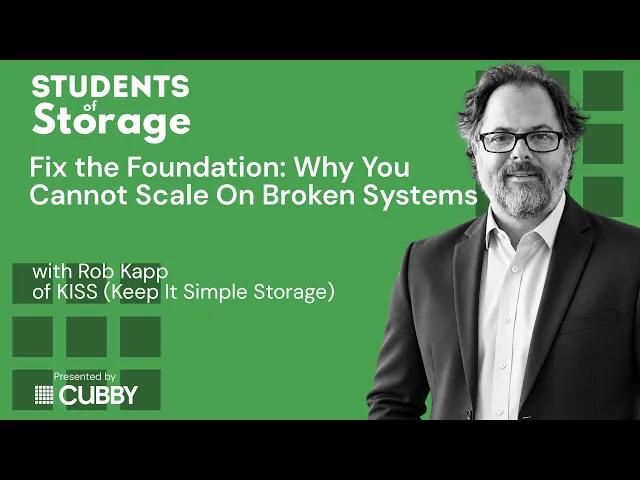
Fix the Foundation: Why You Cannot Scale on Broken Systems with Rob Kapp from KISS
Fix the Foundation: Why You Cannot Scale on Broken Systems with Rob Kapp from KISS
Cubby Team
・
Share:




Self storage was profitable enough, for long enough, that nobody had to fix what was broken underneath. Rob Kapp argues that is exactly why the industry sits 20 to 30 years behind on technology, and why the margin compression operators feel today is finally forcing the issue. As he puts it, the profits masked the inefficiencies. Now that it is a six to ten percent margin game, they cannot.
Rob started in storage 26 years ago as an owner operator and built a top 100 portfolio in North Carolina, running remote operations for 25 years. Five years ago he founded Keep It Simple Storage to build the technology he could never find for his own business. He joins Michael Brevdeh of Cubby for a conversation about what actually has to change in a storage operation, and in what order.
The through line is that technology is not the first step. Rob and Michael both make the case that you fix the operating model, the processes, and the seats people sit in, and only then do you add tools and scale. Every operator says they want to double this year. You cannot do it on a cracked foundation.
Along the way Rob shares the experiment that doubled his conversion rate by moving the rental into the app, why a manager will quietly sabotage a rollout if nobody explains the why, and the conversation with his daughter on her first day in the family business that convinced him to start a technology company. He and Michael also take apart the objection they hear at every trade show, that older customers will not use technology, with evidence from a Florida campfire and a 91 year old neighbor with an Apple Watch.
This is a practical conversation for owners and operators who are tired of trading one problem for another.
Key Takeaways:
(0:00) Intro
(1:04) Meet Rob Kapp and Keep It Simple Storage
(2:31) Why Rob built KISS after 25 years of remote operations
(4:51) How storage fell 30 years behind, and why the margins changed that
(6:43) The app-first rental experiment that doubled conversion
(8:19) Two kinds of owners, and why the rental experience decides
(12:20) Adding new tools without losing the human touch
(14:27) Pump the brakes on AI: drive the outcome, then pick the tool
(16:17) Rewriting the storage manager job description
(18:13) What self storage can borrow from multifamily
(21:53) Getting managers bought in before a rollout
(23:53) Specialization, and why you cannot scale on a cracked foundation (26:46) The conversation with his daughter that started the company
(29:54) The myth that older customers will not use technology
(31:54) Closing thoughts
Resources Mentioned:
Keep It Simple Storage | Website https://keepitsimplestorage.com
Keep It Simple Storage | LinkedIn https://www.linkedin.com/company/kissstorage
Rob Kapp | LinkedIn https://www.linkedin.com/in/robert-kapp-7a543210/
Cubby | Website https://www.cubbystorage.com
Thank you for listening to Students of Storage. If this episode gave you something you can use, please leave us a five star review and subscribe so you do not miss the next one.
Self storage was profitable enough, for long enough, that nobody had to fix what was broken underneath. Rob Kapp argues that is exactly why the industry sits 20 to 30 years behind on technology, and why the margin compression operators feel today is finally forcing the issue. As he puts it, the profits masked the inefficiencies. Now that it is a six to ten percent margin game, they cannot.
Rob started in storage 26 years ago as an owner operator and built a top 100 portfolio in North Carolina, running remote operations for 25 years. Five years ago he founded Keep It Simple Storage to build the technology he could never find for his own business. He joins Michael Brevdeh of Cubby for a conversation about what actually has to change in a storage operation, and in what order.
The through line is that technology is not the first step. Rob and Michael both make the case that you fix the operating model, the processes, and the seats people sit in, and only then do you add tools and scale. Every operator says they want to double this year. You cannot do it on a cracked foundation.
Along the way Rob shares the experiment that doubled his conversion rate by moving the rental into the app, why a manager will quietly sabotage a rollout if nobody explains the why, and the conversation with his daughter on her first day in the family business that convinced him to start a technology company. He and Michael also take apart the objection they hear at every trade show, that older customers will not use technology, with evidence from a Florida campfire and a 91 year old neighbor with an Apple Watch.
This is a practical conversation for owners and operators who are tired of trading one problem for another.
Key Takeaways:
(0:00) Intro
(1:04) Meet Rob Kapp and Keep It Simple Storage
(2:31) Why Rob built KISS after 25 years of remote operations
(4:51) How storage fell 30 years behind, and why the margins changed that
(6:43) The app-first rental experiment that doubled conversion
(8:19) Two kinds of owners, and why the rental experience decides
(12:20) Adding new tools without losing the human touch
(14:27) Pump the brakes on AI: drive the outcome, then pick the tool
(16:17) Rewriting the storage manager job description
(18:13) What self storage can borrow from multifamily
(21:53) Getting managers bought in before a rollout
(23:53) Specialization, and why you cannot scale on a cracked foundation (26:46) The conversation with his daughter that started the company
(29:54) The myth that older customers will not use technology
(31:54) Closing thoughts
Resources Mentioned:
Keep It Simple Storage | Website https://keepitsimplestorage.com
Keep It Simple Storage | LinkedIn https://www.linkedin.com/company/kissstorage
Rob Kapp | LinkedIn https://www.linkedin.com/in/robert-kapp-7a543210/
Cubby | Website https://www.cubbystorage.com
Thank you for listening to Students of Storage. If this episode gave you something you can use, please leave us a five star review and subscribe so you do not miss the next one.
Latest

Content
Learn It, Then Live It: How Community Gets You Your First Storage Deal
Cubby Team
・
Read More

Content
Winning Storage Owners Through Operational Excellence | JC Reed of All-Purpose Storage Management
Cubby Team
・
Read More
Content
Grow Healthy, Not Just Big: Lessons From Scaling a Storage Management Company with Brett Copper of Copper Storage Management
Cubby Team
・
Read More