
Back
Back
Content
From 32 to 600: How SAM Grew With Marketing at the Core with Melissa Stiles of Storage Asset Management
From 32 to 600: How SAM Grew With Marketing at the Core with Melissa Stiles of Storage Asset Management
Cubby Team
・
Share:



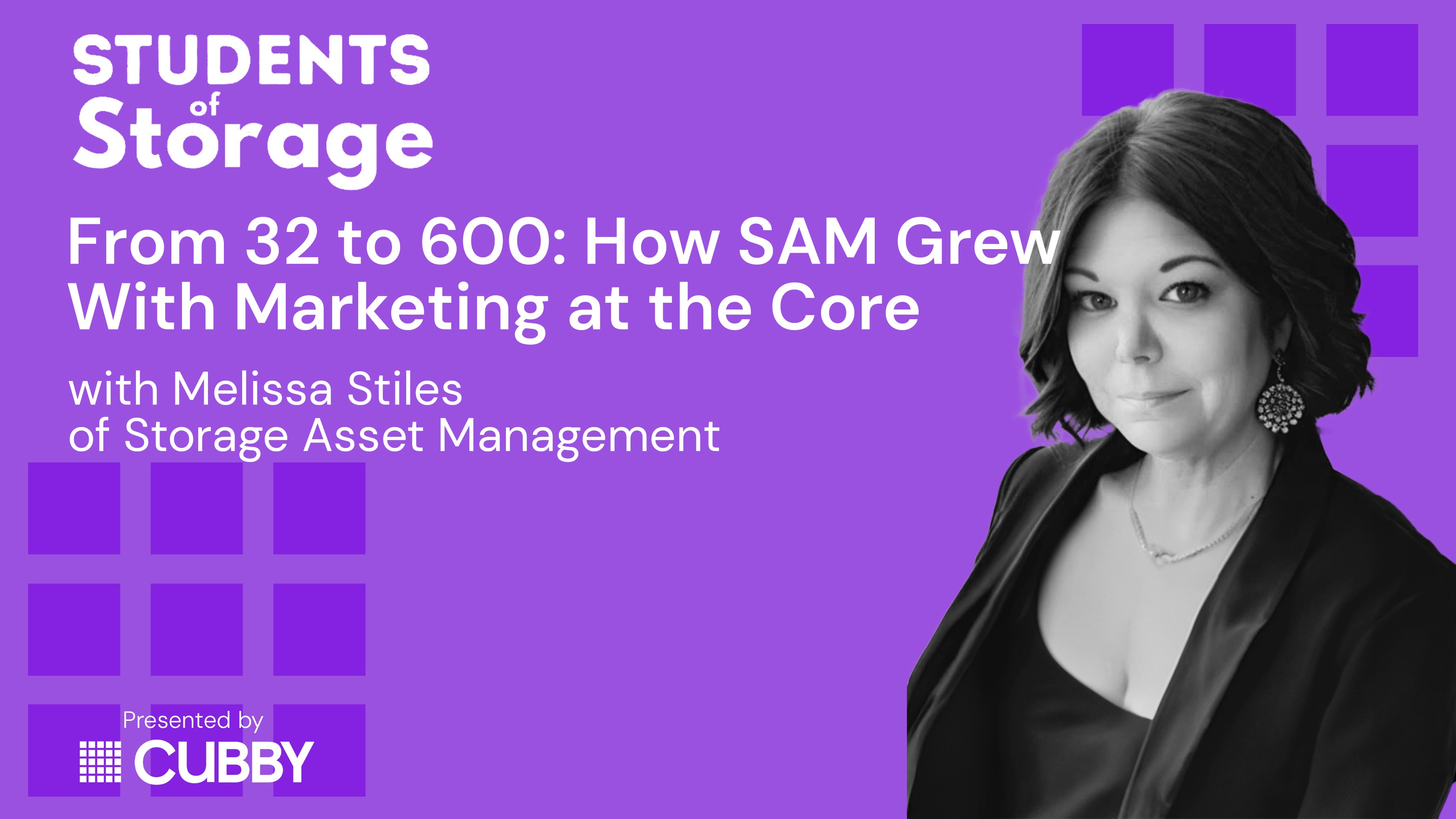
Melissa Stiles, Chief Marketing Officer of Storage Asset Management (SAM), shares her journey from answering a blind ad to leading one of the largest third-party management companies in self-storage. Overseeing marketing, revenue management, business development, and communications, Melissa has helped SAM grow from 32 stores to nearly 600.
In this conversation, she explains how her team evolved into a full-service, agency-style structure with specialists in SEO, paid ads, social, and local marketing. Melissa dives into strategies that drive lease-ups, from influencer partnerships and community events to data-driven revenue management models. She also discusses how AI is reshaping SEO, what makes local marketing still matter, and why reputation and relationships remain central to SAM’s success.
Key Takeaways:
0:00 Introductions - Melissa’s role with SAM
2:02 Melissa’s Journey to become CMO and the growth of SAM
5:27 Developing the marketing team
9:00 Key questions to making a great hire
11:00 Case study for building a marketing strategy for a self storage facility
13:43 Strategies for a successful for lease up
16:46 When should you expect stabilization
17:46 Getting found with AI in the lease up process
20:47 The advantages of scaling up for a brand
23:06 Using data to impact operations
25:33 Revenue management tactics
27:07 The pride of making a real world impact
Transcript
Hey, my name is Matt Engfer. I'm the co-founder and CEO of Cubby, the self storage platform that makes growth simple. Today on our podcast, Students of Storage, we're joined by Melissa Styles, the CMO of Storage Asset Management in York, Pennsylvania.
We dive into her story, the company's growth in her time there, and really dig into what makes a marketing team, what makes a great marketing employee, and then where marketing is headed. We touch on SEO, we touch on the growth that she's looking forward to at SAM, and much more. All right. Hey, Melissa, thanks for hopping on.
Hey, Matt. How are you doing?
I'm doing great. How are you?
Good, thank you.
Yeah. Are you in Pennsylvania today?
Yes, Pennsylvania.
At home at the office. Right.
Before we get started on today's Students of Storage, I'd love to just hear a quick blurb about you — who you are, your position, your name — and then we'll dive into your career and go from there. Does that sound good?
Yeah, sure. So I'm Melissa Styles, chief marketing officer with Storage Asset Management. And currently, part of that, I oversee the marketing, revenue management, business development, and transitions and communications departments.
Awesome. And Storage Asset Management is one of the largest third-party managers in the country for self storage. You're overseeing facility marketing and driving move-ins and all the things that go along with that. The revenue management you mentioned, and then also business development — so that means signing new clients, and that's a whole other part of your job, right?
Right. So you have the B2B and the B2C, then, with the facilities and with SAM. Yeah.
Wow. Okay, so much to dive into there. That's a big job, lot to do.
Let's start, before we get there, with your journey. I've heard you tell this story in different forms on other podcasts and things like that, but tell us how your career evolved and how you ended up at SAM.
Yeah, so right after undergrad college I went to work for the World Trade Center of Harrisburg, to work there for six years helping companies within the South Central Pennsylvania area with exporting, importing, foreign direct investment. Was there, and it was just me and the director, and she wanted me to step out and find more opportunities. So went to work for a client for a year.
Just wasn't a great fit, and then answered a blind ad for a marketing manager position, turned out it was with Storage Asset Management. I met Jay and Alyssa and really liked them, and saw some opportunity within their marketing, both on both sides, B2B and B2C, and thought it would be a fun opportunity if I just went into storage, because I never even rented a unit.
I could do it for a year, make an impact, and then maybe look at going back to international. But I've now been with SAM for 11 and a half years, so it's been fun.
Awesome. Congrats. When — what year did you join SAM?
Okay, cool.
Yeah — oh, sorry, at that point we had 32 stores under management.
Okay. Got it. And what did you walk into? Describe it — what was it like at SAM at that point, picking up your job?
Yeah, it was interesting. There were still a couple facilities that had Yellow Pages ads, and I didn't know what Yellow Pages were.
Websites were very, very basic — showing price, maybe a bill pay option, some form of a reservation that was more like a contact form. So very basic. They were doing well and fine, but definitely saw some opportunities to make that a better digital experience too.
And were you the first marketing hire?
I was not.
No. So who else was there when you got there?
Well, there were two people before me, and I replaced one of them.
Okay. Got it.
So it was me — I was the only person doing marketing when I was hired.
Okay. So 32 stores at that point that you were responsible for essentially filling up.
Mhm.
Today, how many stores does SAM manage?
Roughly 600.
Okay.
So pretty exponential growth. Has it been pretty linear between that 2014 start date and now, like just more and more all the time, or has it come in spurts?
I would say, like, maybe 2014 to '16-'17 it was a smaller growth. Then we saw it start to pick up as we started to really get a lot of good systems in place and really comfortable with our management platform. And then, as we were working with clients, they were able to then purchase more facilities too, so we were able to grow with our clients too.
Okay, cool. And how has your team grown in that time? You were a marketing manager, you've been promoted a number of times, obviously. Explain that story to me.
Yeah, so I think when we got to maybe 55 stores, I hired a second person, and really had them focus on graphic — I'm very comfortable in the digital realm, but the print graphic isn't as natural to me.
So we were able to hire someone in that print/graphic role, and then from there just started to build the team, and we built it — good or bad — in niches. So we have someone on our team specialized in website content, someone specialized in Google paid ads, someone specialized in social, and so on. And we've grown that team now — I have a director of marketing, he oversees that team, Mandeep, he's great.
And we've now, in this past year, hired almost three account managers — three people responsible for the different regions of the country, and they're overseeing that marketing.
So they go back to the person specializing in SEO, the person specializing in paid ads, and communicate what's going on with the market and what the stores need in that market. So really that team is set up like a traditional marketing agency now.
Okay.
Fascinating. So these regional heads are ultimately responsible for the performance of the marketing on the stores in the region they manage, and they deploy your content folks, your paid ads folks, your social folks, and corral those resources and point them at where they need to be pointed, focus on what they need to focus on. Okay, so content, paid ads, social, you said, etc. But I'm not going to let you off the hook — what else?
Yeah.
No, we still have a local marketing team too, that concentrates on helping with events at the store, helping them make those contacts within the community. There's still print, there's still signage that needs to be had. So there are concentrations on that, and flyers if they need something. We do really still believe in local marketing. It's changed as storage has changed — we focused a lot on apartments, realtors, those type of things.
When moving's not happening, we're now concentrating on other places within the community, whether it's organizations, the renovation teams at different hardware stores, or in the community. So our focus on local marketing — maybe those contacts have changed, but we're still 100% behind it and think that local marketing helps get the brand awareness out in the community. Cool.
So I want to talk about the B2B side in a minute, but you said content, paid ads, social, local marketing, print. How many people are involved in that part of the organization for you?
So that local marketing team has four and a half people on it. So — Jared oversees that, he's actually the one that onboards every single store within SAM to the marketing team, and then he oversees the local and print team.
Okay. So total local, print, social, paid ads — how big is your marketing team?
17 people. Okay. Awesome.
Yeah.
Awesome. So you've had your share of hiring, managing, I'm sure firing, the whole gamut,
a team that delivers great results in self storage marketing. What are the themes you're looking for when you're hiring anyone on that team?
Yeah.
And I think anyone within any position too — first, be a problem solver, and be curious.
So those two things are sort of characteristics that are harder to teach. I can teach someone SEO, and where the SEO resources are and those kinds of things, but if they're not curious and want to be the problem solver and really want to understand that, that's a little bit harder to teach. So those are the two main qualities I always look for.
Okay.
And I think for a lot of the listeners, they're not building 17-person marketing teams, but they're probably focused a lot on SEO, a lot on website, maybe a little bit of paid. What are the skill sets, or what are the trick questions you might ask to separate qualified candidates from unqualified candidates? And what are you looking for in hiring someone who might have a bit more of an analytical set of responsibilities?
Yeah.
So I think understanding what KPIs they look at — how do they define success, right? Is it they only are looking at, say, number of users, which is a great KPI, but then are they able to dig into that and understand the trend of that KPI and why it fluctuated or decreased. So not only knowing the KPIs but understanding them and what they indicate, I think, is probably the biggest one too.
Okay.
Awesome. Let's nerd out for a second on this particular topic. Pick a store or a region or just something that comes to mind, and help me deconstruct the story of how you achieve — give me a case study, basically.
Yeah.
And I want to dig into exactly what you did in that example and bring some of these concepts to life.
Yeah.
So if one of our clients acquires a facility within a market, first we're looking at the brand — so we have a national brand, it has 300 facilities on it, so in some markets, Storage Sense — I think, right — and in some markets, and in most cases urban markets, it makes sense to bring in that Storage Sense brand, it has that authority already within domain, it has the Google seller ratings. And or if it's a very
maybe tertiary market and that brand is already doing well, then we decide to keep that brand. So either way, under our management, that's probably one of the first things we'll look at — what's the brand? Then we're starting to do the research — how do people find storage within that community? So even though it might be called — the city might be York, Pennsylvania, maybe that little place is called Red Lion or something like that.
So really understanding how people would find this area and what they would search for, building the website, building the ads and the content all around that research, looking, and then doing a hard look — whoever's doing the due diligence, our marketing team gets on a FaceTime call with them and looks at all the signage, understands what signage is there, what needs replaced, what's really going to give the best customer experience.
And then going from there, to the local marketing — what are the good businesses they should partner with? Our local team provides that to the store. And then really working through the different pieces. Reputation's very important to us, getting reviews. So making sure we go back through, and if it's an existing location, we go back through, we answer them and say we're a new management company now.
Hopefully you'll give us another chance, especially the negative reviews — we'll answer them from the last year. And then start to build that program out of requesting reviews. Very heavy on content and the SEO aspect — making sure that on the back end of our website, all of the tags, everything is driving traffic within that community to that location page.
Okay, cool. So you've run this playbook across, you know, 600 stores at this point. Help me understand the upper bound and lower bound of what's possible. Tell me your best marketing story — what's your fastest lease-up? Just so folks listening have an understanding of what's possible.
Yeah, I mean there are lots of out-of-the-box ideas, right? So having a big splash within the community.
Making sure your signage is correct, or if you have a really big marketing budget, you can host food trucks at your facility. The point is to get traffic there — foot traffic. Host something like that where it's big, and maybe you pay $500 and have an ice cream truck for the community there at the facility. And then online, really it's understanding the market and looking at what will get you to rank first the fastest.
So it might be that you need to spend more on Google Ads to begin with.
If it's already a market that has a heavy presence. So it's really, I would say, driving foot traffic and driving the digital traffic. And then you can do so many out-of-the-box things — we've done billboards, those still work in some communities. We've done guerrilla marketing campaigns, just putting flyers out in the community, online we work with
— we'll look for an influencer in a market, and if there's someone big on TikTok or big on Instagram, partnering with them and having them go to the facility and show the facility in that way as well.
Cool. And what's an example of a facility or two, or a market or two, that you've seen this produce outstanding results in?
Yeah.
The Virginia Beach market — we have some locations there that have done well with an influencer, have done really well with big campaigns for a lease-up. We've had some here in Pennsylvania as well. And really, if we have the spend and are able to do it to make the splash, then it's easier to get that brand awareness. And I will say — oh sorry, we're talking, I know we're marketing — but really, also having a great competitive special.
Doing something fun out of the box — like the first, we just did it at a facility where the first 50 renters get to be entered for a whole year of storage for free. And we got the idea from fast food restaurants when they open up, you see that line around the block because they get McDonald's for a year or whatever that is. So trying to replicate that excitement and get people in the door that way.
Cool. Cool. So let's say you get a brand-new construction facility. Is there a general rule of thumb for reaching stabilization, and what you think is good, great, and mediocre? Like if you lease up to a stabilized 85% occupancy, whatever the target you might set is, in 10 months, is that a really good lease-up?
Is that how you think about it?
Yeah, we think about it — I think stabilization right now is probably in year three to four. And so looking at that, and the projections kind of reflect that. If you can do it in 10 months, that's amazing.
You just — it's obviously — every, a lot of people think they can, right, and then they build something and it turns out to be a three-year process. Makes sense. Okay, cool. What about — okay, let's stick on the nerdy stuff, the SEO.
I've heard you on other podcasts, and just running into you at trade shows and things like that, talking a lot about AI.
Mhm.
When you're sitting down to actually lease up a facility or drive some rentals with your team, and you're thinking about SEO, content, social, whatever is going on — how is AI entering that conversation, and how's it changing things from a tactical perspective for you?
Yeah, it's interesting, and I would say this has been a fast shift within the last three to four months — we've seen Google release their AI modes and their overviews, more use of ChatGPT. So it becomes more about visibility. And what that means for us is we're looking more at the traditional long-tail keywords.
AI tends to be more towards voice search rather than a typing search, because you're asking it — "I need storage in Brooklyn, New York," and it gives you an overview, and you're like, "Okay, but what's closest to X, Y, Z, or what's the cheapest?" So it starts to become more of a conversation than an actual search, and Google is acting more like the web than the tool to get to where you're going.
So even in late last year, in the fall, we started adding some of our prices in our SEO tags too — "starting at $10" — so people are not clicking through to the website, they want all the information there, but it also lends well to the AI, picking up those keywords. So we're looking a lot at how people search being more conversational — what does that mean for our long-tail keywords?
Making sure we have the right content, making sure we have more how-to guides, like "how to choose the right storage unit for you," and those informative pieces on our website.
Interesting. It sounds similar to search, from what I'm hearing — a lot of focus on the back end, the metadata, and then some really useful how-to content is going to reward you.
Yeah.
And using in these LLMs.
Yeah.
I think content — they've always said content is king, and that hasn't changed.
It's just the way we look at content. We were really — and you'll see this — some are really focused on keyword stuffing, where it's like "storage Brooklyn New York, storage Brooklyn New York, storage Brooklyn New York." I think you're now starting to see that content expand and have those long-tail keywords — so it's more like "most affordable storage" or "storage near such-and-such in Brooklyn, New York." So those are expanding, I think, as well.
Cool. I want to talk a little bit about scale, and the advantages it can bring.
Yeah.
Let's start at the local market level.
Storage Sense might have five or six or seven stores in a market, right? What advantage does that bring you over having a single store in a market?
Yeah.
So locally you have that brand awareness — you're driving by, you see Storage Senses, and when you go to make your search, you've probably driven by one in the community, just with the volume there.
But then when you look at search, you have five locations that are at least sending five signals to Google that you are the storage in that area. So it helps drive traffic digitally as well, because you're able to have that space — you have five Google Business listings, then, versus, say, one of another brand.
So it just takes up more real estate space, then, as well.
Do you have a way to quantify the impact of that, or is there a tipping point at which you start to see the impact, depending on how many stores per capita or anything like that, that you're able to pin down so you can forecast when to expect a lift?
That's interesting — we don't, and honestly it's because every community is so different.
So if we go into a market and we have one Storage Sense and the rest are, say, a non-REIT, we're going to do very well there. But if we go in with one Storage Sense and there's like five REITs there, it really depends on the competition there. So I wish there was a magic number for that, but it's so specific and based on the competition there, what that community looks like.
Yeah.
No, that makes sense. And I think it offers a little hope to operators who are hoping to compete — we have operators who have 10-15 facilities in their hometown, and they know that market and are able to take advantage of that homegrown knowledge and compete with, say, a REIT that might throw up one store in town. Cool. So what about the rest of the data you're looking at? How are you consuming it?
And at what point do you have enough data to make it really useful, beyond just looking at management summary reports for a single facility or two or five facilities? How do you manage your data?
Yeah.
So it's interesting — looking at the management summary gives you a really good indication of operations, but tying it together with your website data is key. One of the things we started doing that's been interesting is being able to predict how many website users we need to hit the rental goals. So that really gives the marketing team targets for each facility of how much traffic we need to that website.
So working backwards from — this is how many rentals the store needs, and the industry has always been good at setting that goal — but then working backwards to get the marketing team, "this is how many website users you need," and then the revenue management team, "this is how many of those website visitors you have to convert to leads" to achieve that. And then we're able to predict spend and have a better handle on what we need to get that facility to that number.
Okay, cool. Very interesting. A lot happens in the moment from that initial point of traffic hitting your website.
You mentioned revenue management, converting to a lead, maybe following up with phone calls — there's a whole ocean of activity taking place there.
Backing into those targets of how many people you want on your website, I imagine you have some sort of funnel or series of funnels. Can you break down the components you're looking at for us?
Yeah.
So to get to that number in a regression model — looking at the close rate, obviously — so at the most basic, you can take "this is how many rentals I need" divided by the close rate, and that's how many leads you need. But how many leads, how many website users you need to convert, is a little bit more — so that's taking your unique visitors, and
a lot of it's spend too — you can look at what your spend was and what your click-through rates were from Google, and adjusting those in a regression model to figure that out.
Cool. And then, you're a pretty classically trained marketer, I think — I could be wrong here, but it sounds like you probably learned revenue management on the job. These are so tightly coupled, right, and so incredibly important together.
How do you differentiate — is there a science to it that you can pin down, or how do you evaluate the success of your revenue management as part of the marketing funnel for you?
Yeah, I think it's that leads number, right, is really telling of how they're doing. And when you look at marketing — one of the reasons we moved revenue management, marketing and revenue management are looking at the same data.
So they are the top of the funnel and need to get so many leads to the stores, or to the website, to the call center, to be able to close. So that data is so closely aligned, and then you can start to understand where in the funnel —
is it a leads problem or a pricing problem? So conversions on a website — if you have the same or more traffic but you're not converting, that's telling me it's maybe a pricing problem then.
Awesome.
That's amazing. Thank you so much for this. I'll close with one question, unless you have questions for me — but what's your favorite part of the job, having done it for 11-plus years now?
Yeah. What makes you proud?
Yeah.
I think it's the impact, right — I've never set out to be a CMO, I just wanted to make an impact.
My first couple days with SAM, I saw that if we just change our website a little bit to reflect who we are, what will that look like? So just the impact, and being able to hire these teams, build these teams up and see them grow — like Mandeep, our director of marketing, he's been with us for almost six years, he started as the paid media specialist — being able to mentor and grow different people throughout the company has been one of my favorites.
Also, if you're in the storage industry — the storage industry is just great overall, and I've made some of my best friends now within the industry too.
Totally. I knew you would say that. I knew you'd say that part. Cool.
Awesome. And I'll ask you one more question — you mentioned your business development efforts. What do you see as what's enabled SAM to win new business from net-new clients that you think is special and different?
I think it's really our reputation, and that everyone at SAM is really concentrated on upholding our reputation, doing the best we can for every client. We don't own any of the facilities, which makes us truly unique. And so everything we do is really what's best for that facility and for that client, and being able to at scale continue to do that has been probably the most special piece.
Cool. Where are you headed? What's next for SAM 5 years from now? Are you going to have 1,800 stores? What's the plan?
Our plan is just to continue to grow — with our clients, with new clients where it makes sense — and continue to uphold our reputation. Really, that's what we want to do. Our mission is doing what's best for the facilities, and having that reputation within the industry of being the best at that is what we set out to do, not being at a certain number of facilities.
Cool. Thank you so much for hopping on. I really appreciate it. Fascinating story, and it seems like you've built — your reputation obviously precedes you, you have so many great friends in the industry, everyone says such amazing things about you — but it feels like you've built a pretty awesome culture at SAM, and it's a pleasure to have you on and learn from you.
No, I appreciate it. Thank you for those kind words.
Thank you for listening to Students of Storage. Links to any resources mentioned in the episode can be found in the show notes. If you enjoyed the show, please leave a five-star review and subscribe so you don't miss out on any future episodes. Thanks and have a good one.
Melissa Stiles, Chief Marketing Officer of Storage Asset Management (SAM), shares her journey from answering a blind ad to leading one of the largest third-party management companies in self-storage. Overseeing marketing, revenue management, business development, and communications, Melissa has helped SAM grow from 32 stores to nearly 600.
In this conversation, she explains how her team evolved into a full-service, agency-style structure with specialists in SEO, paid ads, social, and local marketing. Melissa dives into strategies that drive lease-ups, from influencer partnerships and community events to data-driven revenue management models. She also discusses how AI is reshaping SEO, what makes local marketing still matter, and why reputation and relationships remain central to SAM’s success.
Key Takeaways:
0:00 Introductions - Melissa’s role with SAM
2:02 Melissa’s Journey to become CMO and the growth of SAM
5:27 Developing the marketing team
9:00 Key questions to making a great hire
11:00 Case study for building a marketing strategy for a self storage facility
13:43 Strategies for a successful for lease up
16:46 When should you expect stabilization
17:46 Getting found with AI in the lease up process
20:47 The advantages of scaling up for a brand
23:06 Using data to impact operations
25:33 Revenue management tactics
27:07 The pride of making a real world impact
Transcript
Hey, my name is Matt Engfer. I'm the co-founder and CEO of Cubby, the self storage platform that makes growth simple. Today on our podcast, Students of Storage, we're joined by Melissa Styles, the CMO of Storage Asset Management in York, Pennsylvania.
We dive into her story, the company's growth in her time there, and really dig into what makes a marketing team, what makes a great marketing employee, and then where marketing is headed. We touch on SEO, we touch on the growth that she's looking forward to at SAM, and much more. All right. Hey, Melissa, thanks for hopping on.
Hey, Matt. How are you doing?
I'm doing great. How are you?
Good, thank you.
Yeah. Are you in Pennsylvania today?
Yes, Pennsylvania.
At home at the office. Right.
Before we get started on today's Students of Storage, I'd love to just hear a quick blurb about you — who you are, your position, your name — and then we'll dive into your career and go from there. Does that sound good?
Yeah, sure. So I'm Melissa Styles, chief marketing officer with Storage Asset Management. And currently, part of that, I oversee the marketing, revenue management, business development, and transitions and communications departments.
Awesome. And Storage Asset Management is one of the largest third-party managers in the country for self storage. You're overseeing facility marketing and driving move-ins and all the things that go along with that. The revenue management you mentioned, and then also business development — so that means signing new clients, and that's a whole other part of your job, right?
Right. So you have the B2B and the B2C, then, with the facilities and with SAM. Yeah.
Wow. Okay, so much to dive into there. That's a big job, lot to do.
Let's start, before we get there, with your journey. I've heard you tell this story in different forms on other podcasts and things like that, but tell us how your career evolved and how you ended up at SAM.
Yeah, so right after undergrad college I went to work for the World Trade Center of Harrisburg, to work there for six years helping companies within the South Central Pennsylvania area with exporting, importing, foreign direct investment. Was there, and it was just me and the director, and she wanted me to step out and find more opportunities. So went to work for a client for a year.
Just wasn't a great fit, and then answered a blind ad for a marketing manager position, turned out it was with Storage Asset Management. I met Jay and Alyssa and really liked them, and saw some opportunity within their marketing, both on both sides, B2B and B2C, and thought it would be a fun opportunity if I just went into storage, because I never even rented a unit.
I could do it for a year, make an impact, and then maybe look at going back to international. But I've now been with SAM for 11 and a half years, so it's been fun.
Awesome. Congrats. When — what year did you join SAM?
Okay, cool.
Yeah — oh, sorry, at that point we had 32 stores under management.
Okay. Got it. And what did you walk into? Describe it — what was it like at SAM at that point, picking up your job?
Yeah, it was interesting. There were still a couple facilities that had Yellow Pages ads, and I didn't know what Yellow Pages were.
Websites were very, very basic — showing price, maybe a bill pay option, some form of a reservation that was more like a contact form. So very basic. They were doing well and fine, but definitely saw some opportunities to make that a better digital experience too.
And were you the first marketing hire?
I was not.
No. So who else was there when you got there?
Well, there were two people before me, and I replaced one of them.
Okay. Got it.
So it was me — I was the only person doing marketing when I was hired.
Okay. So 32 stores at that point that you were responsible for essentially filling up.
Mhm.
Today, how many stores does SAM manage?
Roughly 600.
Okay.
So pretty exponential growth. Has it been pretty linear between that 2014 start date and now, like just more and more all the time, or has it come in spurts?
I would say, like, maybe 2014 to '16-'17 it was a smaller growth. Then we saw it start to pick up as we started to really get a lot of good systems in place and really comfortable with our management platform. And then, as we were working with clients, they were able to then purchase more facilities too, so we were able to grow with our clients too.
Okay, cool. And how has your team grown in that time? You were a marketing manager, you've been promoted a number of times, obviously. Explain that story to me.
Yeah, so I think when we got to maybe 55 stores, I hired a second person, and really had them focus on graphic — I'm very comfortable in the digital realm, but the print graphic isn't as natural to me.
So we were able to hire someone in that print/graphic role, and then from there just started to build the team, and we built it — good or bad — in niches. So we have someone on our team specialized in website content, someone specialized in Google paid ads, someone specialized in social, and so on. And we've grown that team now — I have a director of marketing, he oversees that team, Mandeep, he's great.
And we've now, in this past year, hired almost three account managers — three people responsible for the different regions of the country, and they're overseeing that marketing.
So they go back to the person specializing in SEO, the person specializing in paid ads, and communicate what's going on with the market and what the stores need in that market. So really that team is set up like a traditional marketing agency now.
Okay.
Fascinating. So these regional heads are ultimately responsible for the performance of the marketing on the stores in the region they manage, and they deploy your content folks, your paid ads folks, your social folks, and corral those resources and point them at where they need to be pointed, focus on what they need to focus on. Okay, so content, paid ads, social, you said, etc. But I'm not going to let you off the hook — what else?
Yeah.
No, we still have a local marketing team too, that concentrates on helping with events at the store, helping them make those contacts within the community. There's still print, there's still signage that needs to be had. So there are concentrations on that, and flyers if they need something. We do really still believe in local marketing. It's changed as storage has changed — we focused a lot on apartments, realtors, those type of things.
When moving's not happening, we're now concentrating on other places within the community, whether it's organizations, the renovation teams at different hardware stores, or in the community. So our focus on local marketing — maybe those contacts have changed, but we're still 100% behind it and think that local marketing helps get the brand awareness out in the community. Cool.
So I want to talk about the B2B side in a minute, but you said content, paid ads, social, local marketing, print. How many people are involved in that part of the organization for you?
So that local marketing team has four and a half people on it. So — Jared oversees that, he's actually the one that onboards every single store within SAM to the marketing team, and then he oversees the local and print team.
Okay. So total local, print, social, paid ads — how big is your marketing team?
17 people. Okay. Awesome.
Yeah.
Awesome. So you've had your share of hiring, managing, I'm sure firing, the whole gamut,
a team that delivers great results in self storage marketing. What are the themes you're looking for when you're hiring anyone on that team?
Yeah.
And I think anyone within any position too — first, be a problem solver, and be curious.
So those two things are sort of characteristics that are harder to teach. I can teach someone SEO, and where the SEO resources are and those kinds of things, but if they're not curious and want to be the problem solver and really want to understand that, that's a little bit harder to teach. So those are the two main qualities I always look for.
Okay.
And I think for a lot of the listeners, they're not building 17-person marketing teams, but they're probably focused a lot on SEO, a lot on website, maybe a little bit of paid. What are the skill sets, or what are the trick questions you might ask to separate qualified candidates from unqualified candidates? And what are you looking for in hiring someone who might have a bit more of an analytical set of responsibilities?
Yeah.
So I think understanding what KPIs they look at — how do they define success, right? Is it they only are looking at, say, number of users, which is a great KPI, but then are they able to dig into that and understand the trend of that KPI and why it fluctuated or decreased. So not only knowing the KPIs but understanding them and what they indicate, I think, is probably the biggest one too.
Okay.
Awesome. Let's nerd out for a second on this particular topic. Pick a store or a region or just something that comes to mind, and help me deconstruct the story of how you achieve — give me a case study, basically.
Yeah.
And I want to dig into exactly what you did in that example and bring some of these concepts to life.
Yeah.
So if one of our clients acquires a facility within a market, first we're looking at the brand — so we have a national brand, it has 300 facilities on it, so in some markets, Storage Sense — I think, right — and in some markets, and in most cases urban markets, it makes sense to bring in that Storage Sense brand, it has that authority already within domain, it has the Google seller ratings. And or if it's a very
maybe tertiary market and that brand is already doing well, then we decide to keep that brand. So either way, under our management, that's probably one of the first things we'll look at — what's the brand? Then we're starting to do the research — how do people find storage within that community? So even though it might be called — the city might be York, Pennsylvania, maybe that little place is called Red Lion or something like that.
So really understanding how people would find this area and what they would search for, building the website, building the ads and the content all around that research, looking, and then doing a hard look — whoever's doing the due diligence, our marketing team gets on a FaceTime call with them and looks at all the signage, understands what signage is there, what needs replaced, what's really going to give the best customer experience.
And then going from there, to the local marketing — what are the good businesses they should partner with? Our local team provides that to the store. And then really working through the different pieces. Reputation's very important to us, getting reviews. So making sure we go back through, and if it's an existing location, we go back through, we answer them and say we're a new management company now.
Hopefully you'll give us another chance, especially the negative reviews — we'll answer them from the last year. And then start to build that program out of requesting reviews. Very heavy on content and the SEO aspect — making sure that on the back end of our website, all of the tags, everything is driving traffic within that community to that location page.
Okay, cool. So you've run this playbook across, you know, 600 stores at this point. Help me understand the upper bound and lower bound of what's possible. Tell me your best marketing story — what's your fastest lease-up? Just so folks listening have an understanding of what's possible.
Yeah, I mean there are lots of out-of-the-box ideas, right? So having a big splash within the community.
Making sure your signage is correct, or if you have a really big marketing budget, you can host food trucks at your facility. The point is to get traffic there — foot traffic. Host something like that where it's big, and maybe you pay $500 and have an ice cream truck for the community there at the facility. And then online, really it's understanding the market and looking at what will get you to rank first the fastest.
So it might be that you need to spend more on Google Ads to begin with.
If it's already a market that has a heavy presence. So it's really, I would say, driving foot traffic and driving the digital traffic. And then you can do so many out-of-the-box things — we've done billboards, those still work in some communities. We've done guerrilla marketing campaigns, just putting flyers out in the community, online we work with
— we'll look for an influencer in a market, and if there's someone big on TikTok or big on Instagram, partnering with them and having them go to the facility and show the facility in that way as well.
Cool. And what's an example of a facility or two, or a market or two, that you've seen this produce outstanding results in?
Yeah.
The Virginia Beach market — we have some locations there that have done well with an influencer, have done really well with big campaigns for a lease-up. We've had some here in Pennsylvania as well. And really, if we have the spend and are able to do it to make the splash, then it's easier to get that brand awareness. And I will say — oh sorry, we're talking, I know we're marketing — but really, also having a great competitive special.
Doing something fun out of the box — like the first, we just did it at a facility where the first 50 renters get to be entered for a whole year of storage for free. And we got the idea from fast food restaurants when they open up, you see that line around the block because they get McDonald's for a year or whatever that is. So trying to replicate that excitement and get people in the door that way.
Cool. Cool. So let's say you get a brand-new construction facility. Is there a general rule of thumb for reaching stabilization, and what you think is good, great, and mediocre? Like if you lease up to a stabilized 85% occupancy, whatever the target you might set is, in 10 months, is that a really good lease-up?
Is that how you think about it?
Yeah, we think about it — I think stabilization right now is probably in year three to four. And so looking at that, and the projections kind of reflect that. If you can do it in 10 months, that's amazing.
You just — it's obviously — every, a lot of people think they can, right, and then they build something and it turns out to be a three-year process. Makes sense. Okay, cool. What about — okay, let's stick on the nerdy stuff, the SEO.
I've heard you on other podcasts, and just running into you at trade shows and things like that, talking a lot about AI.
Mhm.
When you're sitting down to actually lease up a facility or drive some rentals with your team, and you're thinking about SEO, content, social, whatever is going on — how is AI entering that conversation, and how's it changing things from a tactical perspective for you?
Yeah, it's interesting, and I would say this has been a fast shift within the last three to four months — we've seen Google release their AI modes and their overviews, more use of ChatGPT. So it becomes more about visibility. And what that means for us is we're looking more at the traditional long-tail keywords.
AI tends to be more towards voice search rather than a typing search, because you're asking it — "I need storage in Brooklyn, New York," and it gives you an overview, and you're like, "Okay, but what's closest to X, Y, Z, or what's the cheapest?" So it starts to become more of a conversation than an actual search, and Google is acting more like the web than the tool to get to where you're going.
So even in late last year, in the fall, we started adding some of our prices in our SEO tags too — "starting at $10" — so people are not clicking through to the website, they want all the information there, but it also lends well to the AI, picking up those keywords. So we're looking a lot at how people search being more conversational — what does that mean for our long-tail keywords?
Making sure we have the right content, making sure we have more how-to guides, like "how to choose the right storage unit for you," and those informative pieces on our website.
Interesting. It sounds similar to search, from what I'm hearing — a lot of focus on the back end, the metadata, and then some really useful how-to content is going to reward you.
Yeah.
And using in these LLMs.
Yeah.
I think content — they've always said content is king, and that hasn't changed.
It's just the way we look at content. We were really — and you'll see this — some are really focused on keyword stuffing, where it's like "storage Brooklyn New York, storage Brooklyn New York, storage Brooklyn New York." I think you're now starting to see that content expand and have those long-tail keywords — so it's more like "most affordable storage" or "storage near such-and-such in Brooklyn, New York." So those are expanding, I think, as well.
Cool. I want to talk a little bit about scale, and the advantages it can bring.
Yeah.
Let's start at the local market level.
Storage Sense might have five or six or seven stores in a market, right? What advantage does that bring you over having a single store in a market?
Yeah.
So locally you have that brand awareness — you're driving by, you see Storage Senses, and when you go to make your search, you've probably driven by one in the community, just with the volume there.
But then when you look at search, you have five locations that are at least sending five signals to Google that you are the storage in that area. So it helps drive traffic digitally as well, because you're able to have that space — you have five Google Business listings, then, versus, say, one of another brand.
So it just takes up more real estate space, then, as well.
Do you have a way to quantify the impact of that, or is there a tipping point at which you start to see the impact, depending on how many stores per capita or anything like that, that you're able to pin down so you can forecast when to expect a lift?
That's interesting — we don't, and honestly it's because every community is so different.
So if we go into a market and we have one Storage Sense and the rest are, say, a non-REIT, we're going to do very well there. But if we go in with one Storage Sense and there's like five REITs there, it really depends on the competition there. So I wish there was a magic number for that, but it's so specific and based on the competition there, what that community looks like.
Yeah.
No, that makes sense. And I think it offers a little hope to operators who are hoping to compete — we have operators who have 10-15 facilities in their hometown, and they know that market and are able to take advantage of that homegrown knowledge and compete with, say, a REIT that might throw up one store in town. Cool. So what about the rest of the data you're looking at? How are you consuming it?
And at what point do you have enough data to make it really useful, beyond just looking at management summary reports for a single facility or two or five facilities? How do you manage your data?
Yeah.
So it's interesting — looking at the management summary gives you a really good indication of operations, but tying it together with your website data is key. One of the things we started doing that's been interesting is being able to predict how many website users we need to hit the rental goals. So that really gives the marketing team targets for each facility of how much traffic we need to that website.
So working backwards from — this is how many rentals the store needs, and the industry has always been good at setting that goal — but then working backwards to get the marketing team, "this is how many website users you need," and then the revenue management team, "this is how many of those website visitors you have to convert to leads" to achieve that. And then we're able to predict spend and have a better handle on what we need to get that facility to that number.
Okay, cool. Very interesting. A lot happens in the moment from that initial point of traffic hitting your website.
You mentioned revenue management, converting to a lead, maybe following up with phone calls — there's a whole ocean of activity taking place there.
Backing into those targets of how many people you want on your website, I imagine you have some sort of funnel or series of funnels. Can you break down the components you're looking at for us?
Yeah.
So to get to that number in a regression model — looking at the close rate, obviously — so at the most basic, you can take "this is how many rentals I need" divided by the close rate, and that's how many leads you need. But how many leads, how many website users you need to convert, is a little bit more — so that's taking your unique visitors, and
a lot of it's spend too — you can look at what your spend was and what your click-through rates were from Google, and adjusting those in a regression model to figure that out.
Cool. And then, you're a pretty classically trained marketer, I think — I could be wrong here, but it sounds like you probably learned revenue management on the job. These are so tightly coupled, right, and so incredibly important together.
How do you differentiate — is there a science to it that you can pin down, or how do you evaluate the success of your revenue management as part of the marketing funnel for you?
Yeah, I think it's that leads number, right, is really telling of how they're doing. And when you look at marketing — one of the reasons we moved revenue management, marketing and revenue management are looking at the same data.
So they are the top of the funnel and need to get so many leads to the stores, or to the website, to the call center, to be able to close. So that data is so closely aligned, and then you can start to understand where in the funnel —
is it a leads problem or a pricing problem? So conversions on a website — if you have the same or more traffic but you're not converting, that's telling me it's maybe a pricing problem then.
Awesome.
That's amazing. Thank you so much for this. I'll close with one question, unless you have questions for me — but what's your favorite part of the job, having done it for 11-plus years now?
Yeah. What makes you proud?
Yeah.
I think it's the impact, right — I've never set out to be a CMO, I just wanted to make an impact.
My first couple days with SAM, I saw that if we just change our website a little bit to reflect who we are, what will that look like? So just the impact, and being able to hire these teams, build these teams up and see them grow — like Mandeep, our director of marketing, he's been with us for almost six years, he started as the paid media specialist — being able to mentor and grow different people throughout the company has been one of my favorites.
Also, if you're in the storage industry — the storage industry is just great overall, and I've made some of my best friends now within the industry too.
Totally. I knew you would say that. I knew you'd say that part. Cool.
Awesome. And I'll ask you one more question — you mentioned your business development efforts. What do you see as what's enabled SAM to win new business from net-new clients that you think is special and different?
I think it's really our reputation, and that everyone at SAM is really concentrated on upholding our reputation, doing the best we can for every client. We don't own any of the facilities, which makes us truly unique. And so everything we do is really what's best for that facility and for that client, and being able to at scale continue to do that has been probably the most special piece.
Cool. Where are you headed? What's next for SAM 5 years from now? Are you going to have 1,800 stores? What's the plan?
Our plan is just to continue to grow — with our clients, with new clients where it makes sense — and continue to uphold our reputation. Really, that's what we want to do. Our mission is doing what's best for the facilities, and having that reputation within the industry of being the best at that is what we set out to do, not being at a certain number of facilities.
Cool. Thank you so much for hopping on. I really appreciate it. Fascinating story, and it seems like you've built — your reputation obviously precedes you, you have so many great friends in the industry, everyone says such amazing things about you — but it feels like you've built a pretty awesome culture at SAM, and it's a pleasure to have you on and learn from you.
No, I appreciate it. Thank you for those kind words.
Thank you for listening to Students of Storage. Links to any resources mentioned in the episode can be found in the show notes. If you enjoyed the show, please leave a five-star review and subscribe so you don't miss out on any future episodes. Thanks and have a good one.
Latest

Content
From Oil Prices to Storage Units: Building a Business You Control with Karl Graham of Luminus Capital
Cubby Team
・
Read More

Content
The Real Legal Risks for Self-Storage Operators with Jeff Greenberger of Late2Lien
Cubby Team
・
Read More
Content
From Reviews to Rentals: Turning Google Reviews Into Real Growth with Kale Leavitt of StorageReach
Cubby Team
・
Read More