
Back
Back
Content
From Reviews to Rentals: Turning Google Reviews Into Real Growth with Kale Leavitt of StorageReach
From Reviews to Rentals: Turning Google Reviews Into Real Growth with Kale Leavitt of StorageReach
Cubby Team
・
Share:



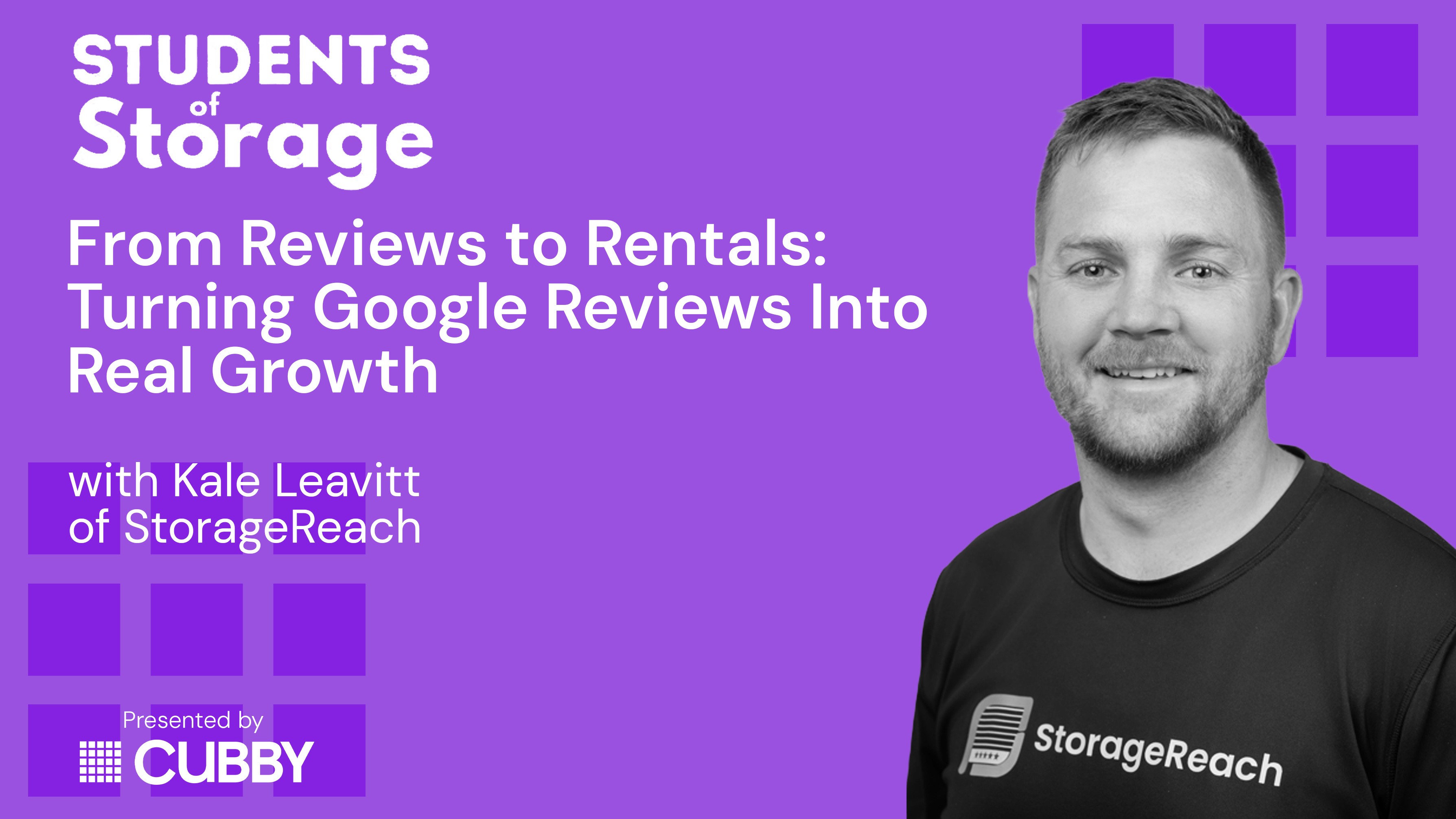
Kale Leavitt, CEO of StorageReach, joins Matt Engfer to break down why Google Reviews have become one of the most powerful—and most misunderstood—drivers of growth in self-storage.
Drawing on nearly a decade of experience in storage marketing, Kale explains how reviews impact far more than reputation. From organic rankings and paid search performance to leasing velocity and customer trust, reviews now touch every part of the renter’s decision-making process. He shares what he learned while helping grow SEO services from zero to nearly 1,500 facilities, and how those lessons led to building StorageReach as a review-first platform designed specifically for self storage.
In this episode, Kale walks through the mechanics behind quality, quantity, and consistency in review generation, why “spikes” hurt more than they help, and how automation allows operators to generate steady reviews without overwhelming tenants. The result is a practical, system-based approach to turning reviews into measurable business performance.
Key Takeaways:
(0:00) Intro
(1:34) Kale's story
(4:16) The beginning and growth of StorageReach
(7:11) Marketing lessons learned from the early days
(9:00) The MVP of StorageReach and getting Google reviews
(11:41) Checking the boxes of getting reviews and seeing results
(14:44) Effective ways to get positive review and avoid negative reviews
(19:56) Working alongside Google
(22:21) What’s next for StorageReach
Transcript
Hey everybody, Matt Engfer here, co-founder and CEO of Cubby. Today on our Students of Storage podcast, we are talking with Kale Levit, the co-founder of Storage Reach. We start with his career story — very cool, very interesting path that he's taken to launching the Storage Reach platform, which has grown like crazy. We've seen it in our customer base and across the industry. Kale, thank you so much for being here.
Yeah, thanks for having me, Matt. I'm really excited for this.
Awesome. So, we're going to get to the nitty-gritty of all things Storage Reach and how operators can think about maximizing the value of the reviews that they can generate for their facilities. But let's start with you, okay? Tell me your story. Where are you from, and tell me the story of your career, like starting from day one.
Yeah.
Yeah, for sure. So, I'm probably like most people in storage — you know, it wasn't an industry I expected to go into. Coming out of high school from a really small town in Nevada, so small we don't even have storage facilities here, which is kind of crazy to think about. But I went to college, my career path was chosen as a firefighter. I was going to join firefighting in Las Vegas. I was on that path. In college, I took a class — I was doing a business admin degree — I took a class as an elective, web design. Loved it.
Kind of switched my major around to get more into marketing and web design. After I graduated college, I actually went to start the process of joining firefighting, and I realized then it wasn't for me. So I took a job with a local company in St. George called Easy Storage Solutions. Some people are probably familiar with — I'm a software provider. It was a very small company when I started. I think I was the seventh employee there.
I was brought on as the vice president of marketing to help them grow their storage portfolio. I was also brought on to help them start a new add-on service for SEO and online marketing. When we started that, there was about 200 clients on Easy Storage — 200 facilities — and we had no clients on our SEO services. So I ended up being with Easy Storage for about 7 years until they sold to Storable.
At that point, we had over 1,500 facilities on our SEO and online marketing services. So, you know, I was really able to learn marketing, learn storage marketing, learn what made a facility work, learn what made it be successful. Fast forward, after Easy Storage sold to Storable, I moved over to the Storable team. I've handled their website, storable.com.
And ended up getting laid off about a year and a half into my time with Storable. The whole marketing team got laid off, and I had always focused on reviews, always talked to operators about reviews, always wanted to make something simpler — make something that was really highly effective and that was also affordable for the storage industry. And that's kind of what led me to Storage Reach.
So, kind of an interesting path. I'm not an operator — I wasn't an operator before starting. I kind of fell into the industry and fell in love with it, and now here I am.
Awesome. And how long ago did you start Storage Reach?
So we started Storage Reach in the summer of 2023. It's been about two and a half years. The whole process — I guess we started building it at the beginning of 2023, started rolling it out. I was talking to you earlier — our first trade show was in 2023. Matt came up to me, and we had a booth. Matt said he was starting Cubby.
That's the first I heard about Cubby. Now, you know, it's everywhere. It's awesome. It's crazy how much you guys have grown, how much we've grown as well.
Awesome. Awesome. And you said "we started it." Who's "we"?
So there's me — I kind of run everything, I'm kind of the CEO. I also have a CTO, more of the developing side. I do a lot of the front-end design, and he does most of the backend work. So I have a CTO named Brandon.
Okay. Awesome. And then since then, today's Storage Reach has additional people helping out with customer success or things like that.
Yeah, we have account managers, we have a marketing operations specialist. We have a few more developers now. So I'm still kind of handling all the sales portions of it. Still haven't outsourced or hired anybody for that. I like to kind of have that personal connection with a lot of our clients.
But we're kind of looking in that direction right now too. So — okay, cool. And how — tell me about the growth. It's been about, you know, three, four years now.
Where is Storage Reach today?
Yeah, so it's been — you know, we've grown really rapidly. Over 100% year-over-year. Right now we're about 1,300 facilities across our platform, and we're adding more and more every day. So it's been crazy. It's been fun. And it's been really awesome seeing how we've made a difference — a lot of facility success.
That is wild. That is absolutely wild.
1,300 facilities in such a short period of time. People just come up — they go to your website and sign up every day.
Yeah.
I mean, they do a lot of it. We still set up a demo to kind of walk through everybody and explain how the system works. There is sign-up on our website. A lot of our marketing right now is also through word of mouth — a lot of clients recommending us. We get a lot of clients that way. So they come on, sign up for a demo, and kind of get that personal connection by meeting with them, and go from there.
Cool. I don't know if you should hire any salespeople, because it sounds like I was the sales guy.
Yeah, I — yeah, that's, you know, it's — I go back and forth all the time.
Cool. Cool. So, you know, let's — before we get to Storage Reach and dive into what you're doing today — what did you learn in the first phase of your career that stuck with you from a marketing perspective for storage? What stayed with you that kind of informed what you're doing today?
Yeah.
So, when I was doing SEO and online marketing for a lot of clients, we would track organic ranking, we'd track conversion rates, we'd do PPC as well. And we'd always get to a point where everything was performing pretty successfully, but we weren't quite where we wanted to be. What kind of stuck with me, and really what paved the way for where we're at today, was just how big of an impact those reviews had on facilities.
We would tell people — and this was in the days, you know, Google Business pages were becoming very, very important, and now today they're ten times as important as they were then.
So this is when they first started focusing on them. And we would always work with operators and tell them, "Hey, focus on reviews." And some operators would do a really good job getting two to three a week — and for a lot of facilities, that's all you need is two or three a week. But other operators would do it really well for about one to two weeks and then fall off and get busy doing other things, which is understandable — there's multiple things they have to be doing. But really what stood out to me was how big of an impact those reviews would have on the facilities.
And how big of an impact they had on every other aspect of their marketing, whether that's pay-per-click, organic rankings, or their website. Reviews were touching every single point of that. And I think that's really what stood out to me and paved the way for where we're at now.
Awesome. Okay, so let's dive into it. Tell me about what was the MVP that you came out to market with, and how's it grown since then? I want to talk product for a little bit here.
Yeah.
Yeah, let's do it. So the MVP — really, we built an automated system.
That's the first thing we did — an automated outreach system that not only tracked how it was doing, but also implemented drip campaigns and the right touch points. A lot of the times people would sign up for review generation tools that weren't necessarily built for storage. They were built for whatever industry that software could work in. With storage, it's a little different there. We don't just have that one interaction and then hope they come back in three weeks or six months or whatever.
You're interacting with somebody every day. They're trusting you with their belongings every day. And so we wanted to build a system that really converted those people as well as people that are just starting out with you. So the first thing we did, we built the automated system — we integrated with the software providers so we could send out review requests at the right touch points, and not only right after a move-in, but also wanting to hit those current tenants.
And with Google, one of the things Google likes to see is they want to see a few things with their reviews — quality, quantity, and consistency.
And what we found is it was more powerful to get one or two or three reviews a week than sending out a review request to all 300 tenants at once, getting 20 reviews in a day and then not getting anything the next few weeks. So what we did, we built the systems in place to automate that and send out those review requests at the right touch points, and also do things to capture feedback — we don't want to send a review request to somebody who's going to have a negative experience. We want a way to capture that as well.
So we give them tools to make sure that person has the opportunity to give private feedback — more of a survey tool. We can't block negative feedback from going online and leaving a negative review, but we can give them the option to leave private feedback. So what we did, we built the system to automate it, built a drip system in place.
Then we built tools for the tenant to send negative feedback privately instead of leaving something negative publicly. That was kind of that MVP — that's what we first rolled out with. After that, we started working on dashboards, more reporting, more tools and things.
Okay.
Awesome. Awesome. And double-click for me on what you've learned about the reviews. You said quality, consistency, and recency or something like that. How are your operators ensuring that they're checking the boxes, and what's the impact on some of the other things they're seeing in their marketing, whether it's SEO or digital or PPC, things like that?
Yeah.
So what we've found with that — quality, quantity, and consistency — it raises you in so many different ways. So in order to make sure you're hitting that, make sure you have systems in place.
Make sure you're not just focusing on reviews one day out of the month, not focusing on reviews for a few days. So making sure you have consistency in place. And then also, what we found is how that has been impactful — I have a few stats I'll share with you really quickly. So facilities with 50-plus reviews and a four-and-a-half star rating tend to fill units 30% faster.
Just by creating that trustworthiness that reviews do. And that's what reviews do — they build trust. 80% of people are looking at reviews before renting from a facility. About 70% of those people actually trust those online reviews more than recommendations from family and friends.
They trust them more than — and I thought that was a crazy stat, but in my day-to-day life, I've seen multiple times where someone's recommended something to me, I looked at reviews, they're like three and a half stars, and you're like, "What are these people talking about, that's crazy, I'm not doing that." So with that being said, reviews
build trust, they build a lot of word-of-mouth marketing, and back in the day that was kind of the most impactful marketing technique — word of mouth. Reviews have really taken over that and have become that digital word of mouth, that first interaction people have. So I hope — I'm not sure if I answered your question completely.
That's really good. That's really good.
So, okay. That's a pretty dramatic impact on leasing velocity that you're talking about. It makes sense to me — before Cubby, I found in the industry as a renter that reviews were like the most important thing that I looked at. Mileage engine. So, okay, cool.
So you talked about kind of budgeting out your tenant base so that you can target a couple at a time, so that you have a consistent stream of reviews coming in, as opposed to just shotgunning on the first of the month or the 15th of the month or whatever it might be.
Yeah.
How do you do that?
Yeah.
Yeah. And are there people that you're trying to avoid? What are the nuances that people at home, if they're trying to do this on their own, should think about?
Yeah.
Yeah. So what our system does — for example, with our integration, we're able to pull different data from the tenant to see how likely they are to have a good interaction. So if they've been with you for a while, if they're making their payments on time all the time, they've never really had any issues, we use our tools to find those people. And we choose — it depends on the facility size. We try to make sure we're getting through all of your tenants within six months.
If we get through them quicker than that, we also don't want to get through them too quickly, because if it's a smaller facility, we don't want to get through them all in two months and then start over, because then we're hitting them more often than we'd like. So what our system does, it usually chooses between five to ten random current tenants a week. Once they're selected, off of that list to send that review request out to — then they're taken off the list, not to be selected again until we're through the whole customer base. That way they're not hit too often.
They're not getting bugged. They don't want to get a review request once a week. And then our system, when choosing that, is also looking at their statuses in your database to make sure they're not in a late payment status, auction status — that they haven't left a review in the past. We're also checking that, and making sure they are someone we believe is going to have — we use AI tools to analyze a few different things to say, all right, we think these people are going to have a good experience.
We're going to send that review request out, and then we're going to put them into like a drip system.
They're put into tools that are more likely to convert that review. But yeah, we choose those five to ten random per week. And what about how you're reaching these people — email, phone, text? What are the channels? What have you learned about what's effective and what should be leveraged?
Yeah.
Yeah. In the beginning, when we first started, we were doing both avenues, text and email. People were getting frustrated because we were sending two text messages out — or, I mean, we were sending an email and a text out on a move-in, for example, and then we were also doing the drip campaign. So if they didn't interact with that message, we were sending another email and another text, and then another email and another text. Usually we did three follow-ups, or two follow-ups after the initial. So that's six touch points. People were getting frustrated.
We were looking at it like, all right, text messages are converting so much higher than our emails were — let's just drop that. So we dropped email. We're strictly text messages. We're also pulling data from the integration to make sure that they are opted into messaging, that we're compliant on that end. And so we strictly send text messages, and that's been our most successful avenue, and that's what we focus on.
Okay, cool. That makes sense. What have you learned about the actual contents of these messages? I'm sure you've learned what works and what doesn't — language, things like that. Any tips there?
Yeah, for sure. So a few things that we do — we've done a lot of different testing. We also give the operator an opportunity to add the text how they want it, and they can run tests on their own. We try to really play off the emotional state of it — like, "If you give us some feedback, it really helps our business."
You give us — it helps us to improve, to make sure we are taking care of you the most effectively. So we try to play on the emotional side of things. That's been the most successful for us.
We also have different tools in place. For example, with Google reviews, you're not supposed to incentivize for a Google review, right? You're not supposed to say, "We'll give you $10 off next month for a positive review." You're not supposed to do that — it's against Google's policy. We do see people doing that. We're not here to police that, but we do see people doing that.
What we've also found to be effective is — maybe you've been to a Home Depot or a Panda Express where at the bottom of their receipt they say, "Take this survey, you're entered to win $500" or something like that. We have tools in place like that as well, where they're taking an internal survey.
We make sure we state that this survey — or leaving an online review — is not required for entering the giveaway. We just simply want to get your experience. They give their experience, we then say, "This is awesome, we're grateful for this feedback."
Also, if you're willing to leave a Google review — it's not required, but it greatly helps our business. That makes a big impact as well. So different tools to try to get them to start the process, whether that's playing off the emotions, or that gift card survey feedback. We want them to start the process. If they start the process, they're a lot more likely to leave that Google review than if they never started it. So that's some of the things that we've implemented.
Cool. Okay. Awesome. You've got 1,400 facilities sending messages to tenants every single day.
Every single day, constantly iterating on this stuff.
I don't want to imagine what your Twilio bill is like, but it's an interesting thing.
Yeah. Talk to me — you're building a lot of this on top of Google, basically.
So you are an expert in developing alongside Google. How frequently are you having to tweak what you guys do in order to make sure you're up to speed with the latest version of Google, if they ship changes or make a change?
Yeah, Google's actually very good — because, I mean, we haven't talked about the dashboard as well. We have a dashboard in place that integrates with your Google Business page, allows you to edit your fields in your Google Business page, uses AI responses and stuff to respond to reviews, manage that. So we have that in place as well. So we're connected to Google in a few different ways. But Google's actually really good about making sure everything flows pretty smoothly. They do a really good job on that. So we're making updates to our tools probably on the Google connection side, probably once or once every other month, kind of thing.
On that side of things, our messaging is a lot different. We're making updates to that constantly.
There's always things changing, I'm sure — 10DLC, different compliances, throughput rates, things like that. We're tinkering with that all the time. And so that's where a lot of our focus is — making sure that we are getting those messages delivered, because that's a big thing — we're not going to get reviews if those messages aren't being delivered. So that's one of our biggest focuses, making sure that we're compliant on everything.
We're making those deliveries, and we're giving them the opportunity to get reviews — because the uninitiated might think, "Hey, it just works," but actually, you know, it takes a lot of work to make sure that it "just works," quote unquote.
Yeah.
Yeah. Exactly. So it's — yeah, it's really interesting stuff. I'm not sure everyone wants to hear about all the different API and rate fees and everything, but it's interesting. No, it's — I mean, it just goes to show you what your vendors in this space are doing. As an operator, it's helpful to know that Kale's out there staying on top of this stuff with his team. So you might not feel the effects of it day to day, but it does take some work.
That's good to know. Okay, cool. What about where are you headed next? Looking out, are you just going to continue to knock down more facilities, grow your business, and where do you want to take this?
Yeah, our goal is — right now we want to focus on storage. We're redesigning our dashboard, adding more tools, adding more features for the operator to be as successful as they can. Our goal is to nail storage. We're only focused on storage. We're only focused on making it the best product for storage. So that's the nice thing too about a lot of our clients — they're working with us trying to think of what's going to be the most effective tool. We're looking at building in a referral system.
We're looking at building in other different marketing efforts that we can work into this system for storage. Eventually, we do want to move into other industries, but we want to do that after we nail storage and feel like we've made a product best for the operator that we can.
Awesome.
Well, congratulations again. I think it's incredible — we're getting pinged every day, or every week at least, from one of your clients asking for some sort of integration. Which has been super easy to get set up with y'all. So congratulations again on the growth, and excited to see you at the next trade show for sure.
Yeah.
Yeah. Congratulations to you as well. You guys have been growing like crazy. Love hearing all the success you guys have had, and when I saw this podcast, I was like, "I love Cubby, I got to try to get on that." They're awesome.
Awesome. Thank you very much, Kale. Have a very good one.
Yeah, you too. Thanks, Matt.
Kale Leavitt, CEO of StorageReach, joins Matt Engfer to break down why Google Reviews have become one of the most powerful—and most misunderstood—drivers of growth in self-storage.
Drawing on nearly a decade of experience in storage marketing, Kale explains how reviews impact far more than reputation. From organic rankings and paid search performance to leasing velocity and customer trust, reviews now touch every part of the renter’s decision-making process. He shares what he learned while helping grow SEO services from zero to nearly 1,500 facilities, and how those lessons led to building StorageReach as a review-first platform designed specifically for self storage.
In this episode, Kale walks through the mechanics behind quality, quantity, and consistency in review generation, why “spikes” hurt more than they help, and how automation allows operators to generate steady reviews without overwhelming tenants. The result is a practical, system-based approach to turning reviews into measurable business performance.
Key Takeaways:
(0:00) Intro
(1:34) Kale's story
(4:16) The beginning and growth of StorageReach
(7:11) Marketing lessons learned from the early days
(9:00) The MVP of StorageReach and getting Google reviews
(11:41) Checking the boxes of getting reviews and seeing results
(14:44) Effective ways to get positive review and avoid negative reviews
(19:56) Working alongside Google
(22:21) What’s next for StorageReach
Transcript
Hey everybody, Matt Engfer here, co-founder and CEO of Cubby. Today on our Students of Storage podcast, we are talking with Kale Levit, the co-founder of Storage Reach. We start with his career story — very cool, very interesting path that he's taken to launching the Storage Reach platform, which has grown like crazy. We've seen it in our customer base and across the industry. Kale, thank you so much for being here.
Yeah, thanks for having me, Matt. I'm really excited for this.
Awesome. So, we're going to get to the nitty-gritty of all things Storage Reach and how operators can think about maximizing the value of the reviews that they can generate for their facilities. But let's start with you, okay? Tell me your story. Where are you from, and tell me the story of your career, like starting from day one.
Yeah.
Yeah, for sure. So, I'm probably like most people in storage — you know, it wasn't an industry I expected to go into. Coming out of high school from a really small town in Nevada, so small we don't even have storage facilities here, which is kind of crazy to think about. But I went to college, my career path was chosen as a firefighter. I was going to join firefighting in Las Vegas. I was on that path. In college, I took a class — I was doing a business admin degree — I took a class as an elective, web design. Loved it.
Kind of switched my major around to get more into marketing and web design. After I graduated college, I actually went to start the process of joining firefighting, and I realized then it wasn't for me. So I took a job with a local company in St. George called Easy Storage Solutions. Some people are probably familiar with — I'm a software provider. It was a very small company when I started. I think I was the seventh employee there.
I was brought on as the vice president of marketing to help them grow their storage portfolio. I was also brought on to help them start a new add-on service for SEO and online marketing. When we started that, there was about 200 clients on Easy Storage — 200 facilities — and we had no clients on our SEO services. So I ended up being with Easy Storage for about 7 years until they sold to Storable.
At that point, we had over 1,500 facilities on our SEO and online marketing services. So, you know, I was really able to learn marketing, learn storage marketing, learn what made a facility work, learn what made it be successful. Fast forward, after Easy Storage sold to Storable, I moved over to the Storable team. I've handled their website, storable.com.
And ended up getting laid off about a year and a half into my time with Storable. The whole marketing team got laid off, and I had always focused on reviews, always talked to operators about reviews, always wanted to make something simpler — make something that was really highly effective and that was also affordable for the storage industry. And that's kind of what led me to Storage Reach.
So, kind of an interesting path. I'm not an operator — I wasn't an operator before starting. I kind of fell into the industry and fell in love with it, and now here I am.
Awesome. And how long ago did you start Storage Reach?
So we started Storage Reach in the summer of 2023. It's been about two and a half years. The whole process — I guess we started building it at the beginning of 2023, started rolling it out. I was talking to you earlier — our first trade show was in 2023. Matt came up to me, and we had a booth. Matt said he was starting Cubby.
That's the first I heard about Cubby. Now, you know, it's everywhere. It's awesome. It's crazy how much you guys have grown, how much we've grown as well.
Awesome. Awesome. And you said "we started it." Who's "we"?
So there's me — I kind of run everything, I'm kind of the CEO. I also have a CTO, more of the developing side. I do a lot of the front-end design, and he does most of the backend work. So I have a CTO named Brandon.
Okay. Awesome. And then since then, today's Storage Reach has additional people helping out with customer success or things like that.
Yeah, we have account managers, we have a marketing operations specialist. We have a few more developers now. So I'm still kind of handling all the sales portions of it. Still haven't outsourced or hired anybody for that. I like to kind of have that personal connection with a lot of our clients.
But we're kind of looking in that direction right now too. So — okay, cool. And how — tell me about the growth. It's been about, you know, three, four years now.
Where is Storage Reach today?
Yeah, so it's been — you know, we've grown really rapidly. Over 100% year-over-year. Right now we're about 1,300 facilities across our platform, and we're adding more and more every day. So it's been crazy. It's been fun. And it's been really awesome seeing how we've made a difference — a lot of facility success.
That is wild. That is absolutely wild.
1,300 facilities in such a short period of time. People just come up — they go to your website and sign up every day.
Yeah.
I mean, they do a lot of it. We still set up a demo to kind of walk through everybody and explain how the system works. There is sign-up on our website. A lot of our marketing right now is also through word of mouth — a lot of clients recommending us. We get a lot of clients that way. So they come on, sign up for a demo, and kind of get that personal connection by meeting with them, and go from there.
Cool. I don't know if you should hire any salespeople, because it sounds like I was the sales guy.
Yeah, I — yeah, that's, you know, it's — I go back and forth all the time.
Cool. Cool. So, you know, let's — before we get to Storage Reach and dive into what you're doing today — what did you learn in the first phase of your career that stuck with you from a marketing perspective for storage? What stayed with you that kind of informed what you're doing today?
Yeah.
So, when I was doing SEO and online marketing for a lot of clients, we would track organic ranking, we'd track conversion rates, we'd do PPC as well. And we'd always get to a point where everything was performing pretty successfully, but we weren't quite where we wanted to be. What kind of stuck with me, and really what paved the way for where we're at today, was just how big of an impact those reviews had on facilities.
We would tell people — and this was in the days, you know, Google Business pages were becoming very, very important, and now today they're ten times as important as they were then.
So this is when they first started focusing on them. And we would always work with operators and tell them, "Hey, focus on reviews." And some operators would do a really good job getting two to three a week — and for a lot of facilities, that's all you need is two or three a week. But other operators would do it really well for about one to two weeks and then fall off and get busy doing other things, which is understandable — there's multiple things they have to be doing. But really what stood out to me was how big of an impact those reviews would have on the facilities.
And how big of an impact they had on every other aspect of their marketing, whether that's pay-per-click, organic rankings, or their website. Reviews were touching every single point of that. And I think that's really what stood out to me and paved the way for where we're at now.
Awesome. Okay, so let's dive into it. Tell me about what was the MVP that you came out to market with, and how's it grown since then? I want to talk product for a little bit here.
Yeah.
Yeah, let's do it. So the MVP — really, we built an automated system.
That's the first thing we did — an automated outreach system that not only tracked how it was doing, but also implemented drip campaigns and the right touch points. A lot of the times people would sign up for review generation tools that weren't necessarily built for storage. They were built for whatever industry that software could work in. With storage, it's a little different there. We don't just have that one interaction and then hope they come back in three weeks or six months or whatever.
You're interacting with somebody every day. They're trusting you with their belongings every day. And so we wanted to build a system that really converted those people as well as people that are just starting out with you. So the first thing we did, we built the automated system — we integrated with the software providers so we could send out review requests at the right touch points, and not only right after a move-in, but also wanting to hit those current tenants.
And with Google, one of the things Google likes to see is they want to see a few things with their reviews — quality, quantity, and consistency.
And what we found is it was more powerful to get one or two or three reviews a week than sending out a review request to all 300 tenants at once, getting 20 reviews in a day and then not getting anything the next few weeks. So what we did, we built the systems in place to automate that and send out those review requests at the right touch points, and also do things to capture feedback — we don't want to send a review request to somebody who's going to have a negative experience. We want a way to capture that as well.
So we give them tools to make sure that person has the opportunity to give private feedback — more of a survey tool. We can't block negative feedback from going online and leaving a negative review, but we can give them the option to leave private feedback. So what we did, we built the system to automate it, built a drip system in place.
Then we built tools for the tenant to send negative feedback privately instead of leaving something negative publicly. That was kind of that MVP — that's what we first rolled out with. After that, we started working on dashboards, more reporting, more tools and things.
Okay.
Awesome. Awesome. And double-click for me on what you've learned about the reviews. You said quality, consistency, and recency or something like that. How are your operators ensuring that they're checking the boxes, and what's the impact on some of the other things they're seeing in their marketing, whether it's SEO or digital or PPC, things like that?
Yeah.
So what we've found with that — quality, quantity, and consistency — it raises you in so many different ways. So in order to make sure you're hitting that, make sure you have systems in place.
Make sure you're not just focusing on reviews one day out of the month, not focusing on reviews for a few days. So making sure you have consistency in place. And then also, what we found is how that has been impactful — I have a few stats I'll share with you really quickly. So facilities with 50-plus reviews and a four-and-a-half star rating tend to fill units 30% faster.
Just by creating that trustworthiness that reviews do. And that's what reviews do — they build trust. 80% of people are looking at reviews before renting from a facility. About 70% of those people actually trust those online reviews more than recommendations from family and friends.
They trust them more than — and I thought that was a crazy stat, but in my day-to-day life, I've seen multiple times where someone's recommended something to me, I looked at reviews, they're like three and a half stars, and you're like, "What are these people talking about, that's crazy, I'm not doing that." So with that being said, reviews
build trust, they build a lot of word-of-mouth marketing, and back in the day that was kind of the most impactful marketing technique — word of mouth. Reviews have really taken over that and have become that digital word of mouth, that first interaction people have. So I hope — I'm not sure if I answered your question completely.
That's really good. That's really good.
So, okay. That's a pretty dramatic impact on leasing velocity that you're talking about. It makes sense to me — before Cubby, I found in the industry as a renter that reviews were like the most important thing that I looked at. Mileage engine. So, okay, cool.
So you talked about kind of budgeting out your tenant base so that you can target a couple at a time, so that you have a consistent stream of reviews coming in, as opposed to just shotgunning on the first of the month or the 15th of the month or whatever it might be.
Yeah.
How do you do that?
Yeah.
Yeah. And are there people that you're trying to avoid? What are the nuances that people at home, if they're trying to do this on their own, should think about?
Yeah.
Yeah. So what our system does — for example, with our integration, we're able to pull different data from the tenant to see how likely they are to have a good interaction. So if they've been with you for a while, if they're making their payments on time all the time, they've never really had any issues, we use our tools to find those people. And we choose — it depends on the facility size. We try to make sure we're getting through all of your tenants within six months.
If we get through them quicker than that, we also don't want to get through them too quickly, because if it's a smaller facility, we don't want to get through them all in two months and then start over, because then we're hitting them more often than we'd like. So what our system does, it usually chooses between five to ten random current tenants a week. Once they're selected, off of that list to send that review request out to — then they're taken off the list, not to be selected again until we're through the whole customer base. That way they're not hit too often.
They're not getting bugged. They don't want to get a review request once a week. And then our system, when choosing that, is also looking at their statuses in your database to make sure they're not in a late payment status, auction status — that they haven't left a review in the past. We're also checking that, and making sure they are someone we believe is going to have — we use AI tools to analyze a few different things to say, all right, we think these people are going to have a good experience.
We're going to send that review request out, and then we're going to put them into like a drip system.
They're put into tools that are more likely to convert that review. But yeah, we choose those five to ten random per week. And what about how you're reaching these people — email, phone, text? What are the channels? What have you learned about what's effective and what should be leveraged?
Yeah.
Yeah. In the beginning, when we first started, we were doing both avenues, text and email. People were getting frustrated because we were sending two text messages out — or, I mean, we were sending an email and a text out on a move-in, for example, and then we were also doing the drip campaign. So if they didn't interact with that message, we were sending another email and another text, and then another email and another text. Usually we did three follow-ups, or two follow-ups after the initial. So that's six touch points. People were getting frustrated.
We were looking at it like, all right, text messages are converting so much higher than our emails were — let's just drop that. So we dropped email. We're strictly text messages. We're also pulling data from the integration to make sure that they are opted into messaging, that we're compliant on that end. And so we strictly send text messages, and that's been our most successful avenue, and that's what we focus on.
Okay, cool. That makes sense. What have you learned about the actual contents of these messages? I'm sure you've learned what works and what doesn't — language, things like that. Any tips there?
Yeah, for sure. So a few things that we do — we've done a lot of different testing. We also give the operator an opportunity to add the text how they want it, and they can run tests on their own. We try to really play off the emotional state of it — like, "If you give us some feedback, it really helps our business."
You give us — it helps us to improve, to make sure we are taking care of you the most effectively. So we try to play on the emotional side of things. That's been the most successful for us.
We also have different tools in place. For example, with Google reviews, you're not supposed to incentivize for a Google review, right? You're not supposed to say, "We'll give you $10 off next month for a positive review." You're not supposed to do that — it's against Google's policy. We do see people doing that. We're not here to police that, but we do see people doing that.
What we've also found to be effective is — maybe you've been to a Home Depot or a Panda Express where at the bottom of their receipt they say, "Take this survey, you're entered to win $500" or something like that. We have tools in place like that as well, where they're taking an internal survey.
We make sure we state that this survey — or leaving an online review — is not required for entering the giveaway. We just simply want to get your experience. They give their experience, we then say, "This is awesome, we're grateful for this feedback."
Also, if you're willing to leave a Google review — it's not required, but it greatly helps our business. That makes a big impact as well. So different tools to try to get them to start the process, whether that's playing off the emotions, or that gift card survey feedback. We want them to start the process. If they start the process, they're a lot more likely to leave that Google review than if they never started it. So that's some of the things that we've implemented.
Cool. Okay. Awesome. You've got 1,400 facilities sending messages to tenants every single day.
Every single day, constantly iterating on this stuff.
I don't want to imagine what your Twilio bill is like, but it's an interesting thing.
Yeah. Talk to me — you're building a lot of this on top of Google, basically.
So you are an expert in developing alongside Google. How frequently are you having to tweak what you guys do in order to make sure you're up to speed with the latest version of Google, if they ship changes or make a change?
Yeah, Google's actually very good — because, I mean, we haven't talked about the dashboard as well. We have a dashboard in place that integrates with your Google Business page, allows you to edit your fields in your Google Business page, uses AI responses and stuff to respond to reviews, manage that. So we have that in place as well. So we're connected to Google in a few different ways. But Google's actually really good about making sure everything flows pretty smoothly. They do a really good job on that. So we're making updates to our tools probably on the Google connection side, probably once or once every other month, kind of thing.
On that side of things, our messaging is a lot different. We're making updates to that constantly.
There's always things changing, I'm sure — 10DLC, different compliances, throughput rates, things like that. We're tinkering with that all the time. And so that's where a lot of our focus is — making sure that we are getting those messages delivered, because that's a big thing — we're not going to get reviews if those messages aren't being delivered. So that's one of our biggest focuses, making sure that we're compliant on everything.
We're making those deliveries, and we're giving them the opportunity to get reviews — because the uninitiated might think, "Hey, it just works," but actually, you know, it takes a lot of work to make sure that it "just works," quote unquote.
Yeah.
Yeah. Exactly. So it's — yeah, it's really interesting stuff. I'm not sure everyone wants to hear about all the different API and rate fees and everything, but it's interesting. No, it's — I mean, it just goes to show you what your vendors in this space are doing. As an operator, it's helpful to know that Kale's out there staying on top of this stuff with his team. So you might not feel the effects of it day to day, but it does take some work.
That's good to know. Okay, cool. What about where are you headed next? Looking out, are you just going to continue to knock down more facilities, grow your business, and where do you want to take this?
Yeah, our goal is — right now we want to focus on storage. We're redesigning our dashboard, adding more tools, adding more features for the operator to be as successful as they can. Our goal is to nail storage. We're only focused on storage. We're only focused on making it the best product for storage. So that's the nice thing too about a lot of our clients — they're working with us trying to think of what's going to be the most effective tool. We're looking at building in a referral system.
We're looking at building in other different marketing efforts that we can work into this system for storage. Eventually, we do want to move into other industries, but we want to do that after we nail storage and feel like we've made a product best for the operator that we can.
Awesome.
Well, congratulations again. I think it's incredible — we're getting pinged every day, or every week at least, from one of your clients asking for some sort of integration. Which has been super easy to get set up with y'all. So congratulations again on the growth, and excited to see you at the next trade show for sure.
Yeah.
Yeah. Congratulations to you as well. You guys have been growing like crazy. Love hearing all the success you guys have had, and when I saw this podcast, I was like, "I love Cubby, I got to try to get on that." They're awesome.
Awesome. Thank you very much, Kale. Have a very good one.
Yeah, you too. Thanks, Matt.
Latest

Content
From Oil Prices to Storage Units: Building a Business You Control with Karl Graham of Luminus Capital
Cubby Team
・
Read More

Content
The Real Legal Risks for Self-Storage Operators with Jeff Greenberger of Late2Lien
Cubby Team
・
Read More

Content
Execution Wins: Scaling Up By Mastering the Basics with Magen Smith of Atomic Storage Group
Cubby Team
・
Read More