
Back
Back
Content
How Customer Empathy Led to an Industry-Leading Conversion Rate with Jonas Duckett of Store It Quick
How Customer Empathy Led to an Industry-Leading Conversion Rate with Jonas Duckett of Store It Quick
Cubby Team
・
Share:



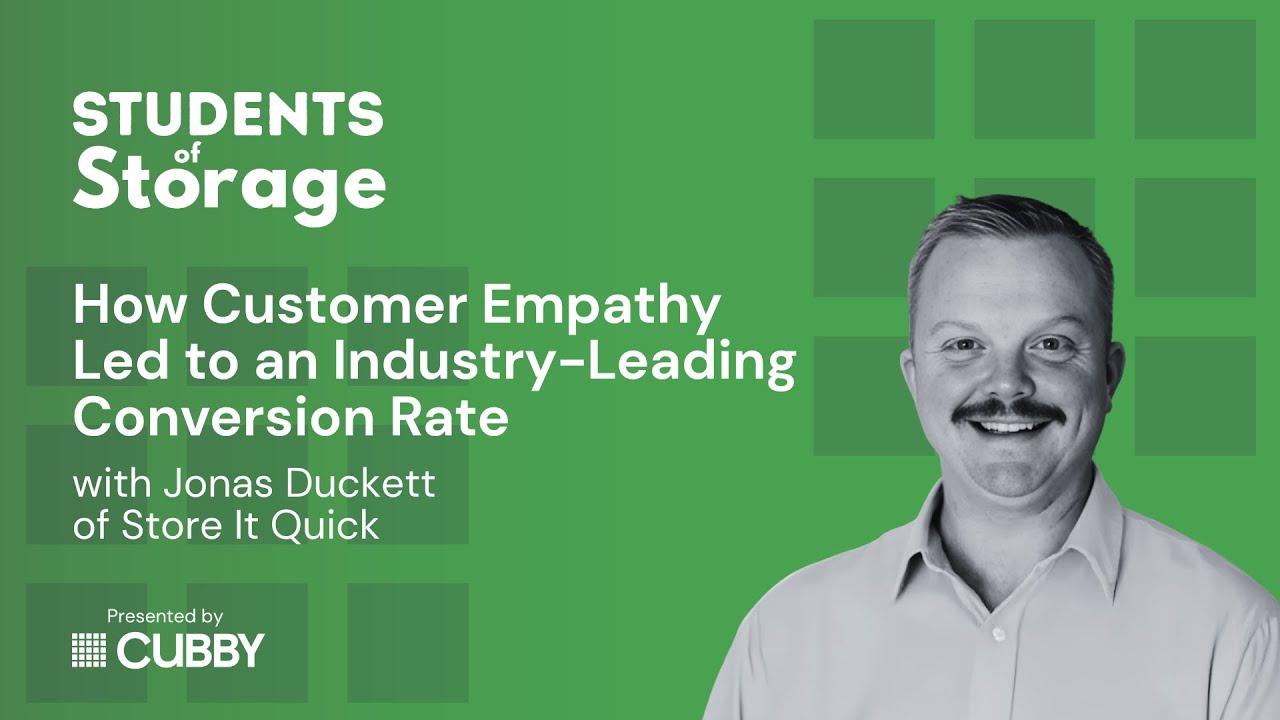
Jonas Duckett, Real Estate Investor of Store It Quick, joins us to share his evolution from solo operator to leading a 40-facility portfolio. With 4,000 units and counting, Jonas reflects on building a people-first storage brand, rebranding under a unified name, and how he drives conversions and minimizes delinquency with high-touch customer service. Jonas offers candid insights on lead conversion, rebrand timing, customer retention, and the importance of empathetic communication in collections. We also unpack how he blends automation with personal follow-up to keep operations lean without sacrificing performance.
Key Takeaways:
(00:53) Turning personal motivation into a scalable business model.
(05:06) Why it's important to unify facility branding early in the growth journey.
(09:51) Simplifying the rental process to improve online conversion rates.
(13:04) Establishing systems that enable high conversion with a lean team.
(18:41) Using a human-centered approach to reduce customer delinquency.
(22:36) Retaining paying customers through flexibility and empathy.
(26:27) The business case for pricing transparency over short-term tactics.
(29:07) Aligning rate increases with demand and customer satisfaction.
(32:59) Knowing when to shift focus from operations back to growth.
Transcript
Hey everyone, welcome back to another episode of the Students of Storage podcast. My name is Michael Brevdeh. I'm with the Cubby team. I'm joined by my co-host Tully Hanan and very special guest Jonas Ducket joining us today.
How are you, Jonas? Good, how are you all doing? Well, thanks for making the time, we really appreciate it. Oh, absolutely, I love to talk storage. Yeah, absolutely. We have a pretty action-packed agenda today just to talk about some topics that you do really well as a business owner, but want to set the tone for the listeners.
Can you just give us a quick overview, elevator pitch, on you, your business, how you got into storage, all that fun stuff? Sure. So I got into storage about five years ago — had, started with just a single location in my hometown. Talked to an owner multiple times.
Finally, he agreed to sell it. And then it just kind of took off from there. My motivation at the time — my son had just gotten diagnosed with autism, and I was trying to figure out a way to have what they call "mailbox money," right, because autism is expensive.
So it just kind of snowballed, took off, and anytime I was out of town, or in my hometown driving around, I would stop, talk to owners, stay in contact with them, and it just kind of grew, grew, grew, grew, grew — to today, we have 40 locations. I was at first on Easy Storage Solutions.
It's an okay software if you have just a couple locations, but I was constantly looking for a different software that checked several boxes. One was affordability. Two was feeling like I was part of a team —
like whoever I wanted to do business with, I wanted it to feel like a team thing, not just, you know, an automated AI call-center type situation.
So I constantly searched, demoed I think every software there was.
Finally landed with Cubby, and probably one of the best decisions I've ever made, for many of the things we'll talk about here today. But that's basically the gist in a nutshell. I could talk about that all day, but that's kind of what got me into storage up until this point.
Yeah. Well, thanks for the kind words. Certainly interesting to call Cubby one of the best decisions you've ever made, but I appreciate the thought there. What's your business like — brand name, how many units are you up to, where's the portfolio concentrated? Sure.
We're Historic Quick Storage. As I was growing, I was buying storage businesses that were already named — I didn't really know how to mitigate that, so I just kept the name normally, or I'd call it like City Name at State — like Cape Girardeau Storage, Cape Girardeau Missouri Storage — and that was good for several reasons, but within the last six months or so I
rebranded it to All Store Quick. Our customers now know us by that,
our website's branded by that. That's been a really hard thing to do, going online and making sure all your listings are changed — there's just a lot more that people don't see. I'd recommend anyone who has to do that, hire someone, pay them — it's one of those things you really can't do on your own. I learned that the hard way, but Exponential Growth, a team, helped me with that. They now handle all my SEO.
But yeah, we got about 4,000 units, give or take, somewhere in that ballpark, and we're constantly growing. We have slowed down with our growth — this year I kind of just wanted to focus on growing occupancy, growing revenue, because a lot of these facilities I purchased were huge value-adds — mom-and-pops that wouldn't answer the phone, that didn't care if they rented a unit or not. These were ones that weren't found online.
So I might buy a 300-unit facility and only 30 or 50 units might be rented, and of those 30 or 50 units, 10 were paying. So I started some of these facilities at 5% occupancy. So I really focused this year, with Exponential Growth, on, hey, let's get more rentals, let's do better at operating these facilities.
And then once we hit this threshold, that we're almost there, then I'll go into the next gear and go into growth mode again. But that's the gist for now. That makes a ton of sense, and that's something we run into all the time speaking with forward-thinking, growth-oriented operators like yourself — when do we rebrand the facilities under one umbrella, how do we do it, that sort of thing.
Can you talk a little more in detail about, in a vacuum, when you would recommend someone consider uniting all their stores under one unified brand, and the dos and don'ts and considerations there — is it five locations, is it 15, is it 20, and so on. I think you do it as you go.
So if I had it to do over again, when I had my first location, I would have thought long and hard — what do I want my business to be called? If I know I'm going to grow this, let's start and do it right. Most people don't do that. Most people don't know they're going to end up loving storage and want to keep buying. So I'd say if you have more than two facilities and you're listening, do it now.
If you have 10 or more — what I learned, a little free nugget of information here — is on your Google My Business, if you change it from your old name to a new name, you're going to drop, just like if you change it to something new you could shoot to the sky. You need to really focus on keeping it if you're ranking well. If you're not ranking well, change to whatever you want, doesn't matter, because you're not doing a good job anyway. But if you are ranking well, make sure to just keep it named,
and then just add "buy Store It Quick." Go ahead and change your website, do the same thing — whatever you do on your Google My Business, do the same on the website, just buy your brand. Hilton does it, Marriott does it, it's nothing new. So that's one thing I'd highly recommend — don't just go in there and change it, like I did on a couple of them, and go from the number one spot to now you're not even in the map pack.
And the map pack is where you're going to get all of your business — not all, but about 55%, I believe. Yeah, absolutely. And that's a natural segue as we're talking about SEO and Google ranking and driving more eyeballs and ultimately rentals to your website.
You all do a really nice job, not only generating leads and getting eyeballs to the website, which is talked about a lot in the storage space — SEO, PPC, how do we drive traffic to our website — but a lot of what I talk about with operators is the back half of the swing. Once someone's on the website, how do we turn that person into a paying customer? How do we make sure we're not just losing all these leads we're paying good money and time and effort for?
Could you talk to us a little about your general approach to the website and making sure you're converting leads, because out of 300-plus Cubby customers, you're in the upper echelon of lead conversion. Kudos to you. Share some of the sauce with the audience, if you don't mind. Yeah, absolutely.
So what I did is I do all my own AB website editing with the help of Exponential Growth, but what I try to do is think — and it's very hard to do because my mind's so storage-motivated — get on your website and think that you are a customer. I'm a customer, I'm renting a unit — can I do this quickly? Anything I buy online, I want to do it fast.
I'm probably a little price-conscious, but I might not go check five other websites — I'm in a hurry, I want to buy it, I want it to tell me when I'm going to get it, and that's it, that's what I want to know. So I went and studied the REITs — what do they do? And what I found is I didn't even like theirs — I thought they hit 80% of it.
Like it was awesome, and I changed a lot of my stuff to match theirs. So I got my daughter and my wife, and I'm like, "Hey, rent — act like a renter, tell me what you see." And most of the time we weren't even seeing the same things, but what they were seeing was like, "Oh man, I didn't think about that."
A lot of the REITs and mom-and-pops, absolutely, aren't doing it — explaining how to do it. So on my website I easily explain — at the very top, above the fold, it'll have the name, drone video maybe — if you go to one of the location pages, for most people the main webpage means nothing. No one should be pointing to the main webpage.
If you have 40 facilities, it might be a little better, but the main webpage really doesn't have any ranking. The drone videos are really sick though, and I do recommend them to a lot of groups as well.
Just something different on the website.
Yeah, so have something that's eye-catching, drone video, good pictures. Have it be easy to call you if they want — a lot of people do want to call, they don't want to rent online, but a vast majority do want to just rent online and be done with it. So easily explained there, you'll see "select a unit" with a picture, "make a payment" with a picture, "receive gate codes" with a picture — so they don't even really have to read it necessarily.
They can just look and think, "Oh, I do this and I can immediately move into the storage unit, because I have a U-Haul and I forgot to do it, and it's past 5:00 and now I'm screwed." So you have to have that. And the availability to rent online, you have to have that. So I think that's one of the bigger things I did was just make it simple, so they don't have to call in to the office. Let them know the easy, simple steps —
"I can do this all myself" — and then you'll see your conversions go up. You just will. And a lot of the big players will put miles and miles of data on there, and I know it helps with SEO for organic, but it doesn't do anything for your map pack.
So I don't do that. I think it makes it convoluted, too hard to read through, too busy. I just want mine to be simple, and I want my frequently asked questions not geared toward the Google algorithm, I want it to be actual questions — "if I'm renting a unit, what do I want to know?" And you'll see your conversions go up, you'll see people not having to call into the office as much.
Yeah, long way of answering your question. No, that's super helpful.
And then for folks who slip through the cracks and don't complete the process on their own, how are you — I know you have a really lean team — how are you making sure you're following up on new leads quickly, whether over the phone, abandoned carts, contact-us forms, waitlists, anything like that — how are you making sure you're following up with the folks who need that personal touch?
So I'd be lying to say it's probably because I am the owner and I am very hands-on.
It would work for someone else as long as that person was very hands-on.
But Cubby has a great way of sending me a text message if there's a lead, so I can read it at 7 o'clock at night or 3:00 in the morning. So if we get a lead, I just wait — I basically set a timer on my phone, 10 minutes from now I'm going to check. If that lead hasn't converted, which I'd automatically know because Cubby's going to text me and tell me — if that didn't happen, I'm texting. Or maybe I'm at the office and I'm like, "Hey, we got to call this person, check in, what's going on?"
What I've noticed is if you can do that within about the first 30 minutes, you're going to convert. If you wait to the next day, you may still convert, but it's not as likely. Most of the time it was an error that happened —
not an error on Cubby's site, it was, "Oh, I went to rent the unit but I forgot, I didn't have my wallet," or "forgot this or that."
So we'll go ahead — "Hey, that's no problem, let's go ahead and rent your unit though, let's get your unit rented, call us back today, tomorrow, whatever, make that payment, no big deal." And we just make a note — "call them tomorrow." We're in Cubby now,
you can do tasks. So that's immediately what we do — set a task, call them back tomorrow at 9am. If they haven't made a payment — I don't know what my percentage is, Richard was telling me earlier, I really don't know how to look at that yet — but yeah, what you'll find is you'll convert a lot of those leads if you're just proactive about it. There's really no secret, it's just being on top of it.
I mean — shout out Richard for getting us these awesome stats — but I can tell you exactly what your lead conversion rate is. Lead conversion is something that gets, I think, misconstrued a lot of times, in terms of what does lead conversion mean and what does the percentage actually mean? For some it's just converting a website visitor into a lead, or someone who left their info,
but when it comes to Cubby, and the truest form of lead conversion, is: I had 100 interested renters, potential renters, how many turned into paying customers? So for you all at Store It Quick, your lead conversion ratio is 71%.
So that means seven to ten folks who were interested in a unit through whatever channel are converting into a paying customer. That's huge. To some degree, folks say you can only capture existing demand versus create new demand — so how can we get that conversion number as high as possible? I think that's really important.
And to your point, having the processes in place — even if it's just Jonas Ducket being Superman — but for folks with more corporate outfits, how are you judging your site managers or call center agents on lead follow-up time and lead conversion rate? You can't improve what's not measured, and you can't improve what there's no process for.
So putting those processes in place is definitely beneficial, and candidly separates the operators I see doing really well versus those who say occupancy is lagging. It's like, well, are you answering the phone?
Are you following up on online leads?
How quickly are you following up?
That's it. So I also think that if someone's on the website, they'll see maybe there's a discount, but if a customer is just clicking the Google My Business and calling and not even going on the website, they won't really sell the discount, in my opinion. You're not going to catch as many, because people are always... I mean, think of anything online — what do you want? You want what you want, and you want a deal on it, and you want it fast.
That's how Amazon became the business it is today — those three simple things. So why not, if someone's calling in, pitch them on what it costs today?
"How much is a 10x20?" Everyone gets that call ten times a day. Instead of saying, "That's 100 bucks a month, that's it," say, "Well, actually this month we've got a heck of a special — two months you're going to get this unit for 25 bucks."
It's a 75% discount — don't mention the hundred, that is not in your vocabulary. You're a salesman. Tell them what it's going to cost for those two months — "We're doing this for you, it's all about you." You've got to train your partners to reprogram how they think — you need to sell them, and be very good salesmen, otherwise they're just going to call someone else.
And if you feel they're about to get off the phone, say, "Hey, I know" — most of them are getting off the phone because they're price shopping.
No matter what they tell you, they're about to call someone else. Say, "Hey, I'm just letting you know too, I price shop this every day with our amazing Cubby software — it tells me what all my competitors are, every single day." That's something I check every day. And I don't try to always be the cheapest, but I do want to be close — I don't want to be way out there. I can get them there once they move in, right, over a period of time through rent increases.
But if they call in and they're trying to get off the phone, I'll say, "Hey, by the way, before you get off here, I've already checked all my competitors, we're right in line with their pricing. If you go ahead and rent it now, I'm going to give you an extra 10 bucks off this month. But if you want to still call a competitor, no problem —
call them. We do have a price match guarantee — anything you find out there, as long as you tell us where it's from and we can verify it, we're going to match their price. And I guarantee our facilities are 10 times nicer, because I've been to every single one of them." Make sure they have a gate, a camera, everything — and we're apples for apples, and I'll get them every time.
No, I think you just dropped like five very valuable nuggets in about a three-sentence span there that I don't think folks are even thinking about.
At the end of the day, storage is a commodity, but anything you can do to make it not that thing, I think is very helpful — using what you know about the market to steer folks in your direction. And if you know the overall cost of acquiring a customer for your business, and you tack an extra 10 bucks on in that one instance, but you know over the course of their tenancy they're going to spend $8,900 or more with you,
what's an extra 10 bucks? It's better to get that rental in the door than lose it to someone else over minuscule amounts. It's like negotiating almost. Yeah, our — people who rent from us, our average, I'd think, is somewhere around 18 months. I looked at it not that long ago, but what amazes me is there are some people who've been here five years before I bought it — some of our customers have been in the unit 10 years. So not every customer's like that, right?
But if that is that one customer who's going to do it, what does giving them two months free really mean? It means nothing in the long haul. And then once you get your occupancy there, you can drop that back down, be more selective. But if you're trying to fill up, who cares about a month or two — give them whatever they want. I'd pay them to move in if it wasn't so red-flaggy.
Oh man, I love it. Any other nuggets or thoughts on the lead conversion side?
Because next I want to jump over to another thing you do really well, which is collections and keeping delinquency super low among your existing tenant base. Yeah. No, I think I'm good with the leads. Cool. You have a very low accounts receivable balance — not to put your business on blast, I won't give any numbers — but you don't have a lot of delinquent tenants. Talk to us about how you approach that side of things.
So, I think one is because Michelle — we're very people-friendly.
We're not trying to be this robot, right — they call in, we talk to them, she knows what's going on in their life.
They know her. So I think when you have a relationship with people, they're much more likely to pay you. If they hate your guts, whatever —
they'll pay you late, forget about you, get mad, whatever. So I think that's first step.
Second step is, you need to be reminding people. Cubby's got a great, probably one of the best in class, past-due notice, auto-pay-failed notice, custom templates I can send out very easily — I can make whatever template I want for whatever facility, and easily amend that within minutes across my entire portfolio.
So, at 5 days late they get a late fee notice, at 15 days late a lockout fee notice that's custom and tailored, and at 22 days late they get the lien fee — through text message and SMS. So at 22 days, it's actually the standard state lien letter through email, but the text message is much different.
It says, "Hey, we don't know what's going on in your life, call us and let us know.
We'll work with you. There's got to be a reason you haven't paid us yet, so call us, let's talk about it." We'll get a call.
Normally, there's a story, right?
Whether they're lying to you or not doesn't matter. We'll say, "Okay, we'll work with you. You have 45 days from the time we sent it —
you got 45 days to figure this out.
At the end of that 45 days, I want this unit paid, but I'll work with you through that time.
Can you pay $10 a week? Could you pay $20 a week? Let's find a balance here." And then I'll start pausing late fees and lien fees, if I look at that customer and they're not doing this every single month, and they just fell in a hard time — a lot of them do — I'll work with them. When you say, "I'm going to pause these late fees, lien fees, because I know you're struggling, let's just get this coming, as long as you're paying every week, I'm not going to make you pay any extra at the end of this, let's just get this caught up."
Customer retention is going to make you more money than a couple late fees and lien fees. So that's probably the biggest reason why. But then we follow up — after the 22 days, if we haven't heard from that customer after we've sent that message, we'll send another one that's a little more harsh.
It's like, "All right, we gave you a chance, we didn't hear from you, we're still here to talk to you, but we're just going through our standard practice now — we're going to auction your unit off at this date." A lot of times, people will still come back and say, "I know I saw your message, but I had all this stuff going on, I'm sorry." "That's okay, no big deal" — same message applies, we'll waive your late fees, waive your lien fees, just pay. And my thing is, at 45 days I'm going to go through the normal practice.
If they've paid me 50 bucks, say they have a $200 balance, if it reaches 50% of what they owed me, I'll say, "All right, I'm going to pause that, we're going to pause your auction —
you're trying here, just keep making your payments." Well, what you'll see is those people actually continue to pay. If they don't, once it hits the next month, they're still on the past-due list, I'll start it over. There are customers who know the cycle, whatever, but I'm still getting paid — their balance isn't increasing, it's decreasing, and I still have that customer.
I'd rather have that than selling their unit for 20 bucks, then paying Google to re-advertise it, sending my guys to clean it, sweep it out, put a new lock on it — you're better off working with them, in my opinion. And every case is different too — if you're 100% occupied and you're dealing with this all the time, I get it, "Come on, you gotta go, give me a new customer who's going to pay, I'm not going to call them every month."
But that's why I'm low — because I work more than a big REIT or big operator who doesn't want to deal with it. They have a clear-cut system — if not paid after 45, they're gone. And a customer isn't going to give you any money if they know that — they'll just say, "Okay, sell it." And you, in my opinion, lost, because that customer may have generally just been in a hard time. Maybe it's tax time, they're broke right now and in three months they're going to be flush.
Well, I think that's probably the biggest reason, and Cubby sending out the automated templates so we don't sound so robotic — I change them every month, tweak it so if the same customer gets it, it doesn't seem the same way. But a big part of that is that.
Yeah. So I think some folks do this better than others on the first half — using the software and tech available to automate as much as possible and make sure they're actually trying to collect. But I think what you just illuminated really well is the back half of, all right, where can we use the human touch?
I think it's almost similar to the existing tenant rate increase side, which we can talk about if we've got — I don't know, Richard, five more minutes after this — but how much is it going to cost me to backfill this unit if I can't retain this customer? So if we can use the human side and get them paying us something, and not have to go through the logistics and legalities of actually auctioning the unit, that's probably a win.
Again, you didn't mention this, but if somebody's not being responsive or being rude, you're going to go through your normal process and get them out of there. But to your point, tough times all around for folks — let's be amenable and human when we can.
So, that's great. You'll also get a lot of good Google reviews if you play it right. Yeah, I can imagine. Awesome.
I think there's so much Cubby can effectively help you do or automate, but I think the personalization and being human aspect, Jonas, really resonated with me — whether that's allowing somebody to go through the rental process and say, "Hey, we'll collect the rent a little later." Not everybody would necessarily be amenable to that, but I think when you look at it from a brand perspective, that's pretty massive.
So, great insight here. No questions on my end — just keep up the good work, appreciate it. Any general nuggets on the revenue management side of things, or anything else valuable for someone listening to know, in terms of how you approach your business — the revenue management? I think I know what you're asking. A lot of the bigger players are putting out a very cheap rate on their website — we actually have a competitor in one of our markets that did it.
So I called and acted like a customer to figure it out. There's some that do weekly — they'll advertise a weekly price, not a monthly price, gaining you an extra month every year. There are some that advertise 10% of the actual market rent rate,
but what they don't say is within two or three months they're going to jack your rent way up. If you go look at those people, go to their Google reviews, see what's happening, see how they're dropping in the rankings. I don't think they'll do this for a very long term, but maybe they will — if they do, great, I advertise against them. If you go to my website, you're going to see a price match guarantee, a rate lock guarantee for a year.
What I advertise is the discount, and it's very clear — you're going to get, for two months, whatever the discount is, 75%, 90%, maybe free —
whatever special I'm running in that market, you're going to know it's only for two months, and at the end of that two months it's going to go to normal price. If I'm a storage customer and I see a competitor, apples for apples, one saying "it's only 10 bucks a month," this guy's saying "it's only going to be 10 bucks a month for two months and then normal price" — I'm going to think, well, what's going on with this other one? Why is that so cheap, right? That's too cheap.
What'll happen is that customer will call and question it — what's going on? And you tell them. We train our staff — tell them what they're doing, let them know here's what's coming. So I think that's the biggest play — you let them know, "This is going to be our price, and this is the max you'll pay for a year." The competitors will get you a 100% increase probably within six months, depending on what their algorithm's telling them to do at that time.
Yeah, so that's my take, and at a year, once I get to that point with them, they will get a rate increase.
It's not just January 1, it's whenever they hit a year — they'll get a rate increase, and then I might go to $12.99. So they get one at the first year, and then depending on occupancy, other metrics, at nine months they might get another one — but I didn't raise their rate for a year, and I held what I told them. So that's kind of my thing. A lot of times I try to do what everyone else had done, just go against them.
But that's what I recommend to folks who say, "How do I compete with the REITs, we're just getting swarmed?" You can do the same effective move-in rate, but transparency always wins, and transparency is always helpful. You don't want to pull the bait-and-switch, like $10 on a 10x10 with no notion it's an introductory rate, then you jack them to 200 bucks.
I was just reading an article this morning where — number one, we could talk ethics all day, but it seems very bait-and-switchy if it's not an intro offer. Number two, it's going to lead to bad reviews, like you said. And number three, for the broader industry as a whole, it's going to make more pissed-off customers that bring more attention, eyeballs, legislators, regulation —
all the things we don't want.
So there's a way to achieve the same economic and revenue result while being transparent about it, I think, and you're doing a great job of that. You mentioned your $12.99 plan and some of the ECRI stuff.
What factors are you looking at and prioritizing above others when it comes to how much of a raise you're going to give someone, or if you might not give someone a raise at 12 months? There are several things there. One is, what's occupancy, or not occupancy, of the facility — what's the occupancy of that particular facility's unit type? What's the occupancy of a 5x10?
Is it 90%? Well, if it's 90%, I'm going to bump it probably 10%.
I'm going to extend out a customer's rent increase — I'm never going to go above 10%, that would tick me off, 10% is high. But 10% of a unit that's only 50 bucks a month is only five bucks, so it's not a whole lot of money, but it is when you have 4,000 units. So that's my key — if I'm over 80%, that's my strategy. If I'm below 80%, probably not going to send them one.
But it's not that I'm not going to send them one for another nine months, it's just they're not getting one this month — instead of hitting them at nine months, I might hit them at 12 months. Time of year — I'm not going to hit all my customers at one time, so the time of year matters. Maybe I'm going to wait and not do it when the weather's good outside — I might wait till there's a foot of snow on the ground or it's 105 degrees.
I'm going to think about all those factors. One thing I forgot to mention, and I think it's very important — if you're a customer looking at that, and a REIT is at $10, and you're showing $90 with a discount of 75,
what I try to do is hit that REIT price. So if they're showing 20 bucks for a 10x20, I'm also going to show my discount for the first two months at 20 bucks, because 90% of customers only think they're going to use storage for two months. So don't just do your discount for one month, do it for both months, because in their eyes, that's all they're going to need it for anyway.
So that's a point I wanted to make and forgot to circle back to. As far as doing the rate increases, it's not a huge thing for me — it's just kind of simple supply and demand, where am I at, and I never go above 10%. But I'm not going to do an increase for 3% either, because they're still going to get mad. If they're a customer who's going to get mad, some of them don't care.
The higher you have on autopay, the better chance you have of keeping them — you'll have fewer move-outs. So that's another thing — really focus on your autopay. But there's not a really big science to me,
it's just business. Yeah. Do you ever look at things like how far someone lives from the facility, or gate access logs, to see how often they're going, or is it more 101-level? I know you guys have been working on showing so much information on that page — I think to me it's more just, what's my occupancy?
I know that stuff matters, and you might be able to charge more if this is someone using it, say, four times a month — hey, it might be a business, or they might be sleeping there, you don't know, right? But you can definitely charge more. So I do see that side, but I just haven't gotten to the point of really diving into all those deep metrics. I just want my 10%, I'm happy.
Yeah. And to your point, I like to geek out on the extra stuff, but the main stuff is occupancy, move-out velocity of a particular unit type, and then your normal rules of how long they've been with you. So that's all really good stuff. Last final question for me, and then if Tully's got anything, that's fine. What's on the agenda for the rest of the year? Is it continued focus on operations? Are you going to reopen the acquisitions pipeline?
What's on your mind for the next few months? Well, January 1, I came into the year — I do what everyone does, get all pumped up for the new year — all right, what's my goals? My goal was operations. At the time I was sitting at 76%, which wasn't bad to me, because like I told you earlier, a lot of these big facilities I bought in the last 5 years were big, 300-400-unit facilities that were 5-10% full. So I've come a long way.
My goal was, hey, when I hit 85%, that's my goal — I want to hit 85% by the end of the year. If I do that, then I'm going to go into acquisition mode. Well, I hit 85% last week. So now I'm thinking, do I just continue to churn and focus, so I'm kind of in this in-between. I am working two deals right now — two deals to me isn't that massive to be working.
So I think I'm going to slowly start putting the feelers out again, which I kind of already am always doing, but maybe looking at new deals, reaching out more to owners — because I do think we're going to see interest rates go down a little bit this year, probably a lot more next year, who knows, crystal ball, right?
But yes, I'm going to get back into acquisition mode, but this year I'm still — now it's like, all right, let me get to 90, which I think I probably am. The last two months I've rented almost 250 units each month, gaining 120 net each month. So I'm pumped. And I don't want listeners to think I'm biased because you guys are hosting the podcast, but I promise you, make the switch — it's not as hard as you think.
Make the switch. If I have any recommendations when you do make the switch, start gaining that autopay information a couple months in advance, as best you can. That's the only thing that was a little hard — not a struggle, just the manual stuff.
Start doing that and your life will be way easier.
Yeah, I appreciate the veiled pitch.
I think you gave a lot of non-Cubby-oriented advice, which is always helpful for our listeners. So thank you for sharing that, and thanks for taking the time. I've known you a little over two years, something like that, and you've come a long way — from juggling 35 different logins and tabs and all that stuff, to really doing what you want to do from a website perspective, from a business perspective.
So really great to see you thriving, and thanks for making the time. It's always great catching up. Yeah, great catching up with you guys. Thanks a lot. Yeah, thanks so much, Jonathan. Thank you for listening to Students of Storage. Links to any of the resources we chatted about in the episode can be found in the show notes. If you enjoyed the show, please leave a five-star review and subscribe so you don't miss out on any future episodes. Hope to see you back here soon.
Jonas Duckett, Real Estate Investor of Store It Quick, joins us to share his evolution from solo operator to leading a 40-facility portfolio. With 4,000 units and counting, Jonas reflects on building a people-first storage brand, rebranding under a unified name, and how he drives conversions and minimizes delinquency with high-touch customer service. Jonas offers candid insights on lead conversion, rebrand timing, customer retention, and the importance of empathetic communication in collections. We also unpack how he blends automation with personal follow-up to keep operations lean without sacrificing performance.
Key Takeaways:
(00:53) Turning personal motivation into a scalable business model.
(05:06) Why it's important to unify facility branding early in the growth journey.
(09:51) Simplifying the rental process to improve online conversion rates.
(13:04) Establishing systems that enable high conversion with a lean team.
(18:41) Using a human-centered approach to reduce customer delinquency.
(22:36) Retaining paying customers through flexibility and empathy.
(26:27) The business case for pricing transparency over short-term tactics.
(29:07) Aligning rate increases with demand and customer satisfaction.
(32:59) Knowing when to shift focus from operations back to growth.
Transcript
Hey everyone, welcome back to another episode of the Students of Storage podcast. My name is Michael Brevdeh. I'm with the Cubby team. I'm joined by my co-host Tully Hanan and very special guest Jonas Ducket joining us today.
How are you, Jonas? Good, how are you all doing? Well, thanks for making the time, we really appreciate it. Oh, absolutely, I love to talk storage. Yeah, absolutely. We have a pretty action-packed agenda today just to talk about some topics that you do really well as a business owner, but want to set the tone for the listeners.
Can you just give us a quick overview, elevator pitch, on you, your business, how you got into storage, all that fun stuff? Sure. So I got into storage about five years ago — had, started with just a single location in my hometown. Talked to an owner multiple times.
Finally, he agreed to sell it. And then it just kind of took off from there. My motivation at the time — my son had just gotten diagnosed with autism, and I was trying to figure out a way to have what they call "mailbox money," right, because autism is expensive.
So it just kind of snowballed, took off, and anytime I was out of town, or in my hometown driving around, I would stop, talk to owners, stay in contact with them, and it just kind of grew, grew, grew, grew, grew — to today, we have 40 locations. I was at first on Easy Storage Solutions.
It's an okay software if you have just a couple locations, but I was constantly looking for a different software that checked several boxes. One was affordability. Two was feeling like I was part of a team —
like whoever I wanted to do business with, I wanted it to feel like a team thing, not just, you know, an automated AI call-center type situation.
So I constantly searched, demoed I think every software there was.
Finally landed with Cubby, and probably one of the best decisions I've ever made, for many of the things we'll talk about here today. But that's basically the gist in a nutshell. I could talk about that all day, but that's kind of what got me into storage up until this point.
Yeah. Well, thanks for the kind words. Certainly interesting to call Cubby one of the best decisions you've ever made, but I appreciate the thought there. What's your business like — brand name, how many units are you up to, where's the portfolio concentrated? Sure.
We're Historic Quick Storage. As I was growing, I was buying storage businesses that were already named — I didn't really know how to mitigate that, so I just kept the name normally, or I'd call it like City Name at State — like Cape Girardeau Storage, Cape Girardeau Missouri Storage — and that was good for several reasons, but within the last six months or so I
rebranded it to All Store Quick. Our customers now know us by that,
our website's branded by that. That's been a really hard thing to do, going online and making sure all your listings are changed — there's just a lot more that people don't see. I'd recommend anyone who has to do that, hire someone, pay them — it's one of those things you really can't do on your own. I learned that the hard way, but Exponential Growth, a team, helped me with that. They now handle all my SEO.
But yeah, we got about 4,000 units, give or take, somewhere in that ballpark, and we're constantly growing. We have slowed down with our growth — this year I kind of just wanted to focus on growing occupancy, growing revenue, because a lot of these facilities I purchased were huge value-adds — mom-and-pops that wouldn't answer the phone, that didn't care if they rented a unit or not. These were ones that weren't found online.
So I might buy a 300-unit facility and only 30 or 50 units might be rented, and of those 30 or 50 units, 10 were paying. So I started some of these facilities at 5% occupancy. So I really focused this year, with Exponential Growth, on, hey, let's get more rentals, let's do better at operating these facilities.
And then once we hit this threshold, that we're almost there, then I'll go into the next gear and go into growth mode again. But that's the gist for now. That makes a ton of sense, and that's something we run into all the time speaking with forward-thinking, growth-oriented operators like yourself — when do we rebrand the facilities under one umbrella, how do we do it, that sort of thing.
Can you talk a little more in detail about, in a vacuum, when you would recommend someone consider uniting all their stores under one unified brand, and the dos and don'ts and considerations there — is it five locations, is it 15, is it 20, and so on. I think you do it as you go.
So if I had it to do over again, when I had my first location, I would have thought long and hard — what do I want my business to be called? If I know I'm going to grow this, let's start and do it right. Most people don't do that. Most people don't know they're going to end up loving storage and want to keep buying. So I'd say if you have more than two facilities and you're listening, do it now.
If you have 10 or more — what I learned, a little free nugget of information here — is on your Google My Business, if you change it from your old name to a new name, you're going to drop, just like if you change it to something new you could shoot to the sky. You need to really focus on keeping it if you're ranking well. If you're not ranking well, change to whatever you want, doesn't matter, because you're not doing a good job anyway. But if you are ranking well, make sure to just keep it named,
and then just add "buy Store It Quick." Go ahead and change your website, do the same thing — whatever you do on your Google My Business, do the same on the website, just buy your brand. Hilton does it, Marriott does it, it's nothing new. So that's one thing I'd highly recommend — don't just go in there and change it, like I did on a couple of them, and go from the number one spot to now you're not even in the map pack.
And the map pack is where you're going to get all of your business — not all, but about 55%, I believe. Yeah, absolutely. And that's a natural segue as we're talking about SEO and Google ranking and driving more eyeballs and ultimately rentals to your website.
You all do a really nice job, not only generating leads and getting eyeballs to the website, which is talked about a lot in the storage space — SEO, PPC, how do we drive traffic to our website — but a lot of what I talk about with operators is the back half of the swing. Once someone's on the website, how do we turn that person into a paying customer? How do we make sure we're not just losing all these leads we're paying good money and time and effort for?
Could you talk to us a little about your general approach to the website and making sure you're converting leads, because out of 300-plus Cubby customers, you're in the upper echelon of lead conversion. Kudos to you. Share some of the sauce with the audience, if you don't mind. Yeah, absolutely.
So what I did is I do all my own AB website editing with the help of Exponential Growth, but what I try to do is think — and it's very hard to do because my mind's so storage-motivated — get on your website and think that you are a customer. I'm a customer, I'm renting a unit — can I do this quickly? Anything I buy online, I want to do it fast.
I'm probably a little price-conscious, but I might not go check five other websites — I'm in a hurry, I want to buy it, I want it to tell me when I'm going to get it, and that's it, that's what I want to know. So I went and studied the REITs — what do they do? And what I found is I didn't even like theirs — I thought they hit 80% of it.
Like it was awesome, and I changed a lot of my stuff to match theirs. So I got my daughter and my wife, and I'm like, "Hey, rent — act like a renter, tell me what you see." And most of the time we weren't even seeing the same things, but what they were seeing was like, "Oh man, I didn't think about that."
A lot of the REITs and mom-and-pops, absolutely, aren't doing it — explaining how to do it. So on my website I easily explain — at the very top, above the fold, it'll have the name, drone video maybe — if you go to one of the location pages, for most people the main webpage means nothing. No one should be pointing to the main webpage.
If you have 40 facilities, it might be a little better, but the main webpage really doesn't have any ranking. The drone videos are really sick though, and I do recommend them to a lot of groups as well.
Just something different on the website.
Yeah, so have something that's eye-catching, drone video, good pictures. Have it be easy to call you if they want — a lot of people do want to call, they don't want to rent online, but a vast majority do want to just rent online and be done with it. So easily explained there, you'll see "select a unit" with a picture, "make a payment" with a picture, "receive gate codes" with a picture — so they don't even really have to read it necessarily.
They can just look and think, "Oh, I do this and I can immediately move into the storage unit, because I have a U-Haul and I forgot to do it, and it's past 5:00 and now I'm screwed." So you have to have that. And the availability to rent online, you have to have that. So I think that's one of the bigger things I did was just make it simple, so they don't have to call in to the office. Let them know the easy, simple steps —
"I can do this all myself" — and then you'll see your conversions go up. You just will. And a lot of the big players will put miles and miles of data on there, and I know it helps with SEO for organic, but it doesn't do anything for your map pack.
So I don't do that. I think it makes it convoluted, too hard to read through, too busy. I just want mine to be simple, and I want my frequently asked questions not geared toward the Google algorithm, I want it to be actual questions — "if I'm renting a unit, what do I want to know?" And you'll see your conversions go up, you'll see people not having to call into the office as much.
Yeah, long way of answering your question. No, that's super helpful.
And then for folks who slip through the cracks and don't complete the process on their own, how are you — I know you have a really lean team — how are you making sure you're following up on new leads quickly, whether over the phone, abandoned carts, contact-us forms, waitlists, anything like that — how are you making sure you're following up with the folks who need that personal touch?
So I'd be lying to say it's probably because I am the owner and I am very hands-on.
It would work for someone else as long as that person was very hands-on.
But Cubby has a great way of sending me a text message if there's a lead, so I can read it at 7 o'clock at night or 3:00 in the morning. So if we get a lead, I just wait — I basically set a timer on my phone, 10 minutes from now I'm going to check. If that lead hasn't converted, which I'd automatically know because Cubby's going to text me and tell me — if that didn't happen, I'm texting. Or maybe I'm at the office and I'm like, "Hey, we got to call this person, check in, what's going on?"
What I've noticed is if you can do that within about the first 30 minutes, you're going to convert. If you wait to the next day, you may still convert, but it's not as likely. Most of the time it was an error that happened —
not an error on Cubby's site, it was, "Oh, I went to rent the unit but I forgot, I didn't have my wallet," or "forgot this or that."
So we'll go ahead — "Hey, that's no problem, let's go ahead and rent your unit though, let's get your unit rented, call us back today, tomorrow, whatever, make that payment, no big deal." And we just make a note — "call them tomorrow." We're in Cubby now,
you can do tasks. So that's immediately what we do — set a task, call them back tomorrow at 9am. If they haven't made a payment — I don't know what my percentage is, Richard was telling me earlier, I really don't know how to look at that yet — but yeah, what you'll find is you'll convert a lot of those leads if you're just proactive about it. There's really no secret, it's just being on top of it.
I mean — shout out Richard for getting us these awesome stats — but I can tell you exactly what your lead conversion rate is. Lead conversion is something that gets, I think, misconstrued a lot of times, in terms of what does lead conversion mean and what does the percentage actually mean? For some it's just converting a website visitor into a lead, or someone who left their info,
but when it comes to Cubby, and the truest form of lead conversion, is: I had 100 interested renters, potential renters, how many turned into paying customers? So for you all at Store It Quick, your lead conversion ratio is 71%.
So that means seven to ten folks who were interested in a unit through whatever channel are converting into a paying customer. That's huge. To some degree, folks say you can only capture existing demand versus create new demand — so how can we get that conversion number as high as possible? I think that's really important.
And to your point, having the processes in place — even if it's just Jonas Ducket being Superman — but for folks with more corporate outfits, how are you judging your site managers or call center agents on lead follow-up time and lead conversion rate? You can't improve what's not measured, and you can't improve what there's no process for.
So putting those processes in place is definitely beneficial, and candidly separates the operators I see doing really well versus those who say occupancy is lagging. It's like, well, are you answering the phone?
Are you following up on online leads?
How quickly are you following up?
That's it. So I also think that if someone's on the website, they'll see maybe there's a discount, but if a customer is just clicking the Google My Business and calling and not even going on the website, they won't really sell the discount, in my opinion. You're not going to catch as many, because people are always... I mean, think of anything online — what do you want? You want what you want, and you want a deal on it, and you want it fast.
That's how Amazon became the business it is today — those three simple things. So why not, if someone's calling in, pitch them on what it costs today?
"How much is a 10x20?" Everyone gets that call ten times a day. Instead of saying, "That's 100 bucks a month, that's it," say, "Well, actually this month we've got a heck of a special — two months you're going to get this unit for 25 bucks."
It's a 75% discount — don't mention the hundred, that is not in your vocabulary. You're a salesman. Tell them what it's going to cost for those two months — "We're doing this for you, it's all about you." You've got to train your partners to reprogram how they think — you need to sell them, and be very good salesmen, otherwise they're just going to call someone else.
And if you feel they're about to get off the phone, say, "Hey, I know" — most of them are getting off the phone because they're price shopping.
No matter what they tell you, they're about to call someone else. Say, "Hey, I'm just letting you know too, I price shop this every day with our amazing Cubby software — it tells me what all my competitors are, every single day." That's something I check every day. And I don't try to always be the cheapest, but I do want to be close — I don't want to be way out there. I can get them there once they move in, right, over a period of time through rent increases.
But if they call in and they're trying to get off the phone, I'll say, "Hey, by the way, before you get off here, I've already checked all my competitors, we're right in line with their pricing. If you go ahead and rent it now, I'm going to give you an extra 10 bucks off this month. But if you want to still call a competitor, no problem —
call them. We do have a price match guarantee — anything you find out there, as long as you tell us where it's from and we can verify it, we're going to match their price. And I guarantee our facilities are 10 times nicer, because I've been to every single one of them." Make sure they have a gate, a camera, everything — and we're apples for apples, and I'll get them every time.
No, I think you just dropped like five very valuable nuggets in about a three-sentence span there that I don't think folks are even thinking about.
At the end of the day, storage is a commodity, but anything you can do to make it not that thing, I think is very helpful — using what you know about the market to steer folks in your direction. And if you know the overall cost of acquiring a customer for your business, and you tack an extra 10 bucks on in that one instance, but you know over the course of their tenancy they're going to spend $8,900 or more with you,
what's an extra 10 bucks? It's better to get that rental in the door than lose it to someone else over minuscule amounts. It's like negotiating almost. Yeah, our — people who rent from us, our average, I'd think, is somewhere around 18 months. I looked at it not that long ago, but what amazes me is there are some people who've been here five years before I bought it — some of our customers have been in the unit 10 years. So not every customer's like that, right?
But if that is that one customer who's going to do it, what does giving them two months free really mean? It means nothing in the long haul. And then once you get your occupancy there, you can drop that back down, be more selective. But if you're trying to fill up, who cares about a month or two — give them whatever they want. I'd pay them to move in if it wasn't so red-flaggy.
Oh man, I love it. Any other nuggets or thoughts on the lead conversion side?
Because next I want to jump over to another thing you do really well, which is collections and keeping delinquency super low among your existing tenant base. Yeah. No, I think I'm good with the leads. Cool. You have a very low accounts receivable balance — not to put your business on blast, I won't give any numbers — but you don't have a lot of delinquent tenants. Talk to us about how you approach that side of things.
So, I think one is because Michelle — we're very people-friendly.
We're not trying to be this robot, right — they call in, we talk to them, she knows what's going on in their life.
They know her. So I think when you have a relationship with people, they're much more likely to pay you. If they hate your guts, whatever —
they'll pay you late, forget about you, get mad, whatever. So I think that's first step.
Second step is, you need to be reminding people. Cubby's got a great, probably one of the best in class, past-due notice, auto-pay-failed notice, custom templates I can send out very easily — I can make whatever template I want for whatever facility, and easily amend that within minutes across my entire portfolio.
So, at 5 days late they get a late fee notice, at 15 days late a lockout fee notice that's custom and tailored, and at 22 days late they get the lien fee — through text message and SMS. So at 22 days, it's actually the standard state lien letter through email, but the text message is much different.
It says, "Hey, we don't know what's going on in your life, call us and let us know.
We'll work with you. There's got to be a reason you haven't paid us yet, so call us, let's talk about it." We'll get a call.
Normally, there's a story, right?
Whether they're lying to you or not doesn't matter. We'll say, "Okay, we'll work with you. You have 45 days from the time we sent it —
you got 45 days to figure this out.
At the end of that 45 days, I want this unit paid, but I'll work with you through that time.
Can you pay $10 a week? Could you pay $20 a week? Let's find a balance here." And then I'll start pausing late fees and lien fees, if I look at that customer and they're not doing this every single month, and they just fell in a hard time — a lot of them do — I'll work with them. When you say, "I'm going to pause these late fees, lien fees, because I know you're struggling, let's just get this coming, as long as you're paying every week, I'm not going to make you pay any extra at the end of this, let's just get this caught up."
Customer retention is going to make you more money than a couple late fees and lien fees. So that's probably the biggest reason why. But then we follow up — after the 22 days, if we haven't heard from that customer after we've sent that message, we'll send another one that's a little more harsh.
It's like, "All right, we gave you a chance, we didn't hear from you, we're still here to talk to you, but we're just going through our standard practice now — we're going to auction your unit off at this date." A lot of times, people will still come back and say, "I know I saw your message, but I had all this stuff going on, I'm sorry." "That's okay, no big deal" — same message applies, we'll waive your late fees, waive your lien fees, just pay. And my thing is, at 45 days I'm going to go through the normal practice.
If they've paid me 50 bucks, say they have a $200 balance, if it reaches 50% of what they owed me, I'll say, "All right, I'm going to pause that, we're going to pause your auction —
you're trying here, just keep making your payments." Well, what you'll see is those people actually continue to pay. If they don't, once it hits the next month, they're still on the past-due list, I'll start it over. There are customers who know the cycle, whatever, but I'm still getting paid — their balance isn't increasing, it's decreasing, and I still have that customer.
I'd rather have that than selling their unit for 20 bucks, then paying Google to re-advertise it, sending my guys to clean it, sweep it out, put a new lock on it — you're better off working with them, in my opinion. And every case is different too — if you're 100% occupied and you're dealing with this all the time, I get it, "Come on, you gotta go, give me a new customer who's going to pay, I'm not going to call them every month."
But that's why I'm low — because I work more than a big REIT or big operator who doesn't want to deal with it. They have a clear-cut system — if not paid after 45, they're gone. And a customer isn't going to give you any money if they know that — they'll just say, "Okay, sell it." And you, in my opinion, lost, because that customer may have generally just been in a hard time. Maybe it's tax time, they're broke right now and in three months they're going to be flush.
Well, I think that's probably the biggest reason, and Cubby sending out the automated templates so we don't sound so robotic — I change them every month, tweak it so if the same customer gets it, it doesn't seem the same way. But a big part of that is that.
Yeah. So I think some folks do this better than others on the first half — using the software and tech available to automate as much as possible and make sure they're actually trying to collect. But I think what you just illuminated really well is the back half of, all right, where can we use the human touch?
I think it's almost similar to the existing tenant rate increase side, which we can talk about if we've got — I don't know, Richard, five more minutes after this — but how much is it going to cost me to backfill this unit if I can't retain this customer? So if we can use the human side and get them paying us something, and not have to go through the logistics and legalities of actually auctioning the unit, that's probably a win.
Again, you didn't mention this, but if somebody's not being responsive or being rude, you're going to go through your normal process and get them out of there. But to your point, tough times all around for folks — let's be amenable and human when we can.
So, that's great. You'll also get a lot of good Google reviews if you play it right. Yeah, I can imagine. Awesome.
I think there's so much Cubby can effectively help you do or automate, but I think the personalization and being human aspect, Jonas, really resonated with me — whether that's allowing somebody to go through the rental process and say, "Hey, we'll collect the rent a little later." Not everybody would necessarily be amenable to that, but I think when you look at it from a brand perspective, that's pretty massive.
So, great insight here. No questions on my end — just keep up the good work, appreciate it. Any general nuggets on the revenue management side of things, or anything else valuable for someone listening to know, in terms of how you approach your business — the revenue management? I think I know what you're asking. A lot of the bigger players are putting out a very cheap rate on their website — we actually have a competitor in one of our markets that did it.
So I called and acted like a customer to figure it out. There's some that do weekly — they'll advertise a weekly price, not a monthly price, gaining you an extra month every year. There are some that advertise 10% of the actual market rent rate,
but what they don't say is within two or three months they're going to jack your rent way up. If you go look at those people, go to their Google reviews, see what's happening, see how they're dropping in the rankings. I don't think they'll do this for a very long term, but maybe they will — if they do, great, I advertise against them. If you go to my website, you're going to see a price match guarantee, a rate lock guarantee for a year.
What I advertise is the discount, and it's very clear — you're going to get, for two months, whatever the discount is, 75%, 90%, maybe free —
whatever special I'm running in that market, you're going to know it's only for two months, and at the end of that two months it's going to go to normal price. If I'm a storage customer and I see a competitor, apples for apples, one saying "it's only 10 bucks a month," this guy's saying "it's only going to be 10 bucks a month for two months and then normal price" — I'm going to think, well, what's going on with this other one? Why is that so cheap, right? That's too cheap.
What'll happen is that customer will call and question it — what's going on? And you tell them. We train our staff — tell them what they're doing, let them know here's what's coming. So I think that's the biggest play — you let them know, "This is going to be our price, and this is the max you'll pay for a year." The competitors will get you a 100% increase probably within six months, depending on what their algorithm's telling them to do at that time.
Yeah, so that's my take, and at a year, once I get to that point with them, they will get a rate increase.
It's not just January 1, it's whenever they hit a year — they'll get a rate increase, and then I might go to $12.99. So they get one at the first year, and then depending on occupancy, other metrics, at nine months they might get another one — but I didn't raise their rate for a year, and I held what I told them. So that's kind of my thing. A lot of times I try to do what everyone else had done, just go against them.
But that's what I recommend to folks who say, "How do I compete with the REITs, we're just getting swarmed?" You can do the same effective move-in rate, but transparency always wins, and transparency is always helpful. You don't want to pull the bait-and-switch, like $10 on a 10x10 with no notion it's an introductory rate, then you jack them to 200 bucks.
I was just reading an article this morning where — number one, we could talk ethics all day, but it seems very bait-and-switchy if it's not an intro offer. Number two, it's going to lead to bad reviews, like you said. And number three, for the broader industry as a whole, it's going to make more pissed-off customers that bring more attention, eyeballs, legislators, regulation —
all the things we don't want.
So there's a way to achieve the same economic and revenue result while being transparent about it, I think, and you're doing a great job of that. You mentioned your $12.99 plan and some of the ECRI stuff.
What factors are you looking at and prioritizing above others when it comes to how much of a raise you're going to give someone, or if you might not give someone a raise at 12 months? There are several things there. One is, what's occupancy, or not occupancy, of the facility — what's the occupancy of that particular facility's unit type? What's the occupancy of a 5x10?
Is it 90%? Well, if it's 90%, I'm going to bump it probably 10%.
I'm going to extend out a customer's rent increase — I'm never going to go above 10%, that would tick me off, 10% is high. But 10% of a unit that's only 50 bucks a month is only five bucks, so it's not a whole lot of money, but it is when you have 4,000 units. So that's my key — if I'm over 80%, that's my strategy. If I'm below 80%, probably not going to send them one.
But it's not that I'm not going to send them one for another nine months, it's just they're not getting one this month — instead of hitting them at nine months, I might hit them at 12 months. Time of year — I'm not going to hit all my customers at one time, so the time of year matters. Maybe I'm going to wait and not do it when the weather's good outside — I might wait till there's a foot of snow on the ground or it's 105 degrees.
I'm going to think about all those factors. One thing I forgot to mention, and I think it's very important — if you're a customer looking at that, and a REIT is at $10, and you're showing $90 with a discount of 75,
what I try to do is hit that REIT price. So if they're showing 20 bucks for a 10x20, I'm also going to show my discount for the first two months at 20 bucks, because 90% of customers only think they're going to use storage for two months. So don't just do your discount for one month, do it for both months, because in their eyes, that's all they're going to need it for anyway.
So that's a point I wanted to make and forgot to circle back to. As far as doing the rate increases, it's not a huge thing for me — it's just kind of simple supply and demand, where am I at, and I never go above 10%. But I'm not going to do an increase for 3% either, because they're still going to get mad. If they're a customer who's going to get mad, some of them don't care.
The higher you have on autopay, the better chance you have of keeping them — you'll have fewer move-outs. So that's another thing — really focus on your autopay. But there's not a really big science to me,
it's just business. Yeah. Do you ever look at things like how far someone lives from the facility, or gate access logs, to see how often they're going, or is it more 101-level? I know you guys have been working on showing so much information on that page — I think to me it's more just, what's my occupancy?
I know that stuff matters, and you might be able to charge more if this is someone using it, say, four times a month — hey, it might be a business, or they might be sleeping there, you don't know, right? But you can definitely charge more. So I do see that side, but I just haven't gotten to the point of really diving into all those deep metrics. I just want my 10%, I'm happy.
Yeah. And to your point, I like to geek out on the extra stuff, but the main stuff is occupancy, move-out velocity of a particular unit type, and then your normal rules of how long they've been with you. So that's all really good stuff. Last final question for me, and then if Tully's got anything, that's fine. What's on the agenda for the rest of the year? Is it continued focus on operations? Are you going to reopen the acquisitions pipeline?
What's on your mind for the next few months? Well, January 1, I came into the year — I do what everyone does, get all pumped up for the new year — all right, what's my goals? My goal was operations. At the time I was sitting at 76%, which wasn't bad to me, because like I told you earlier, a lot of these big facilities I bought in the last 5 years were big, 300-400-unit facilities that were 5-10% full. So I've come a long way.
My goal was, hey, when I hit 85%, that's my goal — I want to hit 85% by the end of the year. If I do that, then I'm going to go into acquisition mode. Well, I hit 85% last week. So now I'm thinking, do I just continue to churn and focus, so I'm kind of in this in-between. I am working two deals right now — two deals to me isn't that massive to be working.
So I think I'm going to slowly start putting the feelers out again, which I kind of already am always doing, but maybe looking at new deals, reaching out more to owners — because I do think we're going to see interest rates go down a little bit this year, probably a lot more next year, who knows, crystal ball, right?
But yes, I'm going to get back into acquisition mode, but this year I'm still — now it's like, all right, let me get to 90, which I think I probably am. The last two months I've rented almost 250 units each month, gaining 120 net each month. So I'm pumped. And I don't want listeners to think I'm biased because you guys are hosting the podcast, but I promise you, make the switch — it's not as hard as you think.
Make the switch. If I have any recommendations when you do make the switch, start gaining that autopay information a couple months in advance, as best you can. That's the only thing that was a little hard — not a struggle, just the manual stuff.
Start doing that and your life will be way easier.
Yeah, I appreciate the veiled pitch.
I think you gave a lot of non-Cubby-oriented advice, which is always helpful for our listeners. So thank you for sharing that, and thanks for taking the time. I've known you a little over two years, something like that, and you've come a long way — from juggling 35 different logins and tabs and all that stuff, to really doing what you want to do from a website perspective, from a business perspective.
So really great to see you thriving, and thanks for making the time. It's always great catching up. Yeah, great catching up with you guys. Thanks a lot. Yeah, thanks so much, Jonathan. Thank you for listening to Students of Storage. Links to any of the resources we chatted about in the episode can be found in the show notes. If you enjoyed the show, please leave a five-star review and subscribe so you don't miss out on any future episodes. Hope to see you back here soon.
Latest

Content
From Oil Prices to Storage Units: Building a Business You Control with Karl Graham of Luminus Capital
Cubby Team
・
Read More

Content
The Real Legal Risks for Self-Storage Operators with Jeff Greenberger of Late2Lien
Cubby Team
・
Read More
Content
From Reviews to Rentals: Turning Google Reviews Into Real Growth with Kale Leavitt of StorageReach
Cubby Team
・
Read More