
Back
Back
Content
How Data-Driven Decisions Are Reshaping Self-Storage with Adam Jarrell of American Self-Storage
How Data-Driven Decisions Are Reshaping Self-Storage with Adam Jarrell of American Self-Storage
Cubby Team
・
Share:



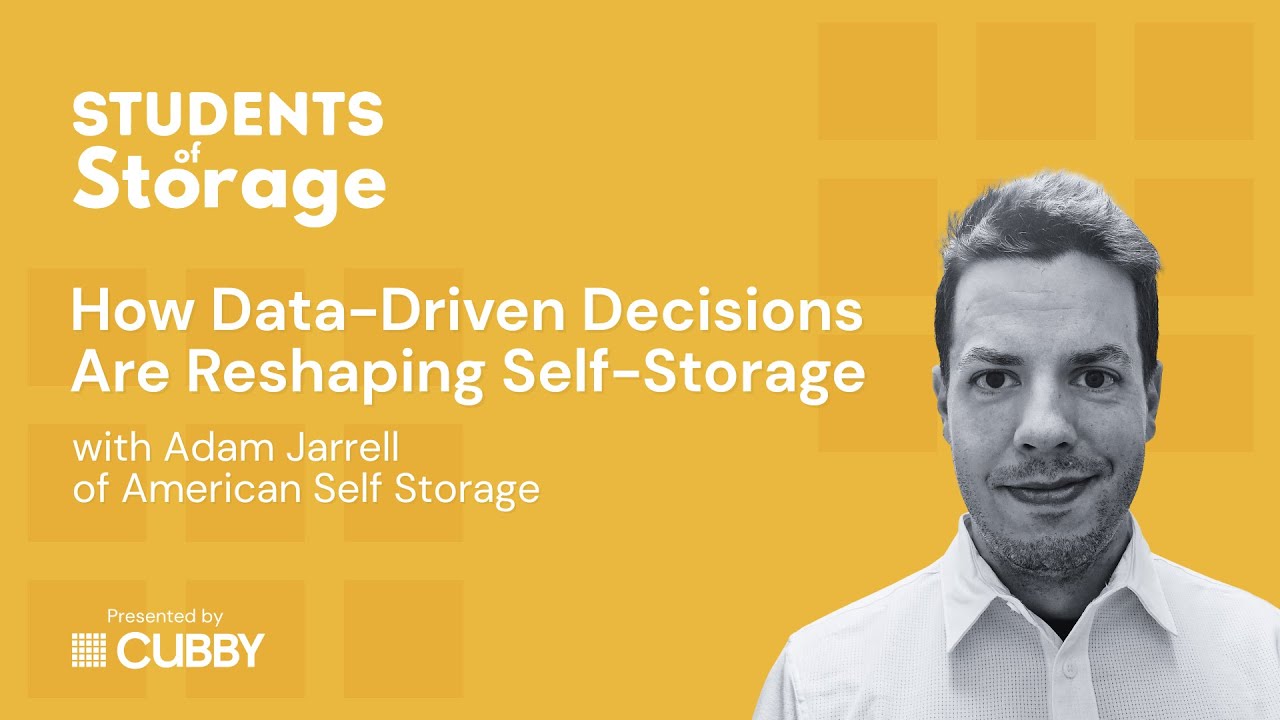
Adam Jarrell, Partner and General Manager of American Self Storage, shares how a background in multifamily real estate shaped his approach to self-storage. From building internal tools like QuickPay links and predictive gate access analytics to adopting business intelligence platforms, Adam outlines how curiosity, data fluency, and a focus on reducing friction drive operational success across his 15+ facility portfolio. He also discusses hiring philosophies, team ownership, and the role of AI in unlocking future efficiencies.
Key Takeaways:
(04:10) Reducing friction in customer workflows improves operational efficiency.
(06:05) Facility-level data collection supports smarter staffing decisions.
(12:51) AI has the potential to automate tasks and unlock new efficiencies.
(18:31) Overreliance on historical trends can limit growth potential.
(23:58) Rate sensitivity is often lower than operators assume.
(26:32) Evaluating risk helps tailor rent increases to specific conditions.
(32:19) Behavior-based analytics can help predict customer actions.
(35:39) A strong first experience drives loyalty and repeat rentals.
Transcript
Hello everyone. Welcome to another episode of Students of Storage. Joined with me today is my co-host, Michael Brevda, as well as Adam Jarrell over at American Storage. Hello, Adam.
Hey, Tully. Hey, Michael. Good to see you guys today.
Great to see you. We were just touching base before we jumped on, hearing a little bit about your exploits into the rowing world. We're happy to report that you've been tapped, I guess is the right term, for the rowing team.
Yeah.
No, thank you. It's been a hobby that I'm disappointed I found so late in life. It's been super rewarding and a lot of fun, but it is hard — the time and commitment and whatnot is a lot. The story of how I got into rowing was truly — I wanted the one exercise I could do the least amount of time to get the most result from. So that's how I picked it, as most people do, I'm sure.
Yeah. Maybe that probably has some ties to how you ended up choosing self storage.
For sure. Yeah, kind of the maximization function of — that's how I approach a lot of things in life.
Good. On that topic, I think it's always interesting hearing how everybody found their way into self storage. Mine's unique, Michael's is unique, but would love to hear yours and what has brought you to present day.
Sure.
I've been in storage a little over nine years now, and I think "found your way to storage" is a great way to put it, because that truly does seem to be a common path.
Everybody's got a little bit of a different story. I found my way to storage — I started in real estate early on, even in my college years, but I was working in the multifamily sector, for one of the larger owner-operators, so I was a small fish in a big pond, but I got to see a lot of interactions of what systems they had in place, what processes they had in place.
And then when I was kind of looking for my next opportunity, I saw self storage, and I was surprised, because I remember talking to a few people and they'd say things that were just really weird to me. Like they'd say, "Well, we're a really modern company because we have online payments," and I'd be like, "What are you talking about?" I think that's important, but people were touting it like it was this new feature nobody had heard of. And it felt kind of behind the curve.
And the more I dug into it, the more I saw there's a lot of examples of that, where storage tended to lag a little behind some of the other real estate disciplines in terms of innovation and other things. And that attracted me to it — like, man, this is a place where I think I can actually add some value.
Like, I think I know what to do here to help push this, at least my little tiny corner of it, forward. I have some ideas. So that's how I got started, and it's been a lot of fun since. That's awesome. How would you say you've explored and scratched that itch with regards to areas of opportunity?
I know one thing that immediately comes to mind is when we first met at that North Carolina SSA event, and we're chatting, and then got to talking over the next couple weeks and months — you highlighted how you utilize cameras at different properties to identify when an existing customer had walked in, or maybe a potential new one. I'm curious what other things you've tweaked or hacked over the years.
Yeah, that's a great question. There's probably too much to get into here, but I can pick one or two examples of things I've hacked around over the years. One of them was — there seems to be so much friction around storage in general, whether it be the rental process, the payment process — there's some owner-operator, and I'm not disparaging or saying these practices are bad, but there do tend
to be these habits that pop up and persist without a reevaluation of, does this help our business? An example of that might be, "Hey, we require a driver's license for every move-in, and if they don't have one, we don't rent to them. And if they can't come during business hours, we're not going to rent to them.
And we're not going to give them the gate code until they perform verification steps A, B, and C." And many of these things, in isolation, have good ideas — there's merit to them. But then when you take them in aggregate, they put up these little roadblocks that may be bigger barriers to customers than people realize when they're designing them up in their head. So for me, one of those friction points was simply paying their bill. People had a hard time — they had a complicated login process,
people don't remember their passwords — I mean, people don't remember their passwords in general, much less for their storage account. Just interacting with customers, you realize they don't think about their storage very much, and you kind of want it that way — you want them to spend as little brain power as possible thinking about their storage unit. But it was really hard for people to pay their bill, and I didn't want them to call me, I wanted them just to do it. I wanted as little effort there as possible.
So I built a little system that would send people what we called quick pay links, that would pre-authenticate the customer. So without a login, they could go in, enter a credit card, pay their bill. And the same thing for over the phone — they could call in, authenticate, and pay their bill right over the phone, because some people really like to pay that way and were convinced that was the right way to pay their bill.
By automating those things, it took more and more load off personnel who run the operation, so they're not doing as much of that day-to-day. And then, fast forward to cameras — now with the prevalence of the internet, we're able to do things we weren't able to do in the past, like the camera detection — we have cameras in our lobbies, we feed those into a central computer, and whenever a person walks in, we flag that event.
We store it in a database. We send a notification to the manager to tag it and say, "Hey, who was this — was this a customer, an employee, or a new rental?" So we had this really good insight into how busy are our stores. And all this started — I won't go too long — but I think it all started with us asking questions like, how busy are our lobbies? How valuable is that lobby space? Which ones do we need to staff, and if so, how much?
And it was really hard to get that information — nobody really knew how to find it or track it. So we started trying to answer these questions, and sometimes we found information that confirmed what we believed, and sometimes we found a store was much busier or much less busy than we realized. And it really shaped the way we ran our business over time. That's been a lot of the pursuit — how can we be as efficient as possible? And to be efficient, you need good data.
Yeah.
Couldn't agree more. And I think it's interesting, when you look at it from a capex/opex perspective, being able to measure what most consider unmeasurable is incredibly valuable. I imagine that probably affected your bottom line pretty significantly, especially across 15, 17-plus stores.
I imagine also there might have been initial pushback from your team, but one thing you've done an exceptional job of, that I've witnessed, is explaining the why. I'd be interested in hearing how you think about hiring, training,
working with your team so they have a concrete understanding of why we're driving toward an end result, or why we're making those changes.
Yeah, that's a really good question, and personnel is, I think, always front and center for a lot of people's minds in storage. For me, I think back — I've evolved a lot on this over the years, but when I first started, I had a pretty rigid approach both to hiring and to training.
And over the years I've realized — I was really inspired by a book by Reed Hastings, called "No Rules Rules," about Netflix. There's some stuff in there that's applicable, some that's not, but the piece that really spoke to me was about personnel and training. It focused on the idea that you want people who can make good decisions, and you want to give people enough context about your business so they know how to make the right decision in a variety of situations.
And I think sometimes there's a tendency — and I feel this too — to make a set of if-then statements to barricade people into forcing them to make the right decision. But in practice, when you really barricade people down through policy and procedure so narrowly, you get people who are afraid to make decisions. And instead of making decisions, they'll make easy ones, but if they get to one that's even a little tough, they freeze up, they don't make it, they postpone. And that slowness is really difficult.
And that could be true even when talking about a new rental who wants to rent a unit — if they have the power to tweak things a little to get that next move-in, I really want them to do that. I want each of my team members to just do it. We can always analyze it afterward and review it later, but I'd much rather be on the more aggressive side.
Hey, if we have to change the rent $10 to get that person to sign right now, I'd much rather do that than the person hangs up, my manager hangs up with the potential customer, calls me and says, "What do you think about dropping the rate $10?" I go through an analysis, and by the time we call that person back, we may have lost the opportunity to rent them a unit. I'd much rather move a little faster.
So that's kind of permeated my approach to training and hiring — can I get people who are comfortable making decisions and who can be trained with that context? I open up my P&Ls to my team — each manager who works for me has the entire P&L for the properties they manage, so they see the revenue and the expense. And that leads to a lot of tough conversations. It was hard to do that.
Any change is hard, but the end result was people who are a little more in tune with the business than they were before. So I think it was a positive change.
Totally. I think being able to give somebody a sense of ownership
changes their frame of mind when they're showing up to work — at the end of the day, they have a stake in the game. Might be a smaller stake than most, but it still impacts the business. And I imagine when you're having these team meetings, it makes it much better for people to showcase and highlight things they've noticed, to share with their colleagues. That's really impressive, something I've admired.
We had a great conversation last week with Jonas, who Michael's very close with, and I feel like you guys overlap with regards to how you view personnel and also how you view the prospective tenant — creating true empathy, understanding, but also eliminating roadblocks. Might not be the most attractive from a clear-cut, if-then-situation standpoint,
but I think your business is much more organic, and the results show up, especially because you're measuring them.
Totally. Well, I think you hit on something important there — the ownership. The more someone feels like they have control over what they're doing, whether it be a task, process, store, company, whatever unit you put there, that ownership always makes people care about it a little more, versus if it's just, "I'm doing a job, I'm collecting a paycheck and absolutely nothing else" — then you don't get that same investment and return from people, or any metric. Totally.
I'm curious — what's been holding your attention or interest, and you've been with Cubby now for like a year and a half, you've been extremely influential with regards to where we've taken the product, whether in revenue management or call center operations, or just general feedback around reporting and analytics.
What's holding your — I'm just curious to hear what's holding your attention, what do you want to see as the next area of opportunity as it relates to technology and self storage?
Doesn't have to be Cubby, but yeah.
Yeah, that's a great question. At the risk of sounding reductive, I'm going to say AI. And half of people will be like, "Yeah," and half will be like, "No."
But I will say — it is a polarizing topic — I'll go back to something briefly to give context. One thing I really enjoyed about our early conversations, Tully, was when we were exploring Cubby, we had a really hard time with simple parts of our new customer workflow. Like, if someone's on our website and puts in their contact information, I want to save that immediately and do something with that.
And that seemed to be an idea that just lagged and lagged and lagged. And that's one thing I've so much enjoyed about our conversations over the years and working with Cubby — that desire to push forward, to move quick, to be at the forefront of where customers are, is so important.
I feel like there's just great alignment on that, and that's something I've really enjoyed. As for the question on technology, I think AI is such an unlocking technology, but people are just now figuring out how to apply it and use it in their businesses.
I think the use cases we see today will be different than the use cases we see tomorrow, but there's no doubt in my mind it has the capacity to do what a lot of the other enhancements Cubby has led have done. I think it has that opportunity to continue to unlock efficiencies for people, whether it be automating more tasks. I think AI really has the ability to unlock that in some pretty powerful ways.
And I think the applications we're seeing are just now getting built for that, but are going to be pretty impactful when they are.
Awesome. Cool. Yeah, I'd tend to agree. I think there are so many efficiencies — we have certain applications of AI present in other industries that have been around for quite some time, right?
The ability to create multiple workflows, automatic follow-up actions — self storage, unfortunately, has kind of been on the later side of that. I imagine you've been able to use tools like make.com or Zapier integrations to solve for a number of these, but it's kind of clunky — I think I learned that word from you, so grateful for that.
I think we touched upon briefly reporting and analytics — you do tend to get into the weeds as it relates to utilizing a Google BigQuery integration into your facility management software, whether you were doing data carves previously or now doing it in real time. What are the things you believe a number of operators might be overlooking as it relates to
reporting, and why is a business intelligence tool so powerful, in your perspective?
Yeah, that's a really good question. I think the major paradigm, let's say three or four years ago in storage, was primarily this report-driven paradigm, where you go and request data.
Now maybe you have it on a schedule where it gets emailed to you, but it was very much this "request report" — you'd get some pre-canned thing, and then you could interface with that company, try to increase its utility, but generally you're kind of with this pre-canned report and had to learn how to use what was on it — that was kind of your only option. There wasn't really anything you could do beyond that. Then with
BigQuery, we use kind of PowerBI as an interface to pull that data in — we can pull in data from our own tools, right? So that database that tracks customers coming into stores — if I want to correlate lead conversion at the store level with visits per month, I can do that and ask that question and say, "I wonder if these two things are connected."
And they may or may not be, but something that previously would take hours probably to compile a report from one software and from another software — if you want to answer it across multiple stores,
it's going to take a long time to correlate that data. You get a one-time answer, and if you want to ask the same question again, or over a different data period, you have more work to do. And that's where the business intelligence tools really unlock that — you can ask that question. Maybe it's a dead end, maybe there's absolutely no relationship between those two things, and it was just a curiosity, but then you know that and can move on and say, "You know what, these things have no relation — visits and closing rate aren't related.
So I don't have to spend time thinking about this anymore. But I wonder — does time of day impact it? Is there a correlation between people who come in at the end of the day — are they in a rush trying to beat our closing hours, do they close at a higher percentage? Maybe that's something I should look at." And you can just dive into your data in this deeper way. Sometimes you get really great insights and sometimes you don't, but the point is you're able to ask questions and get answers quickly.
And that to me feels like it unlocks the speed at which you can move forward, because you're getting answers quickly, and able to explore that tangent until your curiosity is satiated, and know, "Oh, there's something here," or "There's nothing here and I don't need to think about it." I can free up that brain space to go do other things.
Awesome. Yeah. Would you say — a lot of people talk about historical trends and historical data — I'm curious to get your take, like what are the pros and cons of utilizing historical data,
right, at a high level, sometimes people get stuck with, "Oh, the seasonal trends" — like we're noticing something different, well COVID impacted it and created a completely different scenario that throws off how we do revenue management, in this kind of race to the bottom with the REITs — but would love your thoughts around that.
Yeah, that's a really good question. What's interesting about historical trends — the way I feel about historical data is it's really good to know how you did. That's super important, but I also think it can be blinders in a way.
One example — I think COVID's a great example, if I'll use an example relevant to storage — if you have an idea in your mind of what the price of a 10x10 should be, and you went into COVID with that idea and didn't raise your rates, then you probably got to 100% occupancy and may not have realized you could have raised them earlier and higher. You had no idea.
You don't know what the ceiling for your market is because you hit 100%. And that speaks to the reliance on historical data, right — "This is what the price used to be, therefore the price really can't be much different than what it used to be." But in actuality it changed a lot, and it changed quickly. And although we don't always know what the shocks may be — whether local to that market or industrywide — there's always a chance for disruptive forces, both positive and negative.
And if you're so bounded by what you've done in the past that you're unable to anticipate big and/or sudden changes in the present and future, then your historical data kind of is a handicap to you. So I think it's good as a benchmark to know how we did, but I don't think it should be the ultimate ruler for how we should operate and what we should expect today. So that's what I think about historical data. I'm curious your thoughts — what do you see, what do you think?
No, I think you hit the nail on the head with regard to how I view it. I think it's really important to see, from an operational perspective, how you performed year over year — trends are important, but they're not the end-all-be-all. Markets change, tactics change around pricing, occupancy, saturation — all of those influence how you adjust prices over time. I think it's important to look, but to die on that hill is dangerous, but to each their own.
And one thing I'd be curious following up on — what are some of the changes you've noticed with regard to revenue management?
Whether for prospective tenants, existing tenants — I've been hearing a lot more about this idea of "stay rates," how do we get to a point where we're starting to understand when a potential tenant might want to move out, and how do we keep them in there? Would love your thoughts. I know that's pretty broad.
Oh man, yeah, that's a big question. Talking about revenue management and the two sides of it — existing tenant rate increases, ECRIs, and what you're setting your street rates at — is that a good way to talk about those broadly?
Yeah, Michael, if you think there's anything a little more pointed that's come up in your discussions, I'd love to hear it. But I think a lot of folks are starting to think more strategically about revenue management, in particular ECRI, because it might have been a place where they've just been adjusting by three or five percent every six months, and
then that's just kind of the way things have rolled — a couple percentage points here or there based on different tenants can have a pretty significant impact when compounding. So I guess that's directed toward Michael — did you want to add anything?
Yeah, I can just add on the existing tenant rate increase side. I know you ask a lot of questions and do things differently than a lot of groups we talk to. Are there any interesting correlations or factors you look at when deciding raising this tenant's rate versus that one that matter? There's obviously length of stay, rent loss change and difference from street rate, like can I backfill if this person moves out at a higher or lower rate,
but beyond those basic factors, are you looking at things like gate access activity, or how far from the facility they live, or some of these other factors that I think are really interesting and nuanced, versus — I'd say the majority of groups I talk to have their rule that at nine months every single person gets a 5% bump, and that's that, whereas no two customers are actually exactly alike.
So maybe we could start with the ECRI side, and then anything on the street rate side that's of interest to you.
Well, I think you both hit on a good point there — when I started in storage nine years ago, there was debate at that time about whether rate increases were good or bad, there was still this divide of "should we do them, should we not." Then over time that got to the point where most people were like, "Yeah, you got to do rate increases to your existing customers." And I saw that change over time — people recognizing
that increases are good, and I think that's a good starting point for people today — if you can't do anything else, you should at least have some type of schedule, some rule you follow that puts you in that habit of doing it. If you're not in the habit of doing it, you'll fall behind quicker than you realize. That's kind of the baseline to start from.
I think as you start to optimize more — one of the things we do is move-out surveys. We track why people are leaving, and we test that, we see how that changes over time, and we see that about 4% of customers list rate increases as the reason for move-out over time. It continues to be — I mean, we've tested this different ways, we have ongoing surveys and usually do a big one-time survey every summer to try to update this, make sure we haven't fallen out of touch. But it's always less than people think.
So what I like to do when training my team was — that 4%, 14% that I heard?
Yeah.
No, it's super, super small. And the leading reason, by 85%, is for a life event. So by far and away, life event is still the one people leave for. And when you read the comments — there's a comments field for people to leave additional notes — the comments often go something like, "Well, I didn't like the rate increases, but the reason I left was because I moved into my house," or some life event X, Y, or Z.
So they'll remember the rate increases — they do remember them, it's not like they erase them — but the actual reason was still the life event. And that continues to hold true for the majority of people. Anyway, the point is it's always less than you think.
So I do this exercise with my team where we review these numbers. I always ask the team, "How many people move out because of a rate increase? If we have 100 customers who moved out this month across our company, how many moved out because they got a rate increase and were upset by it?"
What are your guesses — 20, 30, 40? And when you hear it's four, it's just that surprise — "Really?" And then we go through and look at the responses and all get on the same page and realize that those four can be very vocal and very loud, but they represent a minority of people who moved out. So that vocal minority can make it feel disproportional. And then cycling it back to the rate increase — what do you decide to give someone? I think generally you want to look at the occupancy of the unit type,
the occupancy of the facility — the more data you can pull in to make that decision, the better. Even leasing velocities — are we running a lot right now, are we seeing a lot of move-outs — that can temper how aggressive or conservative you want to be.
I toyed with a vacancy loss kind of calculator — if this person moves out, assuming that 4% probability of move-out, what is the — I can estimate a vacancy loss off of each rate increase, of what each one on a percentage basis will give me. Sort of like how in the NBA they moved to the effective or estimated point value of a shot. You can estimate the vacancy loss, the risk of each rate increase on a case-by-case basis.
And if one is high risk, you don't have to do it even if it's on the cycle. And if one is low risk, that's one you should definitely increase. So it gives you that additional parameter to do a few more when risk is low and a few less when risk is high, and use that as a barometer to be more targeted with it.
So totally. I wish the Celtics had followed your advice last night, since they went down two games after blowing point leads.
The emotion just plays into it so much. You can know the right thing, but — you live in New York City, Tully.
It's fine.
My condolences.
We got a ring.
Basketball analogy — I hate when you see someone take a long two with their foot on the line. It's probably my most boomer trait.
Like, what are you doing?
Take a step back, drive it to the — it's not rocket science. It's a really difficult shot for the same amount of value.
Oh man.
Yeah. Well, look at storage now.
No, I mean, it correlates exactly.
And I think the emotion component of it — that's easy to forget. That's part of why software like Cubby is so useful — the more you can take the emotion out of it and stick to your plan, the better it works.
I think generally, at any scale — maybe a single owner-operator could do it by gut a little better — but at any scale of two, three-plus stores, you got to have that plan to follow, otherwise you'll make bad decisions. You'll have your toe on the line and miss a bad, almost three-point shot.
Awesome. Well, I think that's a good place to jump off, unless Michael, you think you've got any additional questions.
Yeah, I have one more question while you're here, if you don't mind spending a couple seconds.
No, go for it.
We just got back from ISS Las Vegas, and as a vendor familiar with the space, I was a little overwhelmed at all the options available to groups now, even year over year from last year. Can you talk to us a little more —
obviously you use Cubby today, but for the average operator, if they're trying to figure out what they should do from a software and technology perspective, what are some of the questions they should be asking to make sure they're not just adding more tools on top of a shaky foundation, or just grasping at straws? I sense a lot of, "Well, I heard AI was important,
let's go buy something that has AI in the name," not really thinking about the outcome it's driving. I know you can be as detailed or not as you want, but I thought that'd be something you'd have a good opinion on.
That's a really good question. And it may be different for different operators — in fact, I'm sure it is. But I think one of the hardest parts about the storage industry is — both its strength and weakness — is its diversity. There are so many options for every part of your technology stack, even tenant insurance, right, there's a bazillion options. And sometimes it's hard to get a consensus on what is good, what should I do, what shouldn't I do.
Some of that's held back by long-standing beliefs about what is even legal or not legal in my state —
"I heard 10 years ago we couldn't send electronic lien notices, so we don't send electronic lien notices," even though it may have changed. So the advice I'd give people, the recommendation, is you've got to have a really good grasp on what your business strategy is.
I also know, from a practical standpoint, the more things you bolt on or add on, the harder they are to interoperate — that's universally true, not just in storage. If you buy your software from one company, and you buy another piece from another company, and an AI bolt-on from a fifth company, and your gate is probably already somebody else, and your phone system is already somebody else — you already got a lot of pieces to try to plug together.
I think the fewer of those pieces you have to plug and make work together, the better. And, shameless plug for Cubby here, but I talked about my quick pay links earlier, and I was really proud of that back in the day — I thought I was innovative. But that took time for me to maintain. My ability to facilitate easy payments took away from my time pushing the other parts of the business forward.
And when I met with you, I realized, "Hey, I can take some of these things off my plate."
And instead of me being the bolt-on, I can have our software do that for me, and that helped a ton to unlock my time and say, "You know what, I don't have to spend my time maintaining these things anymore, doing X, Y, and Z." The more we can bring under one umbrella, that's going to make us better just by virtue of reducing complexity. And on top of features working well, that's going to be that next step change in intensity.
And I'll share — one final plug — one thing I've been working on is gate access. We switched away, I built my own gate solution, keypads, the whole bit, so I could have control of that data and do whatever I wanted with it, to see when my customers are coming in and out, and manage it the way I wanted to manage it.
And one of the things tickling my brain right now is, when people are moving out, they move out. They don't tell you when they're going to move out, right? You'd really like for customers to be like, "Hey, I'm thinking about moving out.
What can you do for me?" Obviously given that chance, most people would say, "Of course, let's work together, we want you to be a customer as long as you need storage." But if they've already rented the U-Haul truck and already got the unit loaded up, they're gone. But that usage follows predictable patterns. So what I'm trying to do now is predict, based on gate access usage, if someone is moving out at that moment.
So you can reach out to them before they've loaded up that U-Haul, and see if there's a chance to save them, or just use that to reach out in a more proactive fashion. I think that'll be really interesting to see how that works. But are people coming more often or less often right before they move out?
Well, the access pattern is typically right before your billing cycle — there's an uptick. And people moving out are usually moving out on a weekend, and time of day matters.
And if you see several consecutive back-to-back accesses where there wasn't a pattern of that before, you're almost guaranteed that increases the probability of it being a move-out. So I'm at about 80% consistency, but I want to get it to 95 before I start actually notifying people, because I think it's going to be a little weird at first when people get a text a few minutes after their gate code, like, "Hey, are you moving out?" I don't know how to say that part yet, but we'll get there.
We'll go, neighbor.
Yeah.
Hey, you moved in 18 months ago, you've never come back, and now you've been back three times in the last three days, or you're moving out.
Right.
Right. I think something not creepy, like, "Hey, why don't you just take that U-Haul back and leave your stuff in storage a few more months." No, I'm teasing, I don't know what to say yet, but I'll figure that out. If you have suggestions, let me know, I'm looking for ideas.
Maybe leave them a $20 Dunkin gift card in the unit with a nice note, like, "Hey, we'll miss you." Yeah.
Love it. I know this doesn't function inside Cubby today and it doesn't really matter, but I'm curious since we're on the topic — the tenant portal — do you know how many of your existing customers ultimately rent a second unit, and are there predictive insights you look at, or activity you're monitoring, to see if an
existing tenant goes and creates a new lead or expresses interest in looking at a unit? I wonder if there are triggers we could extract from Cubby based off activity. I know they can't rent a unit inside their tenant portal today, but I wonder if we could track existing tenants that way.
That's a really good question, and I think what we see is there are tenants who need a second unit, and probably the most common reason is they underestimate how much stuff they have. It's a common thing, right?
People are shopping on a price basis and aren't really familiar with how to correlate a 10x15 into what their stuff packed up would actually look like. That's a common reason — "I underestimated." And a second is kind of a needs-change thing. But the takeaway is, once people have rented that first unit, as long as they had a good experience, they don't shop the second time. The first time they're shopping, they call about three or more stores, visit one or more stores —
usually three-to-one is the rough numbers I've heard, maybe different now — but the second unit, they don't really shop for it.
They call you and just say, "Boom, can I get it?" And that's where the big value is. We use Slack for communication internally, so we run a pretty tight organization where managers talk to managers collaboratively and frequently, just for context.
But when a lead comes in off the website — one of those abandoned checkouts, or somebody who was inquiring but didn't get all the way to buying — that pops right into our Slack channel so we can action it within seconds. If they're an existing customer, we can do that manually, but it'd be awesome to integrate that with existing customers — that would be so cool, to make it even more seamless.
Yeah, it's fun ideating on this kind of stuff.
Yeah, little improvements make a big difference over time. There's no one silver bullet, but a lot of little ones that make a big change in the end.
Yeah, as Michael always says, scraps make a pile.
I like it. Absolutely. And that's what I was going to bring up earlier — one thing I think you do really well, that's kind of your superpower compared to some operators we talk to, is you're always asking those sorts of questions and never stop. There are lots of groups out there, some we speak with, some we work with, some we don't, that just check the bottom number every month — how much do we bring in this month, cool — and then only react or do things differently if they see a huge difference in that number.
But there are some folks out there who bought their facilities 30, 40, 50 years ago, and it's now just a coupon clipper, and that's great — you actually don't need to maximize revenue probably in that instance. But for everyone trying to actually run a storage business, continuing to ask these questions is super important — where are the bottlenecks, the friction points, the areas we can improve that will make a difference to that bottom number.
We all like to see the bottom number go up, but you have to do stuff to make that happen. So yeah.
Yeah, that's a really good insight. There are input signals that change that bottom number, they're there, but you always got to be looking for them.
Yeah, if you want to catch them before they make the bottom number go down.
True.
Yeah, once the bottom number starts to fall off a cliff, it's typically too late.
Yeah.
Hard to reverse that trend.
Well, thank you so much for taking the time on a Friday to chat with little old us. Michael, Tully, always a pleasure, great to see you guys, glad to hear you're doing well, always great to catch up.
Yeah, talk soon. Thanks.
All right. Bye, guys. See you.
Thank you for listening to Students of Storage. Links to any of the resources we chatted about in the episode can be found in the show notes. If you enjoyed the show, please leave a five-star review and subscribe so you don't miss out on any future episodes. Hope to see you back here soon.
Adam Jarrell, Partner and General Manager of American Self Storage, shares how a background in multifamily real estate shaped his approach to self-storage. From building internal tools like QuickPay links and predictive gate access analytics to adopting business intelligence platforms, Adam outlines how curiosity, data fluency, and a focus on reducing friction drive operational success across his 15+ facility portfolio. He also discusses hiring philosophies, team ownership, and the role of AI in unlocking future efficiencies.
Key Takeaways:
(04:10) Reducing friction in customer workflows improves operational efficiency.
(06:05) Facility-level data collection supports smarter staffing decisions.
(12:51) AI has the potential to automate tasks and unlock new efficiencies.
(18:31) Overreliance on historical trends can limit growth potential.
(23:58) Rate sensitivity is often lower than operators assume.
(26:32) Evaluating risk helps tailor rent increases to specific conditions.
(32:19) Behavior-based analytics can help predict customer actions.
(35:39) A strong first experience drives loyalty and repeat rentals.
Transcript
Hello everyone. Welcome to another episode of Students of Storage. Joined with me today is my co-host, Michael Brevda, as well as Adam Jarrell over at American Storage. Hello, Adam.
Hey, Tully. Hey, Michael. Good to see you guys today.
Great to see you. We were just touching base before we jumped on, hearing a little bit about your exploits into the rowing world. We're happy to report that you've been tapped, I guess is the right term, for the rowing team.
Yeah.
No, thank you. It's been a hobby that I'm disappointed I found so late in life. It's been super rewarding and a lot of fun, but it is hard — the time and commitment and whatnot is a lot. The story of how I got into rowing was truly — I wanted the one exercise I could do the least amount of time to get the most result from. So that's how I picked it, as most people do, I'm sure.
Yeah. Maybe that probably has some ties to how you ended up choosing self storage.
For sure. Yeah, kind of the maximization function of — that's how I approach a lot of things in life.
Good. On that topic, I think it's always interesting hearing how everybody found their way into self storage. Mine's unique, Michael's is unique, but would love to hear yours and what has brought you to present day.
Sure.
I've been in storage a little over nine years now, and I think "found your way to storage" is a great way to put it, because that truly does seem to be a common path.
Everybody's got a little bit of a different story. I found my way to storage — I started in real estate early on, even in my college years, but I was working in the multifamily sector, for one of the larger owner-operators, so I was a small fish in a big pond, but I got to see a lot of interactions of what systems they had in place, what processes they had in place.
And then when I was kind of looking for my next opportunity, I saw self storage, and I was surprised, because I remember talking to a few people and they'd say things that were just really weird to me. Like they'd say, "Well, we're a really modern company because we have online payments," and I'd be like, "What are you talking about?" I think that's important, but people were touting it like it was this new feature nobody had heard of. And it felt kind of behind the curve.
And the more I dug into it, the more I saw there's a lot of examples of that, where storage tended to lag a little behind some of the other real estate disciplines in terms of innovation and other things. And that attracted me to it — like, man, this is a place where I think I can actually add some value.
Like, I think I know what to do here to help push this, at least my little tiny corner of it, forward. I have some ideas. So that's how I got started, and it's been a lot of fun since. That's awesome. How would you say you've explored and scratched that itch with regards to areas of opportunity?
I know one thing that immediately comes to mind is when we first met at that North Carolina SSA event, and we're chatting, and then got to talking over the next couple weeks and months — you highlighted how you utilize cameras at different properties to identify when an existing customer had walked in, or maybe a potential new one. I'm curious what other things you've tweaked or hacked over the years.
Yeah, that's a great question. There's probably too much to get into here, but I can pick one or two examples of things I've hacked around over the years. One of them was — there seems to be so much friction around storage in general, whether it be the rental process, the payment process — there's some owner-operator, and I'm not disparaging or saying these practices are bad, but there do tend
to be these habits that pop up and persist without a reevaluation of, does this help our business? An example of that might be, "Hey, we require a driver's license for every move-in, and if they don't have one, we don't rent to them. And if they can't come during business hours, we're not going to rent to them.
And we're not going to give them the gate code until they perform verification steps A, B, and C." And many of these things, in isolation, have good ideas — there's merit to them. But then when you take them in aggregate, they put up these little roadblocks that may be bigger barriers to customers than people realize when they're designing them up in their head. So for me, one of those friction points was simply paying their bill. People had a hard time — they had a complicated login process,
people don't remember their passwords — I mean, people don't remember their passwords in general, much less for their storage account. Just interacting with customers, you realize they don't think about their storage very much, and you kind of want it that way — you want them to spend as little brain power as possible thinking about their storage unit. But it was really hard for people to pay their bill, and I didn't want them to call me, I wanted them just to do it. I wanted as little effort there as possible.
So I built a little system that would send people what we called quick pay links, that would pre-authenticate the customer. So without a login, they could go in, enter a credit card, pay their bill. And the same thing for over the phone — they could call in, authenticate, and pay their bill right over the phone, because some people really like to pay that way and were convinced that was the right way to pay their bill.
By automating those things, it took more and more load off personnel who run the operation, so they're not doing as much of that day-to-day. And then, fast forward to cameras — now with the prevalence of the internet, we're able to do things we weren't able to do in the past, like the camera detection — we have cameras in our lobbies, we feed those into a central computer, and whenever a person walks in, we flag that event.
We store it in a database. We send a notification to the manager to tag it and say, "Hey, who was this — was this a customer, an employee, or a new rental?" So we had this really good insight into how busy are our stores. And all this started — I won't go too long — but I think it all started with us asking questions like, how busy are our lobbies? How valuable is that lobby space? Which ones do we need to staff, and if so, how much?
And it was really hard to get that information — nobody really knew how to find it or track it. So we started trying to answer these questions, and sometimes we found information that confirmed what we believed, and sometimes we found a store was much busier or much less busy than we realized. And it really shaped the way we ran our business over time. That's been a lot of the pursuit — how can we be as efficient as possible? And to be efficient, you need good data.
Yeah.
Couldn't agree more. And I think it's interesting, when you look at it from a capex/opex perspective, being able to measure what most consider unmeasurable is incredibly valuable. I imagine that probably affected your bottom line pretty significantly, especially across 15, 17-plus stores.
I imagine also there might have been initial pushback from your team, but one thing you've done an exceptional job of, that I've witnessed, is explaining the why. I'd be interested in hearing how you think about hiring, training,
working with your team so they have a concrete understanding of why we're driving toward an end result, or why we're making those changes.
Yeah, that's a really good question, and personnel is, I think, always front and center for a lot of people's minds in storage. For me, I think back — I've evolved a lot on this over the years, but when I first started, I had a pretty rigid approach both to hiring and to training.
And over the years I've realized — I was really inspired by a book by Reed Hastings, called "No Rules Rules," about Netflix. There's some stuff in there that's applicable, some that's not, but the piece that really spoke to me was about personnel and training. It focused on the idea that you want people who can make good decisions, and you want to give people enough context about your business so they know how to make the right decision in a variety of situations.
And I think sometimes there's a tendency — and I feel this too — to make a set of if-then statements to barricade people into forcing them to make the right decision. But in practice, when you really barricade people down through policy and procedure so narrowly, you get people who are afraid to make decisions. And instead of making decisions, they'll make easy ones, but if they get to one that's even a little tough, they freeze up, they don't make it, they postpone. And that slowness is really difficult.
And that could be true even when talking about a new rental who wants to rent a unit — if they have the power to tweak things a little to get that next move-in, I really want them to do that. I want each of my team members to just do it. We can always analyze it afterward and review it later, but I'd much rather be on the more aggressive side.
Hey, if we have to change the rent $10 to get that person to sign right now, I'd much rather do that than the person hangs up, my manager hangs up with the potential customer, calls me and says, "What do you think about dropping the rate $10?" I go through an analysis, and by the time we call that person back, we may have lost the opportunity to rent them a unit. I'd much rather move a little faster.
So that's kind of permeated my approach to training and hiring — can I get people who are comfortable making decisions and who can be trained with that context? I open up my P&Ls to my team — each manager who works for me has the entire P&L for the properties they manage, so they see the revenue and the expense. And that leads to a lot of tough conversations. It was hard to do that.
Any change is hard, but the end result was people who are a little more in tune with the business than they were before. So I think it was a positive change.
Totally. I think being able to give somebody a sense of ownership
changes their frame of mind when they're showing up to work — at the end of the day, they have a stake in the game. Might be a smaller stake than most, but it still impacts the business. And I imagine when you're having these team meetings, it makes it much better for people to showcase and highlight things they've noticed, to share with their colleagues. That's really impressive, something I've admired.
We had a great conversation last week with Jonas, who Michael's very close with, and I feel like you guys overlap with regards to how you view personnel and also how you view the prospective tenant — creating true empathy, understanding, but also eliminating roadblocks. Might not be the most attractive from a clear-cut, if-then-situation standpoint,
but I think your business is much more organic, and the results show up, especially because you're measuring them.
Totally. Well, I think you hit on something important there — the ownership. The more someone feels like they have control over what they're doing, whether it be a task, process, store, company, whatever unit you put there, that ownership always makes people care about it a little more, versus if it's just, "I'm doing a job, I'm collecting a paycheck and absolutely nothing else" — then you don't get that same investment and return from people, or any metric. Totally.
I'm curious — what's been holding your attention or interest, and you've been with Cubby now for like a year and a half, you've been extremely influential with regards to where we've taken the product, whether in revenue management or call center operations, or just general feedback around reporting and analytics.
What's holding your — I'm just curious to hear what's holding your attention, what do you want to see as the next area of opportunity as it relates to technology and self storage?
Doesn't have to be Cubby, but yeah.
Yeah, that's a great question. At the risk of sounding reductive, I'm going to say AI. And half of people will be like, "Yeah," and half will be like, "No."
But I will say — it is a polarizing topic — I'll go back to something briefly to give context. One thing I really enjoyed about our early conversations, Tully, was when we were exploring Cubby, we had a really hard time with simple parts of our new customer workflow. Like, if someone's on our website and puts in their contact information, I want to save that immediately and do something with that.
And that seemed to be an idea that just lagged and lagged and lagged. And that's one thing I've so much enjoyed about our conversations over the years and working with Cubby — that desire to push forward, to move quick, to be at the forefront of where customers are, is so important.
I feel like there's just great alignment on that, and that's something I've really enjoyed. As for the question on technology, I think AI is such an unlocking technology, but people are just now figuring out how to apply it and use it in their businesses.
I think the use cases we see today will be different than the use cases we see tomorrow, but there's no doubt in my mind it has the capacity to do what a lot of the other enhancements Cubby has led have done. I think it has that opportunity to continue to unlock efficiencies for people, whether it be automating more tasks. I think AI really has the ability to unlock that in some pretty powerful ways.
And I think the applications we're seeing are just now getting built for that, but are going to be pretty impactful when they are.
Awesome. Cool. Yeah, I'd tend to agree. I think there are so many efficiencies — we have certain applications of AI present in other industries that have been around for quite some time, right?
The ability to create multiple workflows, automatic follow-up actions — self storage, unfortunately, has kind of been on the later side of that. I imagine you've been able to use tools like make.com or Zapier integrations to solve for a number of these, but it's kind of clunky — I think I learned that word from you, so grateful for that.
I think we touched upon briefly reporting and analytics — you do tend to get into the weeds as it relates to utilizing a Google BigQuery integration into your facility management software, whether you were doing data carves previously or now doing it in real time. What are the things you believe a number of operators might be overlooking as it relates to
reporting, and why is a business intelligence tool so powerful, in your perspective?
Yeah, that's a really good question. I think the major paradigm, let's say three or four years ago in storage, was primarily this report-driven paradigm, where you go and request data.
Now maybe you have it on a schedule where it gets emailed to you, but it was very much this "request report" — you'd get some pre-canned thing, and then you could interface with that company, try to increase its utility, but generally you're kind of with this pre-canned report and had to learn how to use what was on it — that was kind of your only option. There wasn't really anything you could do beyond that. Then with
BigQuery, we use kind of PowerBI as an interface to pull that data in — we can pull in data from our own tools, right? So that database that tracks customers coming into stores — if I want to correlate lead conversion at the store level with visits per month, I can do that and ask that question and say, "I wonder if these two things are connected."
And they may or may not be, but something that previously would take hours probably to compile a report from one software and from another software — if you want to answer it across multiple stores,
it's going to take a long time to correlate that data. You get a one-time answer, and if you want to ask the same question again, or over a different data period, you have more work to do. And that's where the business intelligence tools really unlock that — you can ask that question. Maybe it's a dead end, maybe there's absolutely no relationship between those two things, and it was just a curiosity, but then you know that and can move on and say, "You know what, these things have no relation — visits and closing rate aren't related.
So I don't have to spend time thinking about this anymore. But I wonder — does time of day impact it? Is there a correlation between people who come in at the end of the day — are they in a rush trying to beat our closing hours, do they close at a higher percentage? Maybe that's something I should look at." And you can just dive into your data in this deeper way. Sometimes you get really great insights and sometimes you don't, but the point is you're able to ask questions and get answers quickly.
And that to me feels like it unlocks the speed at which you can move forward, because you're getting answers quickly, and able to explore that tangent until your curiosity is satiated, and know, "Oh, there's something here," or "There's nothing here and I don't need to think about it." I can free up that brain space to go do other things.
Awesome. Yeah. Would you say — a lot of people talk about historical trends and historical data — I'm curious to get your take, like what are the pros and cons of utilizing historical data,
right, at a high level, sometimes people get stuck with, "Oh, the seasonal trends" — like we're noticing something different, well COVID impacted it and created a completely different scenario that throws off how we do revenue management, in this kind of race to the bottom with the REITs — but would love your thoughts around that.
Yeah, that's a really good question. What's interesting about historical trends — the way I feel about historical data is it's really good to know how you did. That's super important, but I also think it can be blinders in a way.
One example — I think COVID's a great example, if I'll use an example relevant to storage — if you have an idea in your mind of what the price of a 10x10 should be, and you went into COVID with that idea and didn't raise your rates, then you probably got to 100% occupancy and may not have realized you could have raised them earlier and higher. You had no idea.
You don't know what the ceiling for your market is because you hit 100%. And that speaks to the reliance on historical data, right — "This is what the price used to be, therefore the price really can't be much different than what it used to be." But in actuality it changed a lot, and it changed quickly. And although we don't always know what the shocks may be — whether local to that market or industrywide — there's always a chance for disruptive forces, both positive and negative.
And if you're so bounded by what you've done in the past that you're unable to anticipate big and/or sudden changes in the present and future, then your historical data kind of is a handicap to you. So I think it's good as a benchmark to know how we did, but I don't think it should be the ultimate ruler for how we should operate and what we should expect today. So that's what I think about historical data. I'm curious your thoughts — what do you see, what do you think?
No, I think you hit the nail on the head with regard to how I view it. I think it's really important to see, from an operational perspective, how you performed year over year — trends are important, but they're not the end-all-be-all. Markets change, tactics change around pricing, occupancy, saturation — all of those influence how you adjust prices over time. I think it's important to look, but to die on that hill is dangerous, but to each their own.
And one thing I'd be curious following up on — what are some of the changes you've noticed with regard to revenue management?
Whether for prospective tenants, existing tenants — I've been hearing a lot more about this idea of "stay rates," how do we get to a point where we're starting to understand when a potential tenant might want to move out, and how do we keep them in there? Would love your thoughts. I know that's pretty broad.
Oh man, yeah, that's a big question. Talking about revenue management and the two sides of it — existing tenant rate increases, ECRIs, and what you're setting your street rates at — is that a good way to talk about those broadly?
Yeah, Michael, if you think there's anything a little more pointed that's come up in your discussions, I'd love to hear it. But I think a lot of folks are starting to think more strategically about revenue management, in particular ECRI, because it might have been a place where they've just been adjusting by three or five percent every six months, and
then that's just kind of the way things have rolled — a couple percentage points here or there based on different tenants can have a pretty significant impact when compounding. So I guess that's directed toward Michael — did you want to add anything?
Yeah, I can just add on the existing tenant rate increase side. I know you ask a lot of questions and do things differently than a lot of groups we talk to. Are there any interesting correlations or factors you look at when deciding raising this tenant's rate versus that one that matter? There's obviously length of stay, rent loss change and difference from street rate, like can I backfill if this person moves out at a higher or lower rate,
but beyond those basic factors, are you looking at things like gate access activity, or how far from the facility they live, or some of these other factors that I think are really interesting and nuanced, versus — I'd say the majority of groups I talk to have their rule that at nine months every single person gets a 5% bump, and that's that, whereas no two customers are actually exactly alike.
So maybe we could start with the ECRI side, and then anything on the street rate side that's of interest to you.
Well, I think you both hit on a good point there — when I started in storage nine years ago, there was debate at that time about whether rate increases were good or bad, there was still this divide of "should we do them, should we not." Then over time that got to the point where most people were like, "Yeah, you got to do rate increases to your existing customers." And I saw that change over time — people recognizing
that increases are good, and I think that's a good starting point for people today — if you can't do anything else, you should at least have some type of schedule, some rule you follow that puts you in that habit of doing it. If you're not in the habit of doing it, you'll fall behind quicker than you realize. That's kind of the baseline to start from.
I think as you start to optimize more — one of the things we do is move-out surveys. We track why people are leaving, and we test that, we see how that changes over time, and we see that about 4% of customers list rate increases as the reason for move-out over time. It continues to be — I mean, we've tested this different ways, we have ongoing surveys and usually do a big one-time survey every summer to try to update this, make sure we haven't fallen out of touch. But it's always less than people think.
So what I like to do when training my team was — that 4%, 14% that I heard?
Yeah.
No, it's super, super small. And the leading reason, by 85%, is for a life event. So by far and away, life event is still the one people leave for. And when you read the comments — there's a comments field for people to leave additional notes — the comments often go something like, "Well, I didn't like the rate increases, but the reason I left was because I moved into my house," or some life event X, Y, or Z.
So they'll remember the rate increases — they do remember them, it's not like they erase them — but the actual reason was still the life event. And that continues to hold true for the majority of people. Anyway, the point is it's always less than you think.
So I do this exercise with my team where we review these numbers. I always ask the team, "How many people move out because of a rate increase? If we have 100 customers who moved out this month across our company, how many moved out because they got a rate increase and were upset by it?"
What are your guesses — 20, 30, 40? And when you hear it's four, it's just that surprise — "Really?" And then we go through and look at the responses and all get on the same page and realize that those four can be very vocal and very loud, but they represent a minority of people who moved out. So that vocal minority can make it feel disproportional. And then cycling it back to the rate increase — what do you decide to give someone? I think generally you want to look at the occupancy of the unit type,
the occupancy of the facility — the more data you can pull in to make that decision, the better. Even leasing velocities — are we running a lot right now, are we seeing a lot of move-outs — that can temper how aggressive or conservative you want to be.
I toyed with a vacancy loss kind of calculator — if this person moves out, assuming that 4% probability of move-out, what is the — I can estimate a vacancy loss off of each rate increase, of what each one on a percentage basis will give me. Sort of like how in the NBA they moved to the effective or estimated point value of a shot. You can estimate the vacancy loss, the risk of each rate increase on a case-by-case basis.
And if one is high risk, you don't have to do it even if it's on the cycle. And if one is low risk, that's one you should definitely increase. So it gives you that additional parameter to do a few more when risk is low and a few less when risk is high, and use that as a barometer to be more targeted with it.
So totally. I wish the Celtics had followed your advice last night, since they went down two games after blowing point leads.
The emotion just plays into it so much. You can know the right thing, but — you live in New York City, Tully.
It's fine.
My condolences.
We got a ring.
Basketball analogy — I hate when you see someone take a long two with their foot on the line. It's probably my most boomer trait.
Like, what are you doing?
Take a step back, drive it to the — it's not rocket science. It's a really difficult shot for the same amount of value.
Oh man.
Yeah. Well, look at storage now.
No, I mean, it correlates exactly.
And I think the emotion component of it — that's easy to forget. That's part of why software like Cubby is so useful — the more you can take the emotion out of it and stick to your plan, the better it works.
I think generally, at any scale — maybe a single owner-operator could do it by gut a little better — but at any scale of two, three-plus stores, you got to have that plan to follow, otherwise you'll make bad decisions. You'll have your toe on the line and miss a bad, almost three-point shot.
Awesome. Well, I think that's a good place to jump off, unless Michael, you think you've got any additional questions.
Yeah, I have one more question while you're here, if you don't mind spending a couple seconds.
No, go for it.
We just got back from ISS Las Vegas, and as a vendor familiar with the space, I was a little overwhelmed at all the options available to groups now, even year over year from last year. Can you talk to us a little more —
obviously you use Cubby today, but for the average operator, if they're trying to figure out what they should do from a software and technology perspective, what are some of the questions they should be asking to make sure they're not just adding more tools on top of a shaky foundation, or just grasping at straws? I sense a lot of, "Well, I heard AI was important,
let's go buy something that has AI in the name," not really thinking about the outcome it's driving. I know you can be as detailed or not as you want, but I thought that'd be something you'd have a good opinion on.
That's a really good question. And it may be different for different operators — in fact, I'm sure it is. But I think one of the hardest parts about the storage industry is — both its strength and weakness — is its diversity. There are so many options for every part of your technology stack, even tenant insurance, right, there's a bazillion options. And sometimes it's hard to get a consensus on what is good, what should I do, what shouldn't I do.
Some of that's held back by long-standing beliefs about what is even legal or not legal in my state —
"I heard 10 years ago we couldn't send electronic lien notices, so we don't send electronic lien notices," even though it may have changed. So the advice I'd give people, the recommendation, is you've got to have a really good grasp on what your business strategy is.
I also know, from a practical standpoint, the more things you bolt on or add on, the harder they are to interoperate — that's universally true, not just in storage. If you buy your software from one company, and you buy another piece from another company, and an AI bolt-on from a fifth company, and your gate is probably already somebody else, and your phone system is already somebody else — you already got a lot of pieces to try to plug together.
I think the fewer of those pieces you have to plug and make work together, the better. And, shameless plug for Cubby here, but I talked about my quick pay links earlier, and I was really proud of that back in the day — I thought I was innovative. But that took time for me to maintain. My ability to facilitate easy payments took away from my time pushing the other parts of the business forward.
And when I met with you, I realized, "Hey, I can take some of these things off my plate."
And instead of me being the bolt-on, I can have our software do that for me, and that helped a ton to unlock my time and say, "You know what, I don't have to spend my time maintaining these things anymore, doing X, Y, and Z." The more we can bring under one umbrella, that's going to make us better just by virtue of reducing complexity. And on top of features working well, that's going to be that next step change in intensity.
And I'll share — one final plug — one thing I've been working on is gate access. We switched away, I built my own gate solution, keypads, the whole bit, so I could have control of that data and do whatever I wanted with it, to see when my customers are coming in and out, and manage it the way I wanted to manage it.
And one of the things tickling my brain right now is, when people are moving out, they move out. They don't tell you when they're going to move out, right? You'd really like for customers to be like, "Hey, I'm thinking about moving out.
What can you do for me?" Obviously given that chance, most people would say, "Of course, let's work together, we want you to be a customer as long as you need storage." But if they've already rented the U-Haul truck and already got the unit loaded up, they're gone. But that usage follows predictable patterns. So what I'm trying to do now is predict, based on gate access usage, if someone is moving out at that moment.
So you can reach out to them before they've loaded up that U-Haul, and see if there's a chance to save them, or just use that to reach out in a more proactive fashion. I think that'll be really interesting to see how that works. But are people coming more often or less often right before they move out?
Well, the access pattern is typically right before your billing cycle — there's an uptick. And people moving out are usually moving out on a weekend, and time of day matters.
And if you see several consecutive back-to-back accesses where there wasn't a pattern of that before, you're almost guaranteed that increases the probability of it being a move-out. So I'm at about 80% consistency, but I want to get it to 95 before I start actually notifying people, because I think it's going to be a little weird at first when people get a text a few minutes after their gate code, like, "Hey, are you moving out?" I don't know how to say that part yet, but we'll get there.
We'll go, neighbor.
Yeah.
Hey, you moved in 18 months ago, you've never come back, and now you've been back three times in the last three days, or you're moving out.
Right.
Right. I think something not creepy, like, "Hey, why don't you just take that U-Haul back and leave your stuff in storage a few more months." No, I'm teasing, I don't know what to say yet, but I'll figure that out. If you have suggestions, let me know, I'm looking for ideas.
Maybe leave them a $20 Dunkin gift card in the unit with a nice note, like, "Hey, we'll miss you." Yeah.
Love it. I know this doesn't function inside Cubby today and it doesn't really matter, but I'm curious since we're on the topic — the tenant portal — do you know how many of your existing customers ultimately rent a second unit, and are there predictive insights you look at, or activity you're monitoring, to see if an
existing tenant goes and creates a new lead or expresses interest in looking at a unit? I wonder if there are triggers we could extract from Cubby based off activity. I know they can't rent a unit inside their tenant portal today, but I wonder if we could track existing tenants that way.
That's a really good question, and I think what we see is there are tenants who need a second unit, and probably the most common reason is they underestimate how much stuff they have. It's a common thing, right?
People are shopping on a price basis and aren't really familiar with how to correlate a 10x15 into what their stuff packed up would actually look like. That's a common reason — "I underestimated." And a second is kind of a needs-change thing. But the takeaway is, once people have rented that first unit, as long as they had a good experience, they don't shop the second time. The first time they're shopping, they call about three or more stores, visit one or more stores —
usually three-to-one is the rough numbers I've heard, maybe different now — but the second unit, they don't really shop for it.
They call you and just say, "Boom, can I get it?" And that's where the big value is. We use Slack for communication internally, so we run a pretty tight organization where managers talk to managers collaboratively and frequently, just for context.
But when a lead comes in off the website — one of those abandoned checkouts, or somebody who was inquiring but didn't get all the way to buying — that pops right into our Slack channel so we can action it within seconds. If they're an existing customer, we can do that manually, but it'd be awesome to integrate that with existing customers — that would be so cool, to make it even more seamless.
Yeah, it's fun ideating on this kind of stuff.
Yeah, little improvements make a big difference over time. There's no one silver bullet, but a lot of little ones that make a big change in the end.
Yeah, as Michael always says, scraps make a pile.
I like it. Absolutely. And that's what I was going to bring up earlier — one thing I think you do really well, that's kind of your superpower compared to some operators we talk to, is you're always asking those sorts of questions and never stop. There are lots of groups out there, some we speak with, some we work with, some we don't, that just check the bottom number every month — how much do we bring in this month, cool — and then only react or do things differently if they see a huge difference in that number.
But there are some folks out there who bought their facilities 30, 40, 50 years ago, and it's now just a coupon clipper, and that's great — you actually don't need to maximize revenue probably in that instance. But for everyone trying to actually run a storage business, continuing to ask these questions is super important — where are the bottlenecks, the friction points, the areas we can improve that will make a difference to that bottom number.
We all like to see the bottom number go up, but you have to do stuff to make that happen. So yeah.
Yeah, that's a really good insight. There are input signals that change that bottom number, they're there, but you always got to be looking for them.
Yeah, if you want to catch them before they make the bottom number go down.
True.
Yeah, once the bottom number starts to fall off a cliff, it's typically too late.
Yeah.
Hard to reverse that trend.
Well, thank you so much for taking the time on a Friday to chat with little old us. Michael, Tully, always a pleasure, great to see you guys, glad to hear you're doing well, always great to catch up.
Yeah, talk soon. Thanks.
All right. Bye, guys. See you.
Thank you for listening to Students of Storage. Links to any of the resources we chatted about in the episode can be found in the show notes. If you enjoyed the show, please leave a five-star review and subscribe so you don't miss out on any future episodes. Hope to see you back here soon.
Latest

Content
From Oil Prices to Storage Units: Building a Business You Control with Karl Graham of Luminus Capital
Cubby Team
・
Read More

Content
The Real Legal Risks for Self-Storage Operators with Jeff Greenberger of Late2Lien
Cubby Team
・
Read More
Content
From Reviews to Rentals: Turning Google Reviews Into Real Growth with Kale Leavitt of StorageReach
Cubby Team
・
Read More