
Back
Back
Content
Marketing that Matters with Tyler Suchman of The Storage Agency
Marketing that Matters with Tyler Suchman of The Storage Agency
Cubby Team
・
Share:



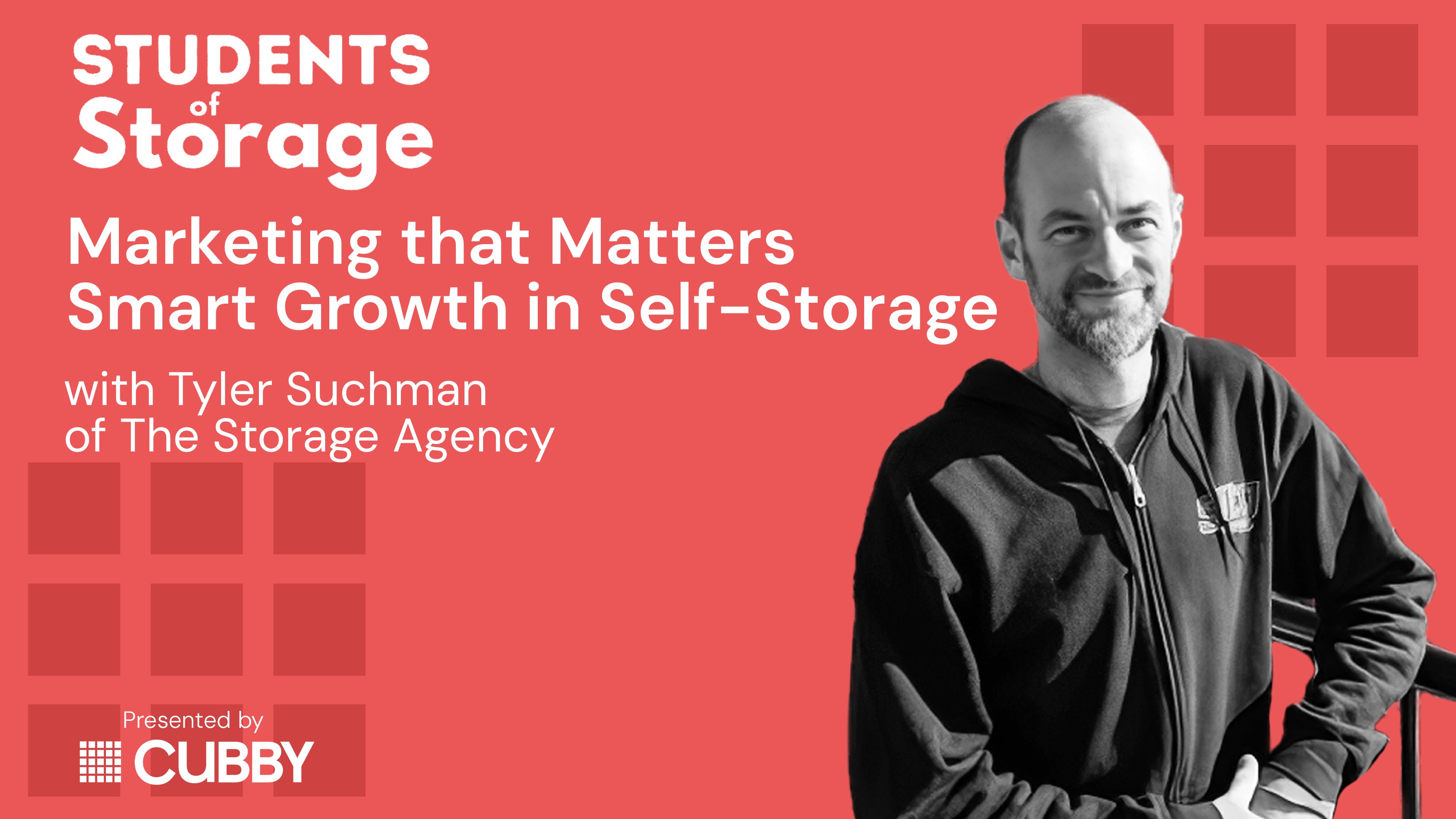
Tyler Suchman, founder of The Storage Agency, shares how local SEO, Google Ads, and a partner-first approach drive smart, sustainable growth in self-storage. With a background spanning sports media, music, and tech startups, Tyler has built a marketing agency serving over 300 facilities nationwide. He walks us through aligning marketing spend with operator goals, cleaning up a facility’s online footprint, leveraging Google reviews, and building trust-based client relationships that last.
Key Takeaways:
0:00 Introductions - From sports radio to self-storage marketing.
05:45 Choosing self-storage as a niche and how they partner with clients.
10:28 Aligning marketing spend with client stabilization goals.
13:26 What an agency should do
15:08 Small operator case study
16:39 The nuts and bolts of local SEO and cleaning up your “web footprint.”
22:39 Why Google reviews matter and how to respond effectively.
26:09 What makes a great client—and the traits that make partnerships thrive.
31:12 Cubby enhancing their platform for better marketing results
34:10 Website considerations for better marketing results.
37:59 Integrity, kindness, and doing business with the right people.
Transcript
Hello everybody. You're listening to Students of Storage. My name is Matt Engfer. I'm the co-founder and CEO of Cubby.
And today we are joined by Tyler Sutman from The Storage Agency. Tyler, how are you?
I'm doing great, and great to see you, man.
Awesome. Thank you so much for being here. I really appreciate it.
Thanks for having me. Yeah.
Yeah.
Awesome. So we're going to talk a lot about marketing today, and renting units online, over the phone, whatever it is that it takes, as an operator, to get your facility filled. But to start, let's just hear your story. Tell me your career journey and kind of how you ended up in self storage. It's always fun to hear the storage origin story.
All right. I thought I was going to be a sportscaster, and I was working for a 50,000-watt all-sports station in Los Angeles, that was purchased by ABC Cap Cities and it turned Spanish, and I didn't speak Spanish at the time. And from there I got into the music industry, and from there I was recruited to a music technology startup, which I did for a few years, and this was the
early 2000s, and when that company was acquired I started just consulting, and that — I founded a company called Tribal Core, which is now the parent agency of The Storage Agency. So I developed Tribal Core over a number of years, and about seven or eight years ago we took a more
ambitious agency approach, and about four years ago I was reading a book called The Seven Figure Agency, and in that book — at Tribal Core we were doing everything right except for one thing, which was focusing on a niche, and I took about six months or so to figure out what that niche was going to be. We had already done a bunch of work in commercial real estate. We had a small regional REIT in the storage industry that we had worked with for a number of years.
And our strategic partner had just done a 1031 exchange out of some warehouse space into a portfolio of storage facilities that he got under Extra Space management. And that went fantastic, and I was in the passenger seat and saw how all that went. And so it became really obvious to us that storage was going to be a very nice niche for us. And so we founded The Storage Agency — when I say "we," we were a team of nine.
And we founded that company in — let's see — May of 2022. So a little over three years ago. And we've since grown to nearly 300 facilities under management, and we love being in storage.
Awesome. So what is it about storage that lends itself to The Storage Agency, or you and your team, being able to have success, or find it an attractive category?
There's a lot about the storage world that is very commodified, and from marketing services to how you build buildings, to how you get into facilities — I think that the intangibles become very important. How well do you communicate? Do you have integrity? Are you honest? Are you clear in what you promise and what you can deliver? And I think that's where we've been able to win and retain quite a bit of business.
Okay, cool. I really want to dive into that. You said when you started Tribal Core and then The Storage Agency, you were — you had nine people to begin with, or was it just you and a dream?
Well, 23 years ago, it was more paying the rent than it was a dream.
But I had started consulting after leaving a startup, and so I essentially consulted for 14, 15 years before I really worked to migrate us to more of a robust agency, where I started adding team members. And when we founded The Storage Agency, we were very similar size, maybe a little bit smaller than we are now — maybe we were six and now we're nine.
Everybody's in the United States except for our accounts lead, Christine, who was born in Tulsa but lives in Dublin. So we're very US-centric, and we have nice coverage across the US where, very early in the morning, we're doing the work, and by the afternoon I'm starting to pick up some work and help out clients myself.
Awesome. Awesome. And you're based in the Bay Area, or Northern California, is that right? Yeah, I'm about two hours north of San Francisco in the coastal redwoods.
Okay, cool. Beautiful. It is nice. Nice. Awesome. So take me through the company's trajectory and kind of the lessons learned along the way. You had some experience with storage, you decided to go all in there. What happened next?
I guess there was a natural learning process where, even though we already had experience in the industry, there's still a language to learn and to really understand what our clients need from marketing and where they're trying to go.
So I try to keep us very aligned with our clients, in that — let's say Google Ads, for instance — a small owner-operator doesn't want to give money to Google Ads any longer than they have to, and so what we really try
to do is stay aligned with them such that if we're able to help them get to a point of stabilization and they're able to turn off Google Ads, that's great — they no longer have to pay us for that, they no longer have to pay Google Ads for the clicks, and hopefully we've earned their trust and we're able to continue supporting them with other marketing services, including local SEO.
So I really try to keep us aligned with our clients, where we know where they want to go, and if we can get them there, then they're going to do an expansion, they're going to acquire their next facility, they're going to tell their friend two towns over that we've been able to help them a lot. And so word of mouth has been a big part of our growth.
Yeah.
So — you have 300 facilities today, I imagine this keeps you very busy. Was there a point at which you hit a tipping point, or has it just been adding one facility here, two facilities there, over the years?
So I would say our first year was primarily mom-and-pops with between one and four facilities. And it really helped me understand — a small owner-operator that may be relying 100% on the income from their three or four facilities. And some of these decisions are like life decisions — do I want to spend on marketing, because this is all I have to pay my rent and put food on the table.
And that's healthy for us, because we've always tried to be very conservative with our clients' spend, knowing that they are committing hard-earned, precious resources towards marketing. Over time we were able to have conversations with bigger and bigger owner-operator groups, and now we work with —
and it's probably premature to talk about some of these clients, but one of our bigger clients is in the process of migrating to Cubby. And we also work with a number of third-party management companies now, and I'd say both of those things have been good sources of growth for us.
Okay, cool. So you've gotten to this point now, you have a nice client footprint and you're doing good work.
Just for everyone listening, what is the suite of services you provide? What's the pitch that you give to clients?
So we primarily focus on cost-effective marketing where we feel we can best move the needle. Being part of a larger agency, there's other stuff we can do, but one of the things we found in storage is that in a more generalist world, where you could be talking to anybody from any industry, typically marketing services tend to have a lot of fat, in the sense that you are
trying to provide a suite of services that brings in a good amount of money and delivers quality for that, but it's better to have, let's say, a $2,000-a-month client than a $500-a-month client. In storage, we really tried to pare that back and be as essential as possible, so we could keep our prices as low as possible, so that we could deal with the smallest of owner-operators and support them, which we do. And that's a conversation I've had with multiple Cubby members as well.
It's a challenging thing to work with a small owner-operator and really be able to help them for the modest marketing budgets that they have. So to answer your question, primarily we do local SEO, search engine optimization, and Google Ads, and then maybe 10-15-20% of our clients also engage us for some content development, which we call content packages, which includes a blog post and a number of images and some social support.
Okay, awesome.
How would you educate the listeners here on how an agency works, and what the cost structure looks like, and what you'd like them to know about what it is you can do as a marketing agency to deliver the service efficiently the way you do, without sacrificing quality? What do you wish they knew about you, or any of the other groups out there providing these services in the industry?
Yeah, I'd start with a metaphor. Talking to a prospective client yesterday, who's already doing a good amount of marketing and doing a decent job on his own — so why did he reach out to us?
Where can we add value if he's already doing it? And so I likened it to changing your own oil. You can get under your car, you can change your oil — you might not know exactly how to do it, right, and it's probably going to be messy — and you have that option of going down to the oil change place and working with pros, and for a modest fee, having them change your oil for you. I think resource allocation is really important. What do you want to spend your money and your time on?
So an agency can fit that role where, much as a third-party management company does, it's trying to say, "Hey, let us take all this stuff off your plate for x amount of money, or this percentage of your revenue, whatever that is." We're flat fee ourselves.
So an agency's job is to make sure that you are underpromising, overdelivering. You're clear in what you say you're going to do and what the scope of your services are,
and then you have to show up every day and earn your client's trust and do good work, which is, I would say, part work, part communication, part reporting, and getting all that dialed in really nicely. So to lift the hood on the agency model, we're a virtual company. Again, everybody in the US except for Christine. And we have really great project management and systems.
Super important for an agency that you build as much efficiency and structure and flexibility into how you manage clients and services as possible. And the ability to do so is a function of cost control.
So for us, we have to deliver — not only the work and communicate well, but also results — within a structure that allows us to be reasonably profitable. So that's essentially how an agency works — you have, for us, we use Asana for project management, great tool. Other people might use Monday or a number of other ones out there, but we've used Asana effectively for maybe six or seven years now.
And I would say that onboarding is critically important. Getting onboarding right is so important, because you're setting the tone for the entire relationship.
And so for us, that means great explainers and a checklist, keeping us all on track of who owes who what, being available for Zoom and screen share just to walk through stuff — here, let me show you how to fire up a Google Analytics account — and top to bottom making sure that client is onboarded as efficiently and quickly as possible so that we can get to the good stuff. We probably have 200-plus steps that we do as part of that onboarding process.
And then once a client's onboarded, hopefully we've earned a lot of trust during that first two weeks, and we've built a relationship for the long haul.
Cool. Let's get to the good stuff. Tell us a story — you don't have to name names if you don't want to — of a great client success, and break it down for us. Walk us through it from start to finish.
Where were they at? What were they coming to you with, and what is it that you were able to do for them? And then I want to dig into the tactics of how you accomplish those things.
Okay.
Let's start with one of the smallest of operators, because those are often the hardest to achieve success for. A guy named John down in Murphy, North Carolina runs a small facility called Storage Murphy. He's a super good guy, one of our earliest clients, taking a leap of faith with us. He had a facility with maybe 60 or so units, and his occupancy was real low —
I don't remember, maybe 20-30% — and we were able to, using local SEO and Google Ads, fill up that facility, and when we did, he was able to start putting out fencing and doing some covered parking and taking in some RV and boat storage. So he's been able to expand his income
potential pretty dramatically and increase the value of that facility quite a bit, because of his ability to get to that point of stabilization and get some cash flow going. So I think he's somebody I like to point to when I'm talking to a small owner-operator that has limited resources.
Cool. So what did you find when you got into the nitty-gritty with him from an SEO perspective, and how did you lift —
what did you change? Were you publishing content? Did you change the website? Were you putting ads out there? Walk me through the tactics of what you did there.
Yeah, for John, we've done local SEO and Google Ads primarily. Local SEO — maybe I could briefly describe that, because sometimes that's an apples-and-oranges thing, and different providers, be it a facility management platform — you know, an FMS or PMS — or a marketing company, might do things somewhat differently. I would also say it's very dependent on the PMS,
especially when you get into things like optimization and content. So local SEO — I describe this as, if I'm starting at the most rudimentary level, an owner-operator has a website, typically, and then they have a Google Business Profile, and beyond that, things get very fuzzy.
But the reality of it is that if you are a small business owner — doesn't matter if you're a plumber or a restaurant or a storage facility or whatever — when you register a business with a secretary of state, that becomes a public record, and that gets crawled and scraped, and that information starts appearing around the web.
So what happens then is that beyond the website, beyond the Google Business Profile, there may be dozens, if not hundreds, of websites and directories out there that have some information about your business. And that information may not be accurate, it may not be updated.
If you're rebranding a facility — let's say you're Shiny New Storage and you've just acquired Greta's Self Storage — Greta has a pretty darn big footprint out there on the web, because she's been around for 30 years. And so now, at the same address, there is essentially Greta and Shiny New Storage, and you have to help Google sort through all that and figure that out.
So let's just take Yelp, for example. Yelp has a listing for Greta, and it's always looking for information about the businesses in its database. So it has a spider or a bot, just like Googlebot or Google's spider, crawling around looking for information. All these sites do.
Doesn't matter if you're Facebook or Bing or Yahoo or Yellow Pages or whatever — they all have crawlers and spiders and bots looking for information about what's in their database. So what local SEO is, from our standpoint, is how do we address and clean up what I call this web footprint, which is everything beyond the website.
So the Google Business Profile, on out to, in our case, about 70 key sites and directories, where we start with — but we're not stopping at — procuring these expensive licenses from an enterprise platform that gives us direct API connections into this footprint of sites and directories. And Yelp, as an example, now has this connection and sees that we are a "source of truth," kind of in quotes.
It's sort of an industry term — on behalf of the owner — and Yelp can now look to us as a source of good information and no longer needs to crawl around looking for information. So what that does, times dozens of sites, is it cleans up this entire footprint out there and makes the information very consistent and accurate. And as you can imagine, Google's become increasingly data-driven, and it'll continue to do so.
And so as Google is looking for signals around the web, it's going to see that Shiny New Storage has this really nice footprint out there, and Greta no longer exists. And it's going to be one of those things that contributes to good organic search listings. There are a number of other things that contribute to that, but from a standpoint of cleaning up that web footprint and making sure all the data is very clean and consistent, it's definitely one of the arrows in the quiver.
I find that in our industry, when you say SEO, the people who really know their stuff just say, "Yeah, it's SEO."
And they take everything you just said for granted, as common knowledge. And maybe that's fair, but for a lot of people in the industry, everything you just described is kind of opaque. It's nice to go back to the building blocks and understand what you're actually talking about when you're talking about SEO.
When you describe it the way you did, it's totally understandable that you get to a certain point, as an operator running a business, where doing all the things you just described, even if it's aided by technology, becomes a bit of a time suck, and then it makes sense to bring in somebody who really knows what they're doing and has the systems you guys have built out to help with that stuff. Okay, cool.
What else contributes to a really successful SEO ranking? One of the things I've seen is, if you have multiple facilities in a market — anecdotally, I've seen our customers who have two, three, four facilities in a small metro, even if they're small facilities, be able to take advantage of that.
What are some of the other things you see really help, aside from the consistency of that footprint out on the internet?
Yeah. Well, I wouldn't advocate for buying your next facility for SEO purposes, but I think there's some truth to that.
I'd say the biggest one is Google reviews these days. It's critically important, and if you are in a primary or some secondary markets where you're competing against one of the big REITs, you'll see that those guys get lots of great reviews, and they may have three or four hundred reviews, and it's hard to compete. And I would say that
may be complicated for some owner-operators with unmanned facilities, which are becoming increasingly prevalent and important, where it's harder to get Google reviews. As an aside, Storage Reach is a great service, because they tie into the property management systems, including Cubby, and they're able to have a real nice loop where they solicit reviews, and I think that's a competitive differentiator for those guys. They do a really good job.
So yeah, Google reviews, super important. Freshness, and having a nice cadence — recency is important with Google reviews. So sometimes you have a facility that two years ago got 50 great reviews and hasn't had any since, and they will slip down the rankings over time, because they don't have that freshness to their site. Here's a nice little tip.
So, Google cares about what's in the content of the reviews and the replies. So what I do is — first of all, local SEO basics is you want to reply to every review. Nuts and bolts, right, blocking and tackling. What I encourage the owner-operator to do is reply with a lot of context and make it keyword-rich.
So if Jim at Springfield RV and Boat Storage gets a great review, then he wants to reply and say, "Hey Tim, thanks for leaving us such a great review. We're really glad you felt that your RV was taken such great care of, and that our covered storage was really helpful for you, and that you liked having 30 amps for your rig."
Putting in that kind of keyword-rich response is actually quite helpful in how Google contextually understands who you are and what you do and what services you offer.
Cool. Yeah, we see the folks who get a lot of online rentals in Cubby — they have a lot of reviews, and they're very recent reviews, and they have a system internally, processes internally, that are just part of an always-on machine, right? Yeah. They're asking for reviews, they're training their managers, they're doing things like that. Call center agents are asking for reviews.
They have it built into messaging that they send out. But the tip about how you respond to those reviews is super actionable, very helpful. Cool.
What about — so you told this story about this client who had a really good experience with you in North Carolina, able to lift the floor of how much they can make by adding new inventory, things like that. Taking a step back, what makes a great client for you or any agency owner in storage? And alternatively, what makes a bad one?
How do you know that you're going to be set up for success for a good relationship and good outcomes — more rentals, etc.?
When you have, in the early stages of these client relationships, what are you looking for?
It's a tricky question, and one thing I'd observe is that some clients really like understanding our work and our business, and they want to learn, and other clients are more than happy to just let us run things and maybe look at a monthly report, and they trust us to do so. And for us, it's important that we can meet a client where they are and take either role.
So we can be an educator, and we can get on a Zoom and walk through some stuff in significant detail. Or we can just provide good reporting, and we can get paid monthly, and we can do good work for that client and not really talk to him that much. And we have to be okay with either of those scenarios.
And so either way, I think in the former case, while it may be more work and time for us, at the same time, good open lines of communication with the client can lead to innovation and ideas and implementing things that otherwise we might not have collectively thought about.
So I welcome either type of client, and you know, they're all — birds of a feather out there — and we've all met clients. Storage can be kind of a quirky industry, quite honestly. So we're definitely characters in the storage industry. All of God's children here in our industry. Totally.
And I find that kind of fun, actually — getting to know our clients and serving them well.
Totally. I mean, when I think of you — we've met a number of times, we've hung out, we've had dinner, I've gotten to know your business a little bit, we share some mutual clients.
When I think of you and The Storage Agency, I think that your relationships with your clients are just different than the other relationships I see between vendors and clients elsewhere in the industry. They seem to be personal and really respectful.
Do you agree? Where does that come from?
Yeah. No, please stop. Very nice of you.
No, I really mean that though — I've definitely observed that your clients talk about you differently than they talk about a typical vendor.
Well, you talk about the relationship between a vendor and a client, and I actually really like us to get to the point where we're seen as a partner, not a vendor. And that's kind of a nuanced thing, but I think it means that we aren't
as disposable as a vendor tends to be, because a vendor is more in that commodity model — do I need service X or service Y, and what's my price point and what's my feature set — that's very different than, "I really like working with The Storage Agency because they've earned my trust and they communicate really well and they seem to know what they're talking about."
And in fact, Matt, one of the things — very often I'm talking to a prospect that is at an inflection point in their business, and they may be thinking about changing PMSs, maybe they have this ancient WordPress site, or maybe they're on a PMS that just isn't
serving them as well, or maybe that PMS has been acquired and how that PMS does customer service has changed a lot, and it may be a bit more opaque, like a more ticketing-system approach. And so when they're thinking about a new PMS, I talk about Cubby. So I'm going to sing your praises here for a moment.
Oh no, please stop, as you say. Yeah.
So a couple things really stand out for you guys. One is — and this is something most people, I think, don't know — is I know how developer-heavy your team is, and my understanding is that you guys are constantly allocating resources to making your platform ever better and making it best-in-class, essentially.
And so where that helps us — and I tell this to prospects and clients alike — is that Cubby, from a marketing standpoint, helps us do our job better. Very briefly — one of the things you guys do is you're able to take your event data and populate Google Analytics with that. So I'm going to be in the weeds here just a bit.
Yeah, let's take it there.
Okay, cool. So when I look in Google Analytics for a Cubby site, I know basically when somebody rents a unit or reserves a unit, and there are a couple others — maybe add-to-cart and some other, what we would call key events in Google Analytics. The reason that's so important is because Google Analytics and Google Ads talk, and in Google Ads you point to those key events as conversions and say, "We want to optimize for those things."
And so when Google Ads knows what to optimize for, it does a more and more efficient job over time and starts bringing down the lead acquisition cost. So from a marketer standpoint, Cubby's great, we totally dig it. I still tell our prospects that that's only part of their consideration.
They still need a platform that has a good toolset, and it's got to manage the unit mix and manage inventory and do all this other stuff that we don't touch. That's on them to understand what they need and make a good decision accordingly. But just from a marketing standpoint, we really dig it.
The last thing I'd say about Cubby is everybody I've met there is just really nice and easygoing and professional and not salesy, and you're just trying to do right by your clients. From Tully to Michael to Briana, everybody I've met has a very similar aesthetic in the way they communicate, and I think it's pretty similar to how we communicate as well.
And I just felt — not to get too "woo" on you — but our companies are kind of kindred spirits in a way. Yeah.
And I really like it when we have the opportunity to work with you guys.
Cool. Cool. So I just want to ask one more question while we're talking websites.
Talk me through — if a customer comes to you and has some ancient site they need help with, standing up a new site — what's important? You talked about key events being able to be tracked. What else do you need to be able to accomplish the best outcomes you can for a client? And where do you run into roadblocks? You don't have to talk about specific technologies here, but what do you look for when setting up a new website?
Well, we don't set up sites ourselves.
So very often we have to go to war with the army we've got.
And so that may be, in rare cases, a site that's not even mobile-responsive because it was built 20 years ago, and I'll often say, "You guys just aren't ready for us." But very often they're on one of, let's say, five or six major PMSs. Yeah. And just briefly — Easy Storage Solutions, StorageLinkedIn, Tenant Inc., you guys, Unit Track, Storable, maybe a couple others — and typically we can work with any of those sites.
Very often the website itself is not optimized. So, back to that SEO discussion — one of the facets of SEO is on-page SEO, meaning what is it you're doing on each individual page to be optimized for the search engines. At a minimum, you've got to crawl the site and make sure meta titles and meta descriptions are all good.
The way I — not to get in the weeds too much — the way I like to describe that sort of optimization is you are putting the content of a page in the right context for Google. And so by just
sort of wrapping that content with some key elements and doing that right, it just gives Google a little better handle on what it is, what you offer, and if you have, let's say, 24-hour storage, or good lighting at night, or whatever those value proposition and attributes are of a facility.
So I think, to answer your question, once in a while I say "you're not ready for us," but usually they have a decent enough setup, and I always try to qualify what we can do for them with an understanding of what their technology is doing for them. So if they don't have any notion of conversion data in Google Analytics, I tell them why that's important.
I say this will probably negatively affect your lead acquisition cost to some degree, and we can still get you good quality traffic by making sure your keyword data and geographic targeting is right, but you do have some technological limitations, and I want to be clear on that. And so pretty frequently they'll say, "Okay, I get that, and maybe over the next 6 to 12 months we're going to migrate," which may be a function of occupancy rate and cash flow. Yes.
So again, I think I'm just trying to keep us and our clients very much on the same page, and help them as they're on this trajectory to a point of stabilization.
Awesome. Well, we get really good reviews from your customers. I would encourage anyone looking for marketing services, SEO, SEM, to reach out to Tyler. Tyler, before we go, anything else you'd like to leave with the listeners?
Anything at all? You know, I think we live in a volatile world, and simply being kind and finding a moral center and having integrity in the business that you do is really important.
And I would hope that we attract those kind of people to us, and we continue to build our business with people that I think appreciate that, and life's too short to work with assholes. So hopefully we can continue to work in an ecosystem where people are just nice and kind and want to do good business and do right by their customers, and hopefully that shines through. Here, here, here, here. Awesome. Thank you so much for joining.
Appreciate your thoughts and perspective. It was nice to get some 101, and maybe some moral lessons at the end here. I love it. Appreciate it. And thanks so much, and we'll see you around.
Sounds great, Matt. Thanks so much for having me, and to you and Richard and the team for putting this together, and maybe we can revisit in a few months.
Give her another.
Sounds good. Sounds good.
Thank you for listening to Students of Storage. Links to any resources mentioned in the episode can be found in the show notes. If you enjoyed the show, please leave a five-star review and subscribe so you don't miss out on any future episodes. Thanks and have a good one.
Tyler Suchman, founder of The Storage Agency, shares how local SEO, Google Ads, and a partner-first approach drive smart, sustainable growth in self-storage. With a background spanning sports media, music, and tech startups, Tyler has built a marketing agency serving over 300 facilities nationwide. He walks us through aligning marketing spend with operator goals, cleaning up a facility’s online footprint, leveraging Google reviews, and building trust-based client relationships that last.
Key Takeaways:
0:00 Introductions - From sports radio to self-storage marketing.
05:45 Choosing self-storage as a niche and how they partner with clients.
10:28 Aligning marketing spend with client stabilization goals.
13:26 What an agency should do
15:08 Small operator case study
16:39 The nuts and bolts of local SEO and cleaning up your “web footprint.”
22:39 Why Google reviews matter and how to respond effectively.
26:09 What makes a great client—and the traits that make partnerships thrive.
31:12 Cubby enhancing their platform for better marketing results
34:10 Website considerations for better marketing results.
37:59 Integrity, kindness, and doing business with the right people.
Transcript
Hello everybody. You're listening to Students of Storage. My name is Matt Engfer. I'm the co-founder and CEO of Cubby.
And today we are joined by Tyler Sutman from The Storage Agency. Tyler, how are you?
I'm doing great, and great to see you, man.
Awesome. Thank you so much for being here. I really appreciate it.
Thanks for having me. Yeah.
Yeah.
Awesome. So we're going to talk a lot about marketing today, and renting units online, over the phone, whatever it is that it takes, as an operator, to get your facility filled. But to start, let's just hear your story. Tell me your career journey and kind of how you ended up in self storage. It's always fun to hear the storage origin story.
All right. I thought I was going to be a sportscaster, and I was working for a 50,000-watt all-sports station in Los Angeles, that was purchased by ABC Cap Cities and it turned Spanish, and I didn't speak Spanish at the time. And from there I got into the music industry, and from there I was recruited to a music technology startup, which I did for a few years, and this was the
early 2000s, and when that company was acquired I started just consulting, and that — I founded a company called Tribal Core, which is now the parent agency of The Storage Agency. So I developed Tribal Core over a number of years, and about seven or eight years ago we took a more
ambitious agency approach, and about four years ago I was reading a book called The Seven Figure Agency, and in that book — at Tribal Core we were doing everything right except for one thing, which was focusing on a niche, and I took about six months or so to figure out what that niche was going to be. We had already done a bunch of work in commercial real estate. We had a small regional REIT in the storage industry that we had worked with for a number of years.
And our strategic partner had just done a 1031 exchange out of some warehouse space into a portfolio of storage facilities that he got under Extra Space management. And that went fantastic, and I was in the passenger seat and saw how all that went. And so it became really obvious to us that storage was going to be a very nice niche for us. And so we founded The Storage Agency — when I say "we," we were a team of nine.
And we founded that company in — let's see — May of 2022. So a little over three years ago. And we've since grown to nearly 300 facilities under management, and we love being in storage.
Awesome. So what is it about storage that lends itself to The Storage Agency, or you and your team, being able to have success, or find it an attractive category?
There's a lot about the storage world that is very commodified, and from marketing services to how you build buildings, to how you get into facilities — I think that the intangibles become very important. How well do you communicate? Do you have integrity? Are you honest? Are you clear in what you promise and what you can deliver? And I think that's where we've been able to win and retain quite a bit of business.
Okay, cool. I really want to dive into that. You said when you started Tribal Core and then The Storage Agency, you were — you had nine people to begin with, or was it just you and a dream?
Well, 23 years ago, it was more paying the rent than it was a dream.
But I had started consulting after leaving a startup, and so I essentially consulted for 14, 15 years before I really worked to migrate us to more of a robust agency, where I started adding team members. And when we founded The Storage Agency, we were very similar size, maybe a little bit smaller than we are now — maybe we were six and now we're nine.
Everybody's in the United States except for our accounts lead, Christine, who was born in Tulsa but lives in Dublin. So we're very US-centric, and we have nice coverage across the US where, very early in the morning, we're doing the work, and by the afternoon I'm starting to pick up some work and help out clients myself.
Awesome. Awesome. And you're based in the Bay Area, or Northern California, is that right? Yeah, I'm about two hours north of San Francisco in the coastal redwoods.
Okay, cool. Beautiful. It is nice. Nice. Awesome. So take me through the company's trajectory and kind of the lessons learned along the way. You had some experience with storage, you decided to go all in there. What happened next?
I guess there was a natural learning process where, even though we already had experience in the industry, there's still a language to learn and to really understand what our clients need from marketing and where they're trying to go.
So I try to keep us very aligned with our clients, in that — let's say Google Ads, for instance — a small owner-operator doesn't want to give money to Google Ads any longer than they have to, and so what we really try
to do is stay aligned with them such that if we're able to help them get to a point of stabilization and they're able to turn off Google Ads, that's great — they no longer have to pay us for that, they no longer have to pay Google Ads for the clicks, and hopefully we've earned their trust and we're able to continue supporting them with other marketing services, including local SEO.
So I really try to keep us aligned with our clients, where we know where they want to go, and if we can get them there, then they're going to do an expansion, they're going to acquire their next facility, they're going to tell their friend two towns over that we've been able to help them a lot. And so word of mouth has been a big part of our growth.
Yeah.
So — you have 300 facilities today, I imagine this keeps you very busy. Was there a point at which you hit a tipping point, or has it just been adding one facility here, two facilities there, over the years?
So I would say our first year was primarily mom-and-pops with between one and four facilities. And it really helped me understand — a small owner-operator that may be relying 100% on the income from their three or four facilities. And some of these decisions are like life decisions — do I want to spend on marketing, because this is all I have to pay my rent and put food on the table.
And that's healthy for us, because we've always tried to be very conservative with our clients' spend, knowing that they are committing hard-earned, precious resources towards marketing. Over time we were able to have conversations with bigger and bigger owner-operator groups, and now we work with —
and it's probably premature to talk about some of these clients, but one of our bigger clients is in the process of migrating to Cubby. And we also work with a number of third-party management companies now, and I'd say both of those things have been good sources of growth for us.
Okay, cool. So you've gotten to this point now, you have a nice client footprint and you're doing good work.
Just for everyone listening, what is the suite of services you provide? What's the pitch that you give to clients?
So we primarily focus on cost-effective marketing where we feel we can best move the needle. Being part of a larger agency, there's other stuff we can do, but one of the things we found in storage is that in a more generalist world, where you could be talking to anybody from any industry, typically marketing services tend to have a lot of fat, in the sense that you are
trying to provide a suite of services that brings in a good amount of money and delivers quality for that, but it's better to have, let's say, a $2,000-a-month client than a $500-a-month client. In storage, we really tried to pare that back and be as essential as possible, so we could keep our prices as low as possible, so that we could deal with the smallest of owner-operators and support them, which we do. And that's a conversation I've had with multiple Cubby members as well.
It's a challenging thing to work with a small owner-operator and really be able to help them for the modest marketing budgets that they have. So to answer your question, primarily we do local SEO, search engine optimization, and Google Ads, and then maybe 10-15-20% of our clients also engage us for some content development, which we call content packages, which includes a blog post and a number of images and some social support.
Okay, awesome.
How would you educate the listeners here on how an agency works, and what the cost structure looks like, and what you'd like them to know about what it is you can do as a marketing agency to deliver the service efficiently the way you do, without sacrificing quality? What do you wish they knew about you, or any of the other groups out there providing these services in the industry?
Yeah, I'd start with a metaphor. Talking to a prospective client yesterday, who's already doing a good amount of marketing and doing a decent job on his own — so why did he reach out to us?
Where can we add value if he's already doing it? And so I likened it to changing your own oil. You can get under your car, you can change your oil — you might not know exactly how to do it, right, and it's probably going to be messy — and you have that option of going down to the oil change place and working with pros, and for a modest fee, having them change your oil for you. I think resource allocation is really important. What do you want to spend your money and your time on?
So an agency can fit that role where, much as a third-party management company does, it's trying to say, "Hey, let us take all this stuff off your plate for x amount of money, or this percentage of your revenue, whatever that is." We're flat fee ourselves.
So an agency's job is to make sure that you are underpromising, overdelivering. You're clear in what you say you're going to do and what the scope of your services are,
and then you have to show up every day and earn your client's trust and do good work, which is, I would say, part work, part communication, part reporting, and getting all that dialed in really nicely. So to lift the hood on the agency model, we're a virtual company. Again, everybody in the US except for Christine. And we have really great project management and systems.
Super important for an agency that you build as much efficiency and structure and flexibility into how you manage clients and services as possible. And the ability to do so is a function of cost control.
So for us, we have to deliver — not only the work and communicate well, but also results — within a structure that allows us to be reasonably profitable. So that's essentially how an agency works — you have, for us, we use Asana for project management, great tool. Other people might use Monday or a number of other ones out there, but we've used Asana effectively for maybe six or seven years now.
And I would say that onboarding is critically important. Getting onboarding right is so important, because you're setting the tone for the entire relationship.
And so for us, that means great explainers and a checklist, keeping us all on track of who owes who what, being available for Zoom and screen share just to walk through stuff — here, let me show you how to fire up a Google Analytics account — and top to bottom making sure that client is onboarded as efficiently and quickly as possible so that we can get to the good stuff. We probably have 200-plus steps that we do as part of that onboarding process.
And then once a client's onboarded, hopefully we've earned a lot of trust during that first two weeks, and we've built a relationship for the long haul.
Cool. Let's get to the good stuff. Tell us a story — you don't have to name names if you don't want to — of a great client success, and break it down for us. Walk us through it from start to finish.
Where were they at? What were they coming to you with, and what is it that you were able to do for them? And then I want to dig into the tactics of how you accomplish those things.
Okay.
Let's start with one of the smallest of operators, because those are often the hardest to achieve success for. A guy named John down in Murphy, North Carolina runs a small facility called Storage Murphy. He's a super good guy, one of our earliest clients, taking a leap of faith with us. He had a facility with maybe 60 or so units, and his occupancy was real low —
I don't remember, maybe 20-30% — and we were able to, using local SEO and Google Ads, fill up that facility, and when we did, he was able to start putting out fencing and doing some covered parking and taking in some RV and boat storage. So he's been able to expand his income
potential pretty dramatically and increase the value of that facility quite a bit, because of his ability to get to that point of stabilization and get some cash flow going. So I think he's somebody I like to point to when I'm talking to a small owner-operator that has limited resources.
Cool. So what did you find when you got into the nitty-gritty with him from an SEO perspective, and how did you lift —
what did you change? Were you publishing content? Did you change the website? Were you putting ads out there? Walk me through the tactics of what you did there.
Yeah, for John, we've done local SEO and Google Ads primarily. Local SEO — maybe I could briefly describe that, because sometimes that's an apples-and-oranges thing, and different providers, be it a facility management platform — you know, an FMS or PMS — or a marketing company, might do things somewhat differently. I would also say it's very dependent on the PMS,
especially when you get into things like optimization and content. So local SEO — I describe this as, if I'm starting at the most rudimentary level, an owner-operator has a website, typically, and then they have a Google Business Profile, and beyond that, things get very fuzzy.
But the reality of it is that if you are a small business owner — doesn't matter if you're a plumber or a restaurant or a storage facility or whatever — when you register a business with a secretary of state, that becomes a public record, and that gets crawled and scraped, and that information starts appearing around the web.
So what happens then is that beyond the website, beyond the Google Business Profile, there may be dozens, if not hundreds, of websites and directories out there that have some information about your business. And that information may not be accurate, it may not be updated.
If you're rebranding a facility — let's say you're Shiny New Storage and you've just acquired Greta's Self Storage — Greta has a pretty darn big footprint out there on the web, because she's been around for 30 years. And so now, at the same address, there is essentially Greta and Shiny New Storage, and you have to help Google sort through all that and figure that out.
So let's just take Yelp, for example. Yelp has a listing for Greta, and it's always looking for information about the businesses in its database. So it has a spider or a bot, just like Googlebot or Google's spider, crawling around looking for information. All these sites do.
Doesn't matter if you're Facebook or Bing or Yahoo or Yellow Pages or whatever — they all have crawlers and spiders and bots looking for information about what's in their database. So what local SEO is, from our standpoint, is how do we address and clean up what I call this web footprint, which is everything beyond the website.
So the Google Business Profile, on out to, in our case, about 70 key sites and directories, where we start with — but we're not stopping at — procuring these expensive licenses from an enterprise platform that gives us direct API connections into this footprint of sites and directories. And Yelp, as an example, now has this connection and sees that we are a "source of truth," kind of in quotes.
It's sort of an industry term — on behalf of the owner — and Yelp can now look to us as a source of good information and no longer needs to crawl around looking for information. So what that does, times dozens of sites, is it cleans up this entire footprint out there and makes the information very consistent and accurate. And as you can imagine, Google's become increasingly data-driven, and it'll continue to do so.
And so as Google is looking for signals around the web, it's going to see that Shiny New Storage has this really nice footprint out there, and Greta no longer exists. And it's going to be one of those things that contributes to good organic search listings. There are a number of other things that contribute to that, but from a standpoint of cleaning up that web footprint and making sure all the data is very clean and consistent, it's definitely one of the arrows in the quiver.
I find that in our industry, when you say SEO, the people who really know their stuff just say, "Yeah, it's SEO."
And they take everything you just said for granted, as common knowledge. And maybe that's fair, but for a lot of people in the industry, everything you just described is kind of opaque. It's nice to go back to the building blocks and understand what you're actually talking about when you're talking about SEO.
When you describe it the way you did, it's totally understandable that you get to a certain point, as an operator running a business, where doing all the things you just described, even if it's aided by technology, becomes a bit of a time suck, and then it makes sense to bring in somebody who really knows what they're doing and has the systems you guys have built out to help with that stuff. Okay, cool.
What else contributes to a really successful SEO ranking? One of the things I've seen is, if you have multiple facilities in a market — anecdotally, I've seen our customers who have two, three, four facilities in a small metro, even if they're small facilities, be able to take advantage of that.
What are some of the other things you see really help, aside from the consistency of that footprint out on the internet?
Yeah. Well, I wouldn't advocate for buying your next facility for SEO purposes, but I think there's some truth to that.
I'd say the biggest one is Google reviews these days. It's critically important, and if you are in a primary or some secondary markets where you're competing against one of the big REITs, you'll see that those guys get lots of great reviews, and they may have three or four hundred reviews, and it's hard to compete. And I would say that
may be complicated for some owner-operators with unmanned facilities, which are becoming increasingly prevalent and important, where it's harder to get Google reviews. As an aside, Storage Reach is a great service, because they tie into the property management systems, including Cubby, and they're able to have a real nice loop where they solicit reviews, and I think that's a competitive differentiator for those guys. They do a really good job.
So yeah, Google reviews, super important. Freshness, and having a nice cadence — recency is important with Google reviews. So sometimes you have a facility that two years ago got 50 great reviews and hasn't had any since, and they will slip down the rankings over time, because they don't have that freshness to their site. Here's a nice little tip.
So, Google cares about what's in the content of the reviews and the replies. So what I do is — first of all, local SEO basics is you want to reply to every review. Nuts and bolts, right, blocking and tackling. What I encourage the owner-operator to do is reply with a lot of context and make it keyword-rich.
So if Jim at Springfield RV and Boat Storage gets a great review, then he wants to reply and say, "Hey Tim, thanks for leaving us such a great review. We're really glad you felt that your RV was taken such great care of, and that our covered storage was really helpful for you, and that you liked having 30 amps for your rig."
Putting in that kind of keyword-rich response is actually quite helpful in how Google contextually understands who you are and what you do and what services you offer.
Cool. Yeah, we see the folks who get a lot of online rentals in Cubby — they have a lot of reviews, and they're very recent reviews, and they have a system internally, processes internally, that are just part of an always-on machine, right? Yeah. They're asking for reviews, they're training their managers, they're doing things like that. Call center agents are asking for reviews.
They have it built into messaging that they send out. But the tip about how you respond to those reviews is super actionable, very helpful. Cool.
What about — so you told this story about this client who had a really good experience with you in North Carolina, able to lift the floor of how much they can make by adding new inventory, things like that. Taking a step back, what makes a great client for you or any agency owner in storage? And alternatively, what makes a bad one?
How do you know that you're going to be set up for success for a good relationship and good outcomes — more rentals, etc.?
When you have, in the early stages of these client relationships, what are you looking for?
It's a tricky question, and one thing I'd observe is that some clients really like understanding our work and our business, and they want to learn, and other clients are more than happy to just let us run things and maybe look at a monthly report, and they trust us to do so. And for us, it's important that we can meet a client where they are and take either role.
So we can be an educator, and we can get on a Zoom and walk through some stuff in significant detail. Or we can just provide good reporting, and we can get paid monthly, and we can do good work for that client and not really talk to him that much. And we have to be okay with either of those scenarios.
And so either way, I think in the former case, while it may be more work and time for us, at the same time, good open lines of communication with the client can lead to innovation and ideas and implementing things that otherwise we might not have collectively thought about.
So I welcome either type of client, and you know, they're all — birds of a feather out there — and we've all met clients. Storage can be kind of a quirky industry, quite honestly. So we're definitely characters in the storage industry. All of God's children here in our industry. Totally.
And I find that kind of fun, actually — getting to know our clients and serving them well.
Totally. I mean, when I think of you — we've met a number of times, we've hung out, we've had dinner, I've gotten to know your business a little bit, we share some mutual clients.
When I think of you and The Storage Agency, I think that your relationships with your clients are just different than the other relationships I see between vendors and clients elsewhere in the industry. They seem to be personal and really respectful.
Do you agree? Where does that come from?
Yeah. No, please stop. Very nice of you.
No, I really mean that though — I've definitely observed that your clients talk about you differently than they talk about a typical vendor.
Well, you talk about the relationship between a vendor and a client, and I actually really like us to get to the point where we're seen as a partner, not a vendor. And that's kind of a nuanced thing, but I think it means that we aren't
as disposable as a vendor tends to be, because a vendor is more in that commodity model — do I need service X or service Y, and what's my price point and what's my feature set — that's very different than, "I really like working with The Storage Agency because they've earned my trust and they communicate really well and they seem to know what they're talking about."
And in fact, Matt, one of the things — very often I'm talking to a prospect that is at an inflection point in their business, and they may be thinking about changing PMSs, maybe they have this ancient WordPress site, or maybe they're on a PMS that just isn't
serving them as well, or maybe that PMS has been acquired and how that PMS does customer service has changed a lot, and it may be a bit more opaque, like a more ticketing-system approach. And so when they're thinking about a new PMS, I talk about Cubby. So I'm going to sing your praises here for a moment.
Oh no, please stop, as you say. Yeah.
So a couple things really stand out for you guys. One is — and this is something most people, I think, don't know — is I know how developer-heavy your team is, and my understanding is that you guys are constantly allocating resources to making your platform ever better and making it best-in-class, essentially.
And so where that helps us — and I tell this to prospects and clients alike — is that Cubby, from a marketing standpoint, helps us do our job better. Very briefly — one of the things you guys do is you're able to take your event data and populate Google Analytics with that. So I'm going to be in the weeds here just a bit.
Yeah, let's take it there.
Okay, cool. So when I look in Google Analytics for a Cubby site, I know basically when somebody rents a unit or reserves a unit, and there are a couple others — maybe add-to-cart and some other, what we would call key events in Google Analytics. The reason that's so important is because Google Analytics and Google Ads talk, and in Google Ads you point to those key events as conversions and say, "We want to optimize for those things."
And so when Google Ads knows what to optimize for, it does a more and more efficient job over time and starts bringing down the lead acquisition cost. So from a marketer standpoint, Cubby's great, we totally dig it. I still tell our prospects that that's only part of their consideration.
They still need a platform that has a good toolset, and it's got to manage the unit mix and manage inventory and do all this other stuff that we don't touch. That's on them to understand what they need and make a good decision accordingly. But just from a marketing standpoint, we really dig it.
The last thing I'd say about Cubby is everybody I've met there is just really nice and easygoing and professional and not salesy, and you're just trying to do right by your clients. From Tully to Michael to Briana, everybody I've met has a very similar aesthetic in the way they communicate, and I think it's pretty similar to how we communicate as well.
And I just felt — not to get too "woo" on you — but our companies are kind of kindred spirits in a way. Yeah.
And I really like it when we have the opportunity to work with you guys.
Cool. Cool. So I just want to ask one more question while we're talking websites.
Talk me through — if a customer comes to you and has some ancient site they need help with, standing up a new site — what's important? You talked about key events being able to be tracked. What else do you need to be able to accomplish the best outcomes you can for a client? And where do you run into roadblocks? You don't have to talk about specific technologies here, but what do you look for when setting up a new website?
Well, we don't set up sites ourselves.
So very often we have to go to war with the army we've got.
And so that may be, in rare cases, a site that's not even mobile-responsive because it was built 20 years ago, and I'll often say, "You guys just aren't ready for us." But very often they're on one of, let's say, five or six major PMSs. Yeah. And just briefly — Easy Storage Solutions, StorageLinkedIn, Tenant Inc., you guys, Unit Track, Storable, maybe a couple others — and typically we can work with any of those sites.
Very often the website itself is not optimized. So, back to that SEO discussion — one of the facets of SEO is on-page SEO, meaning what is it you're doing on each individual page to be optimized for the search engines. At a minimum, you've got to crawl the site and make sure meta titles and meta descriptions are all good.
The way I — not to get in the weeds too much — the way I like to describe that sort of optimization is you are putting the content of a page in the right context for Google. And so by just
sort of wrapping that content with some key elements and doing that right, it just gives Google a little better handle on what it is, what you offer, and if you have, let's say, 24-hour storage, or good lighting at night, or whatever those value proposition and attributes are of a facility.
So I think, to answer your question, once in a while I say "you're not ready for us," but usually they have a decent enough setup, and I always try to qualify what we can do for them with an understanding of what their technology is doing for them. So if they don't have any notion of conversion data in Google Analytics, I tell them why that's important.
I say this will probably negatively affect your lead acquisition cost to some degree, and we can still get you good quality traffic by making sure your keyword data and geographic targeting is right, but you do have some technological limitations, and I want to be clear on that. And so pretty frequently they'll say, "Okay, I get that, and maybe over the next 6 to 12 months we're going to migrate," which may be a function of occupancy rate and cash flow. Yes.
So again, I think I'm just trying to keep us and our clients very much on the same page, and help them as they're on this trajectory to a point of stabilization.
Awesome. Well, we get really good reviews from your customers. I would encourage anyone looking for marketing services, SEO, SEM, to reach out to Tyler. Tyler, before we go, anything else you'd like to leave with the listeners?
Anything at all? You know, I think we live in a volatile world, and simply being kind and finding a moral center and having integrity in the business that you do is really important.
And I would hope that we attract those kind of people to us, and we continue to build our business with people that I think appreciate that, and life's too short to work with assholes. So hopefully we can continue to work in an ecosystem where people are just nice and kind and want to do good business and do right by their customers, and hopefully that shines through. Here, here, here, here. Awesome. Thank you so much for joining.
Appreciate your thoughts and perspective. It was nice to get some 101, and maybe some moral lessons at the end here. I love it. Appreciate it. And thanks so much, and we'll see you around.
Sounds great, Matt. Thanks so much for having me, and to you and Richard and the team for putting this together, and maybe we can revisit in a few months.
Give her another.
Sounds good. Sounds good.
Thank you for listening to Students of Storage. Links to any resources mentioned in the episode can be found in the show notes. If you enjoyed the show, please leave a five-star review and subscribe so you don't miss out on any future episodes. Thanks and have a good one.
Latest
Content
From Oil Prices to Storage Units: Building a Business You Control with Karl Graham of Luminus Capital
Cubby Team
・
Read More

Content
The Real Legal Risks for Self-Storage Operators with Jeff Greenberger of Late2Lien
Cubby Team
・
Read More
Content
From Reviews to Rentals: Turning Google Reviews Into Real Growth with Kale Leavitt of StorageReach
Cubby Team
・
Read More