
Back
Back
Content
Power and Responsibility: Staying Compliant in the Self-Storage Lien Process with Scott Zucker and Luke Shardlow of Ai Lean
Power and Responsibility: Staying Compliant in the Self-Storage Lien Process with Scott Zucker and Luke Shardlow of Ai Lean
Cubby Team
・
Share:



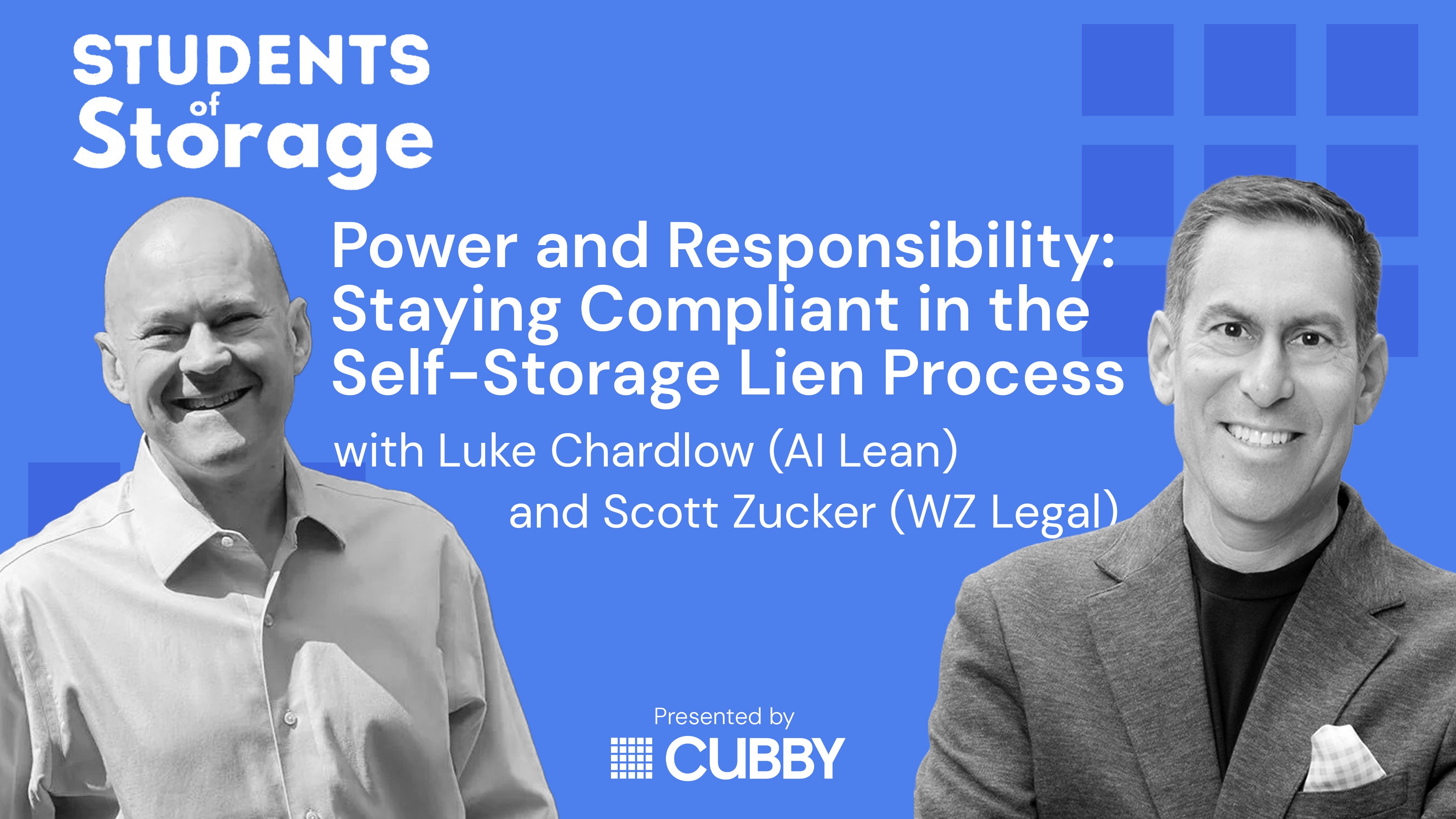
Self-storage attorney Scott Zucker and Luke Shardlow, CEO of AI Lean, join host Matt Engfer for a deep dive into one of the most critical—and risky—parts of operating a storage facility: the lien process. Together, they discuss the legal responsibilities operators carry when enforcing tenant liens, why accuracy and documentation matter more than ever, and how technology can help reduce human error, avoid legal pitfalls, and keep operators fully compliant.
Scott highlights the newest challenges around SCRA protection, bankruptcy filings, returned mail, and changing state laws, while Luke explains how AI Lean’s platform automates verification, mailing, tracking, and recordkeeping to protect operators at every step.
Whether you’re a new operator or managing a large portfolio, this episode gives you the practical tools and insights you need to navigate liens with confidence—and avoid costly mistakes.
Key Takeaways:
(01:47) Speaker Introductions
(09:14) Understanding SCRA compliance and military verification.
(10:09) The Power and Responsibility the go along with the lien process
(15:20) Technology considerations for staying SCRA compliant
(19:30) How bankruptcy impacts the lien timeline.
(21:28) Complications that come from deceased tenants
(23:00) What operators should look for in a lien-processing partner
(26:53) Don’t be afraid to cancel the sale
(29:58) Solutions to avoiding a cancelled or illegal sale
(36:00) Final lessons learned
Transcript
Hey everybody, Matt Engfer here from Cubby. Today on our Students of Storage podcast, we are excited to talk with Luke Shardlow and Scott Zucker about all things lien. We're going to dive into the risks.
We're going to dive into the possible consequences of blowing those risks and the things that you need to keep in mind as an operator in order to avoid landing in a sticky situation that can cost you a bunch of money, and all the regulations that go into the storage industry. I thought it was a great conversation.
Hope you enjoy. Let's dive in. Luke and Scott, thank you guys so much for being here today. Really appreciate it.
Great pleasure. Great to join. Awesome.
So we're going to cover a lot today. Before we jump in, maybe we can start with you, Scott. Give us a little background on who you are. I know a lot of our listeners are going to know, but who are you, what is your company, and what's your experience in the storage industry?
Well, it's always funny to call myself a self storage lawyer, but that's what I am and that's what I've become. I started in this industry back in the late 1980s. So it's been a long road working with a lot of great people, advising operators on their businesses in the unique industry of self storage compliance, and construction and employment and management. It's been really a fascinating ride with so many wonderful folks in our industry.
I operate out of Atlanta with a law firm, Weissmann Zucker, and also operate with Carlos Kaslow, the former general counsel of the Self Storage Association, on something called the Self Storage Legal Network, and we're here to help operators stay in the lines for self storage legal compliance.
Awesome.
Really, really important — or it might not seem that way until it becomes the most important thing on your mind. So, pleasure to meet you, your experience is basically unimpeachable. Everyone loves to hear from Scott. Thank you for joining us. Luke, tell us about yourself. Tell us about what you're doing at AI Lien, and then we'll dive into it.
Sounds good, Matt. It's always a tough ask to have to follow Scott in anything, but pleasure to be here. I'm relatively new to the industry. I don't have the 30-ish years that Scott brings to the table, but that's part of the reason we identified Scott as a fantastic partner earlier on and made that connection, and I've really enjoyed
getting to know Scott over the last 18 months and building that relationship. He's certainly a wealth of information and someone that we at AI Lien rely on day in, day out. So what does AI Lien do? We are a collections and delinquency management platform built specifically for storage. So today we're going to talk a little bit about — well, I'm going to tee it up, and Scott's going to give you the info.
But we're going to talk a little bit about some of the challenges that you can find yourself in if you're not thinking — you know, maybe I'll restate that, like, not even just not thinking, right — it's not enough to have thought through and have a process here to manage some of these edge cases, right?
But also your organization, your operation needs to have that implemented consistently every time, right? Because — was it you, Matt, that said, you know, it's the things that you probably don't think too much about, but when they go wrong, they really are critical issues.
Yeah.
Can leave — can leave your business with a black eye, you might say.
I like the way you worked that in there, Matt. Are we going to talk to viewers and give us a story? [laughter] I promise everyone we didn't set that up, that was Matt coming up with that on the spot.
Yeah.
Nice, nice. Well, look, if only this was some brilliant story about negotiations between us and a prospect or a vendor or something, but it's as boring as a jiu-jitsu injury last Friday.
So that's not boring at all, that sounds incredible. [clears throat] Don't mess with Luke. Okay, got it. [laughter] Well, appreciate you fighting through and being here for it. Cool, so yeah, so AI Lien, actually works with Cubby — we're integrated on several clients, and, you know, from what I understand — correct me if I'm wrong, Luke — basically the minute a tenant hits late status, you guys help operators ensure that
the way that tenant is handled and collected, and if not auctioned, ultimately stays compliant, and there's a lot that goes into it, right? Yeah, that's right. I mean, we obviously have worked with you guys over the last 12 months to build that integration, and you know, what's great about automation is that it's going to happen the same way every time, every instance, without fail, right?
And so, you know, we like to think about it as trying to distill Scott Zucker into every single process, right, and make sure that Scott's experience and knowledge is implemented as best as possible in a consistent fashion across all the jurisdictions you operate in.
Okay, awesome. So let's dive in. What are we here to really dissect today, Luke? What do the listeners really need to understand about this landscape and kind of the risk it can pose to your business?
Yeah.
Great. And I'm not going to belabor this too much, I'll provide a bit of the framework and throw it over to Scott. But you know, one of the things to think about, and we've touched on this a couple of times already, is it's not a particularly fun part of the business. It's not thinking about driving your occupancy.
It's not thinking about — if you're a third party, it's not thinking about those relationships with your owners, right? It's this kind of drudgery of having to manage this process, and often you're dealing with tenants that might not always be in a good situation. So it's not really a fun piece of the business, and then you get it wrong, right?
Yeah, I mean, a single SCRA violation can be upwards of, you know, 75 grand per issue, and we've seen the Justice Department be quite active in the industry in the last 12 months, and it can be pretty damaging.
So I think, you know, one of the things Scott and I were chatting about, what would make an interesting set of topics for listeners of yours, Matt, and we thought, well, let's cover some of these edge cases, right? What about deceased tenants, maybe some of the bankruptcy complications, and I think that's a good set of things you need to be thinking about as an operator.
Yeah. And if you have a portfolio of 10-plus facilities, you know these things, right? You've run into these cases.
But if [clears throat] you're just starting out, even if you're getting into a 300-unit facility, you get to 80-90% occupancy a couple years in, you're going to run into one of these edge cases. These edge cases happen every day, right? So, awesome, let's dive into it. You said SCRA — for the uninitiated, what is that? What does that even mean?
You know, let's throw it to Scott, shall we? Throw to the experts.
Happy to work with the acronyms here. I'm just thinking about the initial part of your conversation, maybe the jiu-jitsu thought made me think of Spider-Man, in the context of what I'm going to say. As self storage operators, with great power comes great responsibility.
And self storage operators have this tremendous self-help ability to deal with collections and delinquency and default with their customers. It's a statutory right of self-help remedy, ultimately leading to the foreclosure and sale of a tenant's goods without going to court, unless brought by certain actions of the tenant.
So with that tremendous power of an operator to deal with the delinquency of its tenants comes that great responsibility of following state and federal law with regard to the foreclosure of the tenant's goods. So that's a big responsibility of the operators, to put on their lawyer hat every time they're doing a delinquency and lien sale of their customers.
So what I liked about, and really intrigued me about AI Lien to start out with, is the automation of that process — the AI aspect of something that otherwise has been done manually by managers or folks in administrative status of a self storage facility, having to deal with the paperwork and timing and timeline of the process.
So to automate that is tremendous cost savings, obviously, for operators, and that's what intrigued me about the first AI company coming to self storage. Not unlike what Cubby brings to the table in terms of unique strategy and technology to this industry. I enjoy so much watching the technology hit the door of self storage operators, especially a guy like me who's been around for 30-plus years. It's just amazing to watch this.
So having said that, okay — yeah, go ahead, Matt, I'm sorry, I just wanted to say — no, it's fine, I was just going to say that I want to give you some props, because you're talking about the great responsibility — basically what it is, is a privilege that a lot of people worked hard to get the industry to a place where you have the ability to write a lease the way that it's written.
I'm sure, Scott, you played a role over the last 20 years in establishing these things, and these things can go away if they're abused or ignored, right? The law is always changing. So just taking that privilege and actually making it real every single day is a responsibility of a storage operator, not just for the sake of their own business, but to keep storage moving in the right direction in an environment where there's so much attention and scrutiny from a legal perspective.
I think you bring up a great point there, and I just want to give you your flowers, because you obviously made a big impact on the industry at large and helping operators stand up a lot of these things. So — I cut you off — the actual actionable stuff. So in that context, it is uniquely a federal law, the Service Members Civil Relief Act, that overshadows self storage.
And this just happened within the last decade — what was the Soldiers and Sailors Relief Act was amended back in the early 2000s to the Service Members Civil Relief Act, and as part of that amendment, included this crazy thing called protection from self storage leases,
right — where did we get, now included on the list of car repossessions and mortgage foreclosures to protect service members, now you've added a specific provision relating to self storage. So in that context, we now have a duty of
asking our tenants whether they are active-duty military, or their spouses, for the purpose of putting them in a separate category of protection if they go into delinquency, and then dealing with the separate protections of having to go to court to get a right to sell their property if they don't cure their default. Now, that's — we can go into little tangents on this. It's actually a violation of military code for service members not to pay their rent.
And a lot of these issues can be resolved by communicating with the commanding officers of the centers where these military folks are located. But still, if you have to follow an active-duty resolution, you have to follow the rules relating to that under federal law, which involves the compliance with the court notice.
What AI Lien does, as an example of that, is — if you think about it in terms of a branch of process — once the operator and AI Lien is notified these are active-duty tenants, as indicated by their lease or by later notification from the tenant during the process of collection, they go off into a separate branch of resolution.
Now, if that is missed, and the operator sells the tenant's goods without complying with the law that protects those service members, which we all want to protect — I mean, these folks are putting their lives on the line to protect our country, they deserve that extra protection — but if they miss it, there's liability that goes not just statutory damages, but the property's valuation, maybe sentimental loss. There's been some big cases over the years of violation of the SCRA.
AI Lien, again, is created to flag those unique branches of process and deal with them, as well as the other issues we'll talk about.
Yeah.
So, you know, we're familiar with this at Cubby, just from the earliest days of our company. It became absolutely required to be able to enable this kind of data capture and lease signature and all these provisions, to gather this data for all of your tenants, so that if they fit that criteria of being active-duty military, we can equip your organization and your partners like AI Lien to take action appropriately.
Luke, how do you guys take that, and what's the impact of SCRA from a technology perspective?
Yeah.
Yeah. And just want to call out, Scott — it's always fascinating when I sit down with Scott, I always learn something, right?
I wasn't aware that it was a violation of the military code not to pay your rent. So there you go — I'm going to add that into my back pocket as well.
Yeah.
But, Matt, your question was around what is the impact of this legislation, or statute, and how does that affect how we think about the product? I think Scott called it well. It's absolutely critical that we facilitate the capture of this status and ensure that essentially there's an off-ramp on the automation, right?
So whenever this is identified, the last thing you want is for that to get missed somehow. And so we do a couple of things. We have strict criteria around when an SCRA search must be performed, right, and that is legislated. So we follow that to the letter, firstly.
Secondly, one of our services that's built into the product — we have a close to 50-point audit that gets completed before a "clear to sell" is given. And without going into all of the piece parts of that, obviously SCRA is front and center.
And so, for example, if a tenant has indicated they are military, even if they're not active military, that may send us down a pathway off this sort of traditional, straight-down-the-line automation to some alternative processing. So I think it's a horrible answer, but it does sort of depend a little bit. Yeah.
Okay. Awesome.
Okay.
So you've got this system baked where you are basically guaranteed 100% never to sell the goods and livelihood of a military service member out from underneath them.
Yeah, I haven't heard this 100% guarantee issue. [laughter] I'll play lawyer for a minute since — in fact, we just had this conversation the other day, Scott. I think — I had something in front of Scott and he's like, "Hell no, you cannot put that in writing." I can't remember what it was.
Well, I'll say it, man — you can create every software system you want, but if you can promise me that every tenant that comes into the facilities that use Cubby signed that rental agreement before they get to that unit, I'd love to see a guarantee like that. It's a rough and tumble business, guys. Self storage — there's no guarantees on anything.
Yeah, for sure. And I think that's why you need multiple layers, right, Scott?
You've got to be blocking and tackling up front. You've got to be making sure your operators are following that lease process, right? The automation you guys provide, Matt, around digital leasing, etc., and how that data gets duplicated into the master record — there's multiple stages in this process, and we've all got to do our part to keep our customers, the operators, safe.
Yeah.
And in that same sense of branches, since I know we wanted to talk about this, and this is a good segue to the next topic of bankruptcy — it's the same philosophy. So the federal bankruptcy laws — these are not a state-by-state process, it's a federal law. Again, this is how unique federal law applies on top of the state laws for self storage — in bankruptcy. Federal law of a filing of a bankruptcy, whether it's an individual bankruptcy or corporate bankruptcy, creates a stay of creditor action.
So no longer can the operator send the lien notices, send the demands with regard to payments. They're stuck in a situation where they can't pursue the tenant to collect the debt without permission of the court once the bankruptcy has been filed.
So that's another — if you visualize it, another branch with respect to the lien foreclosure process — as they're going through that process, the operator's notified that the tenant's filed bankruptcy, or there's a claim relating to the assets in storage that are in bankruptcy. The flag goes up, the branch happens, the process moves, as Luke's describing, to another consideration and
review of that process, ultimately to get permission of the court for the foreclosure of the property, similar to the SCRA process, where you're looking for court authority, or resolution by the tenant with the vacating of their unit and the resolution of the debt. So there are strategies that go with bankruptcy, but I want to call out the fact that when you're thinking about automation of a statutory process, these little roadblocks are going to come up.
SCRA, bankruptcy — and you have to be prepared for how you're going to deal with them. And that's what I've seen AI Lien do.
Awesome.
What else — you've got bankruptcy — what are the other off-ramps?
If there are any. The other off-ramp I think that really is on our list is deceased tenants. And you know, I would tell you what's fascinating to me — I joke about this at every conference, you guys have heard my bad jokes over the years — number one cause of death in the United States is renting a self storage unit. It's remarkable to me how often operators come across tenants that are delinquent because they died.
And I don't know if this is a demographic reality of self storage, that many of our customers are elderly and moving their property in before they move into their retirement home. I'm starting to worry for myself. But then, to find out that the tenant died puts itself into another branch of consideration and notice and process, and consideration for that known deceased tenant, before the property and the unit is sold.
So — and we could talk about these further — but I think the lack of thought by an operator who's doing this themselves, that "oh, I can tackle every situation the same way" on a deceased tenant, a delinquent tenant, creates the risk of liability.
Right. Right.
Right.
You can't be in this industry for 20 years without some dark humor. It makes perfect sense. Luke, what is this — you're talking to operators every day about this kind of stuff. [clears throat] What's the state of play in self storage? What's the current reality for how people are handling this? Are these things being missed every day? Are there patterns?
What's going on out there?
Yeah, that's a great question.
I think overwhelmingly, what we see out there when we're talking to prospective customers is a mix, right? You have some operators that believe they have this nailed — they're like, "We don't have a problem," right?
And well, you don't have a problem yet, or you don't have a problem that you know about. We've come into certain customers, and as we're doing a bit of cleanup, you're sort of like, "That's not great, that's not great." Often some of this stuff — the operator is just completely unaware, right? Because how do you think about how they're doing this right now?
They might be using some of their existing communication tools and the timelining around outbound communications, and they're plugging this together and thinking, "All right, we got it nailed because we only operate in x state." And that's the other thing, right, this all varies state by state. So take a small operator — we've got three facilities, we're in one state, we got it all handled, we send these notices out the same way every time — but what is that relying on, right?
It's relying on, number one, a codified process, right? So you've got to get the process right, and most operators are savvy enough — they either work that out using resources from SSA, which often come from Scott and Carlos anyway, or they're engaging someone like Scott. So most folks have got their arms around that. But then you've got to write that down. Then you've got to make sure that's trained.
You've got to make sure it's implemented the same way every time. You've got to make sure these edge cases are trained in. And you think about the stuff you've got actually out in your facilities — what you're trying to do by codifying this process is take away the value judgment piece, right, because your facility managers aren't always going to be the best ones to make the appropriate risk-adjusted value judgment at the time.
So you're trying to cover all these edge cases, and then, hey, something changes, you've got to keep up with the changes. So then everyone has to remember they've got to tick every box on that process and make sure they make the right decision anytime there's a branch, and people are human, right?
So of course there are going to be errors, right? And what you hope is that the error is less consequential than more, right? Maybe it was a slightly missed timeline, and hopefully you catch it when your district manager does your audit.
I'm not aware of any process that does the same level of audit that we do, with close to 50 points that we audit. But hopefully your district manager catches it, and it's one that can be easily rectified, and maybe you've got to bump an auction or two.
But that process — it's just ripe for failure, because it's so reliant on people, and people are human, and this process is changing, keep training up — it's tough, right, it really is a place where automation — yeah, I was just going to say, I love your expression about bumping a sale.
If there's anything that comes out of this conversation, in terms of a strategy for their operations — whether they're using AI Lien or doing it themselves, or just relying on their managers through training to be aware of this — once you start a process of a lien sale through a delinquency for a tenant, don't be afraid to cancel the sale. There's no obligation or risk if you're starting the process to, like you said, bump a sale.
That's obviously — collateral to — that's some Australia inside baseball.
Where was that? Where are you from again, Luke? Where's home?
Yeah. Well, I was born in Sydney, Australia, and made my way to the West Coast — gosh, it must be almost 17 years ago now.
Okay.
But "bumping" — that's a good one, I might steal that one too. So the concept of feeling confident that you control the process — if any of these sort of oddities come up, that gut check that operators sometimes have about a tenant that they thought they received the notice on, maybe read the obituary in the paper but haven't heard from the family — saw military camouflage or something in the unit before — stop the sale. It's not worth it. And I want people to have that comfort, that when they say to me, "Can I stop a sale?" my answer is always yes.
Right. And you don't need — great point.
Yeah. You don't need a lawyer to tell you that.
And I think just to add on to that — stop, what do you say, Scott — cancel the sale, stop the sale, whatever language, terminology we want to use here. I think I revert to bumping it, because it's sort of like, push it down the track, right?
Like, I'm not saying — I mean, you need to clear that asset so you can turn it, right, you need to get it back in circulation. But I think Scott's point around — yeah, just stop the process, and if you have any questions, you can reach out to someone like Scott and, for short money, get an opinion that you can stand behind and feel comfortable, right? You don't want to be going through your day operations with some of these potential really severe issues hanging over your head, right?
But if it becomes a habit, then, as a guy who spends a lot of time talking to my clients about revenue — what you're talking about there is downtime. No one cares about the revenue that they're getting from any auction.
You want to be able to get your operation to a place where this is not a regular occurrence, because you're costing yourself real downtime and real dollars from net-new renters who are not going to be delinquent. So, cancel the sale, avoid the risk — but what's the solution to doing this? And look, I imagine this is just a pitch for AI Lien, and [laughter] [snorts] that's fine.
There's a reason that you guys exist and do what you do, but what is the solution for systematizing this so that you don't run into situations where you're bumping sales, or you're running into $75,000 fines? How do you make it real, whether it's through AI Lien or not?
Yeah, I mean, we believe, obviously, that there is a real problem here, and I think Scott and I have been talking a little bit about the risk side. You know, Matt, you bring up a fantastic point, which is — hey, you've got revenue pressures, right? Either they're your facilities, or you've got a proforma to deliver against to your owners, right? The pressures are real.
And I do understand why some operators maybe take risks that they shouldn't. But you can have both, right? You can drive for compliant sales every month, according to a predetermined schedule.
You can manage thousands of facilities through this, and you can do it consistently in a way that keeps up with the changing statutes by using a solution like ours, right?
I think if you're a Public Storage, maybe you've probably invested some money into building something that maybe does half as good a job as we do. But if you're not Public Storage, I'm yet to see a solution out there that enables the risk mitigation that we deliver while also focusing on that throughput.
Because, as you said, Matt, this inventory is perishable, right? If it's not let last month, you don't get that $100 back. So I think you can't have it all. And that's what we talk to operators about — number one, be thinking about the risk side, for sure.
But number two, what we can help you do as an operator is manage that downside and improve the upside. So lower your overall delinquency dollars, eliminate 90-day-plus. We save you time while doing it. So right now you may have DMs auditing — that can take up, you know, 20 hours per facility a month, right, just from all the audits and checks and double checks to make sure you're avoiding the downside.
So you can have both, I guess, is sort of my message.
Mhm.
Basically what I think you guys really provide is you take the experience of somebody like Scott and boil it into a piece of technology that's up to date at all times,
and those are the guardrails that your operations teams run on. And so long as you stick to the system, essentially, your chances — not 100%, maybe, but close to 100% — of avoiding some of these pitfalls and risks, basically.
Yeah.
Yeah, I mean, I mentioned this at the start — none of us would be here without the likes of Scott and Carlos, and folks who blazed the trail ahead of us, right? But I like to think we've been able to build on top of what Scott and Carlos have built out for the industry, and distilled that down into, you know, "Auto Scott," right? Imagine having Scott on every single delinquent sale.
Yeah, [laughter] Scott, if you're ever feeling down, come back on, we'll praise you for 30-40 minutes and get you back to your series. I'm looking forward to the caricature of me stamped on every lien sale notice.
Scott approved.
Yeah.
No, but really, what's been fun about helping AI Lien is what you said, Matt — the movement and recognition of the compliance piece that I live every day with. It's a fun ride because there are so many unique challenges with regard to the interpretation of the statutes, the operation of statutes, the mistakes that people made, and how to turn those mistakes around to resolution.
So then you have a company that tries to come in and automate that strategy, process of working through these laws. It's not easy — it's been an uphill battle to build a system that works like that, but they've done a really good job to do that. If I get replaced with automation one of these days, that'll be fine with me. That's how things are — irrable, Scott.
Irreplaceable. [laughter] I'll see you on the beach when that happens.
Yeah.
Yeah. And I would agree — Luke, you and I met a couple years ago now. What you guys have done, just as a software — you know, founder of Cubby — I've been impressed watching you guys in the market create a really viable business, and
build the team, earn the respect of the industry. It's been impressive to watch. Appreciate that. What have we not covered today, if anything, that is really important before — I'm just going to say you're just being nice to Luke because obviously he knows jiu-jitsu, so I feel a little intimidated personally here.
I'm glad this is all virtual. I did not know that about him. So I think one of the lessons we've all learned is, when Luke tells you something, you better listen.
No, you know, I learned that lesson a while ago. Yeah.
I want the power of a lawsuit and subpoena — I always thought that was pretty impressive, but jiu-jitsu, I mean, come on.
Yeah.
You know, it's tough, right? As you get older, right,
you want to try and stay in shape, and you think you can do all the things you used to do when you're 20 — definitely not the case, but you've got to stay in the game, right? It's important.
Yeah.
Lessons learned, Matt, as we wind — to me, it's again this power and responsibility. I think it's a theme that operators need to be reminded about, that it's a very special industry.
Everyone's worked very hard to create these laws to enhance a self storage operator's rights with regard to its tenants. It's a very unique circumstance. And if they're reminded about that, and the compliance issue, keeping up with their state laws, getting involved in their state associations, getting involved in the national association so they continue to be educated about that — is an important lesson here for everybody, because it's a moving target, and
they can certainly rely on companies like yours, and AI Lien, but guidance — they have their own responsibility of staying up to date on their industry and what's happening in the industry, because this is one fun thing about our industry — it is changing, it is moving. Makes it fun. We're not an old, stodgy industry that hasn't changed its rules in 40 years — there are changes monthly. So, yeah — up to date, folks.
Yeah.
Awesome. Awesome. Anything else, Luke?
Otherwise, I'll cut you all loose. I really appreciate you being here.
I think this was great. I think it's a little bit of a different conversation from the one we normally have. We like to think glass half full, but you need to think glass half empty every once in a while, just to make sure you're not stepping in any of these pitfalls and costing yourself a big legal bill.
Thank you guys so much for working with us and others, and Scott, thank you for everything you've done for the industry. I think everybody will appreciate what we covered today. I really appreciate you all being on.
Yeah.
And thank you both for your partnership and counsel over the last couple of years, and look forward to continuing that into the future.
Thanks, Matt. Cheers. Been fun. Cheers.
Yeah.
Self-storage attorney Scott Zucker and Luke Shardlow, CEO of AI Lean, join host Matt Engfer for a deep dive into one of the most critical—and risky—parts of operating a storage facility: the lien process. Together, they discuss the legal responsibilities operators carry when enforcing tenant liens, why accuracy and documentation matter more than ever, and how technology can help reduce human error, avoid legal pitfalls, and keep operators fully compliant.
Scott highlights the newest challenges around SCRA protection, bankruptcy filings, returned mail, and changing state laws, while Luke explains how AI Lean’s platform automates verification, mailing, tracking, and recordkeeping to protect operators at every step.
Whether you’re a new operator or managing a large portfolio, this episode gives you the practical tools and insights you need to navigate liens with confidence—and avoid costly mistakes.
Key Takeaways:
(01:47) Speaker Introductions
(09:14) Understanding SCRA compliance and military verification.
(10:09) The Power and Responsibility the go along with the lien process
(15:20) Technology considerations for staying SCRA compliant
(19:30) How bankruptcy impacts the lien timeline.
(21:28) Complications that come from deceased tenants
(23:00) What operators should look for in a lien-processing partner
(26:53) Don’t be afraid to cancel the sale
(29:58) Solutions to avoiding a cancelled or illegal sale
(36:00) Final lessons learned
Transcript
Hey everybody, Matt Engfer here from Cubby. Today on our Students of Storage podcast, we are excited to talk with Luke Shardlow and Scott Zucker about all things lien. We're going to dive into the risks.
We're going to dive into the possible consequences of blowing those risks and the things that you need to keep in mind as an operator in order to avoid landing in a sticky situation that can cost you a bunch of money, and all the regulations that go into the storage industry. I thought it was a great conversation.
Hope you enjoy. Let's dive in. Luke and Scott, thank you guys so much for being here today. Really appreciate it.
Great pleasure. Great to join. Awesome.
So we're going to cover a lot today. Before we jump in, maybe we can start with you, Scott. Give us a little background on who you are. I know a lot of our listeners are going to know, but who are you, what is your company, and what's your experience in the storage industry?
Well, it's always funny to call myself a self storage lawyer, but that's what I am and that's what I've become. I started in this industry back in the late 1980s. So it's been a long road working with a lot of great people, advising operators on their businesses in the unique industry of self storage compliance, and construction and employment and management. It's been really a fascinating ride with so many wonderful folks in our industry.
I operate out of Atlanta with a law firm, Weissmann Zucker, and also operate with Carlos Kaslow, the former general counsel of the Self Storage Association, on something called the Self Storage Legal Network, and we're here to help operators stay in the lines for self storage legal compliance.
Awesome.
Really, really important — or it might not seem that way until it becomes the most important thing on your mind. So, pleasure to meet you, your experience is basically unimpeachable. Everyone loves to hear from Scott. Thank you for joining us. Luke, tell us about yourself. Tell us about what you're doing at AI Lien, and then we'll dive into it.
Sounds good, Matt. It's always a tough ask to have to follow Scott in anything, but pleasure to be here. I'm relatively new to the industry. I don't have the 30-ish years that Scott brings to the table, but that's part of the reason we identified Scott as a fantastic partner earlier on and made that connection, and I've really enjoyed
getting to know Scott over the last 18 months and building that relationship. He's certainly a wealth of information and someone that we at AI Lien rely on day in, day out. So what does AI Lien do? We are a collections and delinquency management platform built specifically for storage. So today we're going to talk a little bit about — well, I'm going to tee it up, and Scott's going to give you the info.
But we're going to talk a little bit about some of the challenges that you can find yourself in if you're not thinking — you know, maybe I'll restate that, like, not even just not thinking, right — it's not enough to have thought through and have a process here to manage some of these edge cases, right?
But also your organization, your operation needs to have that implemented consistently every time, right? Because — was it you, Matt, that said, you know, it's the things that you probably don't think too much about, but when they go wrong, they really are critical issues.
Yeah.
Can leave — can leave your business with a black eye, you might say.
I like the way you worked that in there, Matt. Are we going to talk to viewers and give us a story? [laughter] I promise everyone we didn't set that up, that was Matt coming up with that on the spot.
Yeah.
Nice, nice. Well, look, if only this was some brilliant story about negotiations between us and a prospect or a vendor or something, but it's as boring as a jiu-jitsu injury last Friday.
So that's not boring at all, that sounds incredible. [clears throat] Don't mess with Luke. Okay, got it. [laughter] Well, appreciate you fighting through and being here for it. Cool, so yeah, so AI Lien, actually works with Cubby — we're integrated on several clients, and, you know, from what I understand — correct me if I'm wrong, Luke — basically the minute a tenant hits late status, you guys help operators ensure that
the way that tenant is handled and collected, and if not auctioned, ultimately stays compliant, and there's a lot that goes into it, right? Yeah, that's right. I mean, we obviously have worked with you guys over the last 12 months to build that integration, and you know, what's great about automation is that it's going to happen the same way every time, every instance, without fail, right?
And so, you know, we like to think about it as trying to distill Scott Zucker into every single process, right, and make sure that Scott's experience and knowledge is implemented as best as possible in a consistent fashion across all the jurisdictions you operate in.
Okay, awesome. So let's dive in. What are we here to really dissect today, Luke? What do the listeners really need to understand about this landscape and kind of the risk it can pose to your business?
Yeah.
Great. And I'm not going to belabor this too much, I'll provide a bit of the framework and throw it over to Scott. But you know, one of the things to think about, and we've touched on this a couple of times already, is it's not a particularly fun part of the business. It's not thinking about driving your occupancy.
It's not thinking about — if you're a third party, it's not thinking about those relationships with your owners, right? It's this kind of drudgery of having to manage this process, and often you're dealing with tenants that might not always be in a good situation. So it's not really a fun piece of the business, and then you get it wrong, right?
Yeah, I mean, a single SCRA violation can be upwards of, you know, 75 grand per issue, and we've seen the Justice Department be quite active in the industry in the last 12 months, and it can be pretty damaging.
So I think, you know, one of the things Scott and I were chatting about, what would make an interesting set of topics for listeners of yours, Matt, and we thought, well, let's cover some of these edge cases, right? What about deceased tenants, maybe some of the bankruptcy complications, and I think that's a good set of things you need to be thinking about as an operator.
Yeah. And if you have a portfolio of 10-plus facilities, you know these things, right? You've run into these cases.
But if [clears throat] you're just starting out, even if you're getting into a 300-unit facility, you get to 80-90% occupancy a couple years in, you're going to run into one of these edge cases. These edge cases happen every day, right? So, awesome, let's dive into it. You said SCRA — for the uninitiated, what is that? What does that even mean?
You know, let's throw it to Scott, shall we? Throw to the experts.
Happy to work with the acronyms here. I'm just thinking about the initial part of your conversation, maybe the jiu-jitsu thought made me think of Spider-Man, in the context of what I'm going to say. As self storage operators, with great power comes great responsibility.
And self storage operators have this tremendous self-help ability to deal with collections and delinquency and default with their customers. It's a statutory right of self-help remedy, ultimately leading to the foreclosure and sale of a tenant's goods without going to court, unless brought by certain actions of the tenant.
So with that tremendous power of an operator to deal with the delinquency of its tenants comes that great responsibility of following state and federal law with regard to the foreclosure of the tenant's goods. So that's a big responsibility of the operators, to put on their lawyer hat every time they're doing a delinquency and lien sale of their customers.
So what I liked about, and really intrigued me about AI Lien to start out with, is the automation of that process — the AI aspect of something that otherwise has been done manually by managers or folks in administrative status of a self storage facility, having to deal with the paperwork and timing and timeline of the process.
So to automate that is tremendous cost savings, obviously, for operators, and that's what intrigued me about the first AI company coming to self storage. Not unlike what Cubby brings to the table in terms of unique strategy and technology to this industry. I enjoy so much watching the technology hit the door of self storage operators, especially a guy like me who's been around for 30-plus years. It's just amazing to watch this.
So having said that, okay — yeah, go ahead, Matt, I'm sorry, I just wanted to say — no, it's fine, I was just going to say that I want to give you some props, because you're talking about the great responsibility — basically what it is, is a privilege that a lot of people worked hard to get the industry to a place where you have the ability to write a lease the way that it's written.
I'm sure, Scott, you played a role over the last 20 years in establishing these things, and these things can go away if they're abused or ignored, right? The law is always changing. So just taking that privilege and actually making it real every single day is a responsibility of a storage operator, not just for the sake of their own business, but to keep storage moving in the right direction in an environment where there's so much attention and scrutiny from a legal perspective.
I think you bring up a great point there, and I just want to give you your flowers, because you obviously made a big impact on the industry at large and helping operators stand up a lot of these things. So — I cut you off — the actual actionable stuff. So in that context, it is uniquely a federal law, the Service Members Civil Relief Act, that overshadows self storage.
And this just happened within the last decade — what was the Soldiers and Sailors Relief Act was amended back in the early 2000s to the Service Members Civil Relief Act, and as part of that amendment, included this crazy thing called protection from self storage leases,
right — where did we get, now included on the list of car repossessions and mortgage foreclosures to protect service members, now you've added a specific provision relating to self storage. So in that context, we now have a duty of
asking our tenants whether they are active-duty military, or their spouses, for the purpose of putting them in a separate category of protection if they go into delinquency, and then dealing with the separate protections of having to go to court to get a right to sell their property if they don't cure their default. Now, that's — we can go into little tangents on this. It's actually a violation of military code for service members not to pay their rent.
And a lot of these issues can be resolved by communicating with the commanding officers of the centers where these military folks are located. But still, if you have to follow an active-duty resolution, you have to follow the rules relating to that under federal law, which involves the compliance with the court notice.
What AI Lien does, as an example of that, is — if you think about it in terms of a branch of process — once the operator and AI Lien is notified these are active-duty tenants, as indicated by their lease or by later notification from the tenant during the process of collection, they go off into a separate branch of resolution.
Now, if that is missed, and the operator sells the tenant's goods without complying with the law that protects those service members, which we all want to protect — I mean, these folks are putting their lives on the line to protect our country, they deserve that extra protection — but if they miss it, there's liability that goes not just statutory damages, but the property's valuation, maybe sentimental loss. There's been some big cases over the years of violation of the SCRA.
AI Lien, again, is created to flag those unique branches of process and deal with them, as well as the other issues we'll talk about.
Yeah.
So, you know, we're familiar with this at Cubby, just from the earliest days of our company. It became absolutely required to be able to enable this kind of data capture and lease signature and all these provisions, to gather this data for all of your tenants, so that if they fit that criteria of being active-duty military, we can equip your organization and your partners like AI Lien to take action appropriately.
Luke, how do you guys take that, and what's the impact of SCRA from a technology perspective?
Yeah.
Yeah. And just want to call out, Scott — it's always fascinating when I sit down with Scott, I always learn something, right?
I wasn't aware that it was a violation of the military code not to pay your rent. So there you go — I'm going to add that into my back pocket as well.
Yeah.
But, Matt, your question was around what is the impact of this legislation, or statute, and how does that affect how we think about the product? I think Scott called it well. It's absolutely critical that we facilitate the capture of this status and ensure that essentially there's an off-ramp on the automation, right?
So whenever this is identified, the last thing you want is for that to get missed somehow. And so we do a couple of things. We have strict criteria around when an SCRA search must be performed, right, and that is legislated. So we follow that to the letter, firstly.
Secondly, one of our services that's built into the product — we have a close to 50-point audit that gets completed before a "clear to sell" is given. And without going into all of the piece parts of that, obviously SCRA is front and center.
And so, for example, if a tenant has indicated they are military, even if they're not active military, that may send us down a pathway off this sort of traditional, straight-down-the-line automation to some alternative processing. So I think it's a horrible answer, but it does sort of depend a little bit. Yeah.
Okay. Awesome.
Okay.
So you've got this system baked where you are basically guaranteed 100% never to sell the goods and livelihood of a military service member out from underneath them.
Yeah, I haven't heard this 100% guarantee issue. [laughter] I'll play lawyer for a minute since — in fact, we just had this conversation the other day, Scott. I think — I had something in front of Scott and he's like, "Hell no, you cannot put that in writing." I can't remember what it was.
Well, I'll say it, man — you can create every software system you want, but if you can promise me that every tenant that comes into the facilities that use Cubby signed that rental agreement before they get to that unit, I'd love to see a guarantee like that. It's a rough and tumble business, guys. Self storage — there's no guarantees on anything.
Yeah, for sure. And I think that's why you need multiple layers, right, Scott?
You've got to be blocking and tackling up front. You've got to be making sure your operators are following that lease process, right? The automation you guys provide, Matt, around digital leasing, etc., and how that data gets duplicated into the master record — there's multiple stages in this process, and we've all got to do our part to keep our customers, the operators, safe.
Yeah.
And in that same sense of branches, since I know we wanted to talk about this, and this is a good segue to the next topic of bankruptcy — it's the same philosophy. So the federal bankruptcy laws — these are not a state-by-state process, it's a federal law. Again, this is how unique federal law applies on top of the state laws for self storage — in bankruptcy. Federal law of a filing of a bankruptcy, whether it's an individual bankruptcy or corporate bankruptcy, creates a stay of creditor action.
So no longer can the operator send the lien notices, send the demands with regard to payments. They're stuck in a situation where they can't pursue the tenant to collect the debt without permission of the court once the bankruptcy has been filed.
So that's another — if you visualize it, another branch with respect to the lien foreclosure process — as they're going through that process, the operator's notified that the tenant's filed bankruptcy, or there's a claim relating to the assets in storage that are in bankruptcy. The flag goes up, the branch happens, the process moves, as Luke's describing, to another consideration and
review of that process, ultimately to get permission of the court for the foreclosure of the property, similar to the SCRA process, where you're looking for court authority, or resolution by the tenant with the vacating of their unit and the resolution of the debt. So there are strategies that go with bankruptcy, but I want to call out the fact that when you're thinking about automation of a statutory process, these little roadblocks are going to come up.
SCRA, bankruptcy — and you have to be prepared for how you're going to deal with them. And that's what I've seen AI Lien do.
Awesome.
What else — you've got bankruptcy — what are the other off-ramps?
If there are any. The other off-ramp I think that really is on our list is deceased tenants. And you know, I would tell you what's fascinating to me — I joke about this at every conference, you guys have heard my bad jokes over the years — number one cause of death in the United States is renting a self storage unit. It's remarkable to me how often operators come across tenants that are delinquent because they died.
And I don't know if this is a demographic reality of self storage, that many of our customers are elderly and moving their property in before they move into their retirement home. I'm starting to worry for myself. But then, to find out that the tenant died puts itself into another branch of consideration and notice and process, and consideration for that known deceased tenant, before the property and the unit is sold.
So — and we could talk about these further — but I think the lack of thought by an operator who's doing this themselves, that "oh, I can tackle every situation the same way" on a deceased tenant, a delinquent tenant, creates the risk of liability.
Right. Right.
Right.
You can't be in this industry for 20 years without some dark humor. It makes perfect sense. Luke, what is this — you're talking to operators every day about this kind of stuff. [clears throat] What's the state of play in self storage? What's the current reality for how people are handling this? Are these things being missed every day? Are there patterns?
What's going on out there?
Yeah, that's a great question.
I think overwhelmingly, what we see out there when we're talking to prospective customers is a mix, right? You have some operators that believe they have this nailed — they're like, "We don't have a problem," right?
And well, you don't have a problem yet, or you don't have a problem that you know about. We've come into certain customers, and as we're doing a bit of cleanup, you're sort of like, "That's not great, that's not great." Often some of this stuff — the operator is just completely unaware, right? Because how do you think about how they're doing this right now?
They might be using some of their existing communication tools and the timelining around outbound communications, and they're plugging this together and thinking, "All right, we got it nailed because we only operate in x state." And that's the other thing, right, this all varies state by state. So take a small operator — we've got three facilities, we're in one state, we got it all handled, we send these notices out the same way every time — but what is that relying on, right?
It's relying on, number one, a codified process, right? So you've got to get the process right, and most operators are savvy enough — they either work that out using resources from SSA, which often come from Scott and Carlos anyway, or they're engaging someone like Scott. So most folks have got their arms around that. But then you've got to write that down. Then you've got to make sure that's trained.
You've got to make sure it's implemented the same way every time. You've got to make sure these edge cases are trained in. And you think about the stuff you've got actually out in your facilities — what you're trying to do by codifying this process is take away the value judgment piece, right, because your facility managers aren't always going to be the best ones to make the appropriate risk-adjusted value judgment at the time.
So you're trying to cover all these edge cases, and then, hey, something changes, you've got to keep up with the changes. So then everyone has to remember they've got to tick every box on that process and make sure they make the right decision anytime there's a branch, and people are human, right?
So of course there are going to be errors, right? And what you hope is that the error is less consequential than more, right? Maybe it was a slightly missed timeline, and hopefully you catch it when your district manager does your audit.
I'm not aware of any process that does the same level of audit that we do, with close to 50 points that we audit. But hopefully your district manager catches it, and it's one that can be easily rectified, and maybe you've got to bump an auction or two.
But that process — it's just ripe for failure, because it's so reliant on people, and people are human, and this process is changing, keep training up — it's tough, right, it really is a place where automation — yeah, I was just going to say, I love your expression about bumping a sale.
If there's anything that comes out of this conversation, in terms of a strategy for their operations — whether they're using AI Lien or doing it themselves, or just relying on their managers through training to be aware of this — once you start a process of a lien sale through a delinquency for a tenant, don't be afraid to cancel the sale. There's no obligation or risk if you're starting the process to, like you said, bump a sale.
That's obviously — collateral to — that's some Australia inside baseball.
Where was that? Where are you from again, Luke? Where's home?
Yeah. Well, I was born in Sydney, Australia, and made my way to the West Coast — gosh, it must be almost 17 years ago now.
Okay.
But "bumping" — that's a good one, I might steal that one too. So the concept of feeling confident that you control the process — if any of these sort of oddities come up, that gut check that operators sometimes have about a tenant that they thought they received the notice on, maybe read the obituary in the paper but haven't heard from the family — saw military camouflage or something in the unit before — stop the sale. It's not worth it. And I want people to have that comfort, that when they say to me, "Can I stop a sale?" my answer is always yes.
Right. And you don't need — great point.
Yeah. You don't need a lawyer to tell you that.
And I think just to add on to that — stop, what do you say, Scott — cancel the sale, stop the sale, whatever language, terminology we want to use here. I think I revert to bumping it, because it's sort of like, push it down the track, right?
Like, I'm not saying — I mean, you need to clear that asset so you can turn it, right, you need to get it back in circulation. But I think Scott's point around — yeah, just stop the process, and if you have any questions, you can reach out to someone like Scott and, for short money, get an opinion that you can stand behind and feel comfortable, right? You don't want to be going through your day operations with some of these potential really severe issues hanging over your head, right?
But if it becomes a habit, then, as a guy who spends a lot of time talking to my clients about revenue — what you're talking about there is downtime. No one cares about the revenue that they're getting from any auction.
You want to be able to get your operation to a place where this is not a regular occurrence, because you're costing yourself real downtime and real dollars from net-new renters who are not going to be delinquent. So, cancel the sale, avoid the risk — but what's the solution to doing this? And look, I imagine this is just a pitch for AI Lien, and [laughter] [snorts] that's fine.
There's a reason that you guys exist and do what you do, but what is the solution for systematizing this so that you don't run into situations where you're bumping sales, or you're running into $75,000 fines? How do you make it real, whether it's through AI Lien or not?
Yeah, I mean, we believe, obviously, that there is a real problem here, and I think Scott and I have been talking a little bit about the risk side. You know, Matt, you bring up a fantastic point, which is — hey, you've got revenue pressures, right? Either they're your facilities, or you've got a proforma to deliver against to your owners, right? The pressures are real.
And I do understand why some operators maybe take risks that they shouldn't. But you can have both, right? You can drive for compliant sales every month, according to a predetermined schedule.
You can manage thousands of facilities through this, and you can do it consistently in a way that keeps up with the changing statutes by using a solution like ours, right?
I think if you're a Public Storage, maybe you've probably invested some money into building something that maybe does half as good a job as we do. But if you're not Public Storage, I'm yet to see a solution out there that enables the risk mitigation that we deliver while also focusing on that throughput.
Because, as you said, Matt, this inventory is perishable, right? If it's not let last month, you don't get that $100 back. So I think you can't have it all. And that's what we talk to operators about — number one, be thinking about the risk side, for sure.
But number two, what we can help you do as an operator is manage that downside and improve the upside. So lower your overall delinquency dollars, eliminate 90-day-plus. We save you time while doing it. So right now you may have DMs auditing — that can take up, you know, 20 hours per facility a month, right, just from all the audits and checks and double checks to make sure you're avoiding the downside.
So you can have both, I guess, is sort of my message.
Mhm.
Basically what I think you guys really provide is you take the experience of somebody like Scott and boil it into a piece of technology that's up to date at all times,
and those are the guardrails that your operations teams run on. And so long as you stick to the system, essentially, your chances — not 100%, maybe, but close to 100% — of avoiding some of these pitfalls and risks, basically.
Yeah.
Yeah, I mean, I mentioned this at the start — none of us would be here without the likes of Scott and Carlos, and folks who blazed the trail ahead of us, right? But I like to think we've been able to build on top of what Scott and Carlos have built out for the industry, and distilled that down into, you know, "Auto Scott," right? Imagine having Scott on every single delinquent sale.
Yeah, [laughter] Scott, if you're ever feeling down, come back on, we'll praise you for 30-40 minutes and get you back to your series. I'm looking forward to the caricature of me stamped on every lien sale notice.
Scott approved.
Yeah.
No, but really, what's been fun about helping AI Lien is what you said, Matt — the movement and recognition of the compliance piece that I live every day with. It's a fun ride because there are so many unique challenges with regard to the interpretation of the statutes, the operation of statutes, the mistakes that people made, and how to turn those mistakes around to resolution.
So then you have a company that tries to come in and automate that strategy, process of working through these laws. It's not easy — it's been an uphill battle to build a system that works like that, but they've done a really good job to do that. If I get replaced with automation one of these days, that'll be fine with me. That's how things are — irrable, Scott.
Irreplaceable. [laughter] I'll see you on the beach when that happens.
Yeah.
Yeah. And I would agree — Luke, you and I met a couple years ago now. What you guys have done, just as a software — you know, founder of Cubby — I've been impressed watching you guys in the market create a really viable business, and
build the team, earn the respect of the industry. It's been impressive to watch. Appreciate that. What have we not covered today, if anything, that is really important before — I'm just going to say you're just being nice to Luke because obviously he knows jiu-jitsu, so I feel a little intimidated personally here.
I'm glad this is all virtual. I did not know that about him. So I think one of the lessons we've all learned is, when Luke tells you something, you better listen.
No, you know, I learned that lesson a while ago. Yeah.
I want the power of a lawsuit and subpoena — I always thought that was pretty impressive, but jiu-jitsu, I mean, come on.
Yeah.
You know, it's tough, right? As you get older, right,
you want to try and stay in shape, and you think you can do all the things you used to do when you're 20 — definitely not the case, but you've got to stay in the game, right? It's important.
Yeah.
Lessons learned, Matt, as we wind — to me, it's again this power and responsibility. I think it's a theme that operators need to be reminded about, that it's a very special industry.
Everyone's worked very hard to create these laws to enhance a self storage operator's rights with regard to its tenants. It's a very unique circumstance. And if they're reminded about that, and the compliance issue, keeping up with their state laws, getting involved in their state associations, getting involved in the national association so they continue to be educated about that — is an important lesson here for everybody, because it's a moving target, and
they can certainly rely on companies like yours, and AI Lien, but guidance — they have their own responsibility of staying up to date on their industry and what's happening in the industry, because this is one fun thing about our industry — it is changing, it is moving. Makes it fun. We're not an old, stodgy industry that hasn't changed its rules in 40 years — there are changes monthly. So, yeah — up to date, folks.
Yeah.
Awesome. Awesome. Anything else, Luke?
Otherwise, I'll cut you all loose. I really appreciate you being here.
I think this was great. I think it's a little bit of a different conversation from the one we normally have. We like to think glass half full, but you need to think glass half empty every once in a while, just to make sure you're not stepping in any of these pitfalls and costing yourself a big legal bill.
Thank you guys so much for working with us and others, and Scott, thank you for everything you've done for the industry. I think everybody will appreciate what we covered today. I really appreciate you all being on.
Yeah.
And thank you both for your partnership and counsel over the last couple of years, and look forward to continuing that into the future.
Thanks, Matt. Cheers. Been fun. Cheers.
Yeah.
Latest
Content
From Oil Prices to Storage Units: Building a Business You Control with Karl Graham of Luminus Capital
Cubby Team
・
Read More
Content
The Real Legal Risks for Self-Storage Operators with Jeff Greenberger of Late2Lien
Cubby Team
・
Read More
Content
From Reviews to Rentals: Turning Google Reviews Into Real Growth with Kale Leavitt of StorageReach
Cubby Team
・
Read More