
Back
Back
Content
Taking the Guesswork Out Of Marketing: Data, Partnerships, and Performance with Gabe Thayn of Marketing.Storage
Taking the Guesswork Out Of Marketing: Data, Partnerships, and Performance with Gabe Thayn of Marketing.Storage
Cubby Team
・
Share:



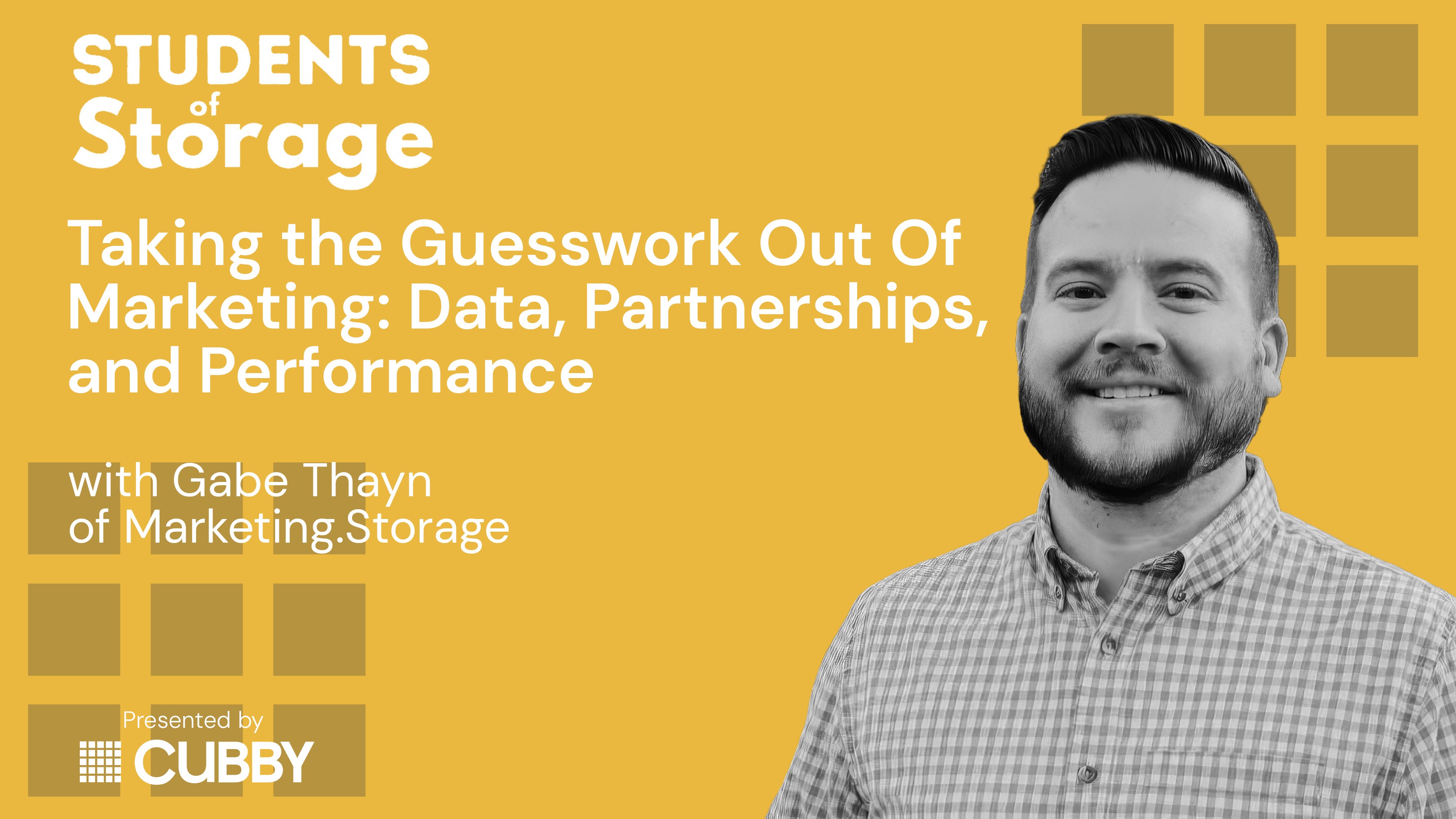
Gabe Thayn, Co-Founder of Marketing.Storage, joins Matt Engfer to share how data, transparency, and true partnership—not vendor relationships—drive marketing success for self-storage operators. With nearly 20 years of experience leading digital marketing at companies like Extra Space Storage and Adigma, Gabe has helped shape how the industry approaches SEO, paid search, and performance measurement.
In this episode, Gabe explains why understanding and tracking your data is the foundation of every effective marketing strategy. He outlines the three core pillars of SEO—technical structure, content, and backlinks—and how to optimize each one for local impact. Gabe also breaks down what it takes to achieve accurate attribution, measure true ROI, and turn marketing insights into more rentals.
For operators and owners looking to make smarter marketing investments and build stronger partnerships, this episode offers a clear roadmap for turning data into performance.
Key Takeaways:
(01:44) Gabe’s journey from tech and gaming into marketing
(07:00) Lessons learned from leading paid media at Extra Space Storage
(10:30) Leaving Extra Space and using Google data in the hotel industry and beyond
(13:00) Agencies vs Firms - the importance of partnerships and beginning Marketing.Storage
(16:00) The foundation underneath Marketing.Storage - partners, not clients
(18:00) Why you need a marketing partner vs DIY - SEO Tips
(20:35) The three pillars of SEO: technical, content, and backlinks
(24:50) Practical local backlink strategies for storage facilities
(29:05) How you can generate more rentals- Measurement and analytics
(35:36) Using data to make smarter marketing and investment decisions
(37:44) The difference between vendors and partners in marketing success
(41:00) Why communication and accountability lead to better results
Transcript
Hey everybody, I'm Matt Engfer, the co-founder and CEO of Cubby. We're the self storage platform that makes growth simple. We make facility management, revenue management, and call center management software for the self storage industry.
Today on our Students of Storage podcast, I'm joined by Gabe Dayne, co-founder of marketing.storage, one of the faster growing marketing agencies, or "un-agencies," as you'll hear today, in the self storage industry. Let's go.
Gabe, thank you for joining us.
Thanks. How are you having me? I'm great, I'm excited.
Awesome. Yeah. Our teams have worked closely together for years now.
We know you well. I thought it'd be great to have you on because I think a lot of people in our industry crave good marketing expertise, definitely that you provide to your clients in spades.
Thank you.
Tell us your story. How did you get into marketing, from the minute your career started to today?
Yeah, for sure. It's interesting — I've always been very technical, because I love computers and video games and all those different pieces. And where I started getting more technical is I wanted to create forums for my video games and my community there, and that's how I learned how to do coding and pieces, and joined a website company, and then it became very much like, okay, we need to market these websites. So I moved from there to join an agency — a popular agency here in Utah — and I joined just as an account manager, really.
I didn't know marketing, I just knew stuff about the internet and how to use it. And I was pretty good at learning the different marketing pieces and how that worked, and decided it'd be fun to actually do marketing pieces. And one time I was at Walmart, just walking down the aisle, and the head of the paid search team walks by with her cart and says, "Gabe, are you planning on applying for the PPC technical lead?"
And I was like, "Well, I'm not on the PPC team, I don't do these things."
She kind of looked at me, and said, "I think you should, I'd highly recommend it." And when the head of that department tells you that, you're like, "Okay, I guess I'll apply." So, no joke, on the way home, my wife and I stopped by Barnes & Noble, back when it was a thing, and I literally bought the book "AdWords for Dummies," and I read that front to back like three times, went to the interview, got the job, and now I do paid search, I do Google Ads.
I did that there for a couple of years. And when was that?
This was 18-20 years ago. 20 years ago.
Okay.
Not trying to get you to age yourself on the podcast here, but — I look younger than I actually am. So yeah, it was about 20 years I've been doing marketing, and that was a really great experience, learning all that Google Ads and the technologies of it, and working with every type of business under the sun — ecom, B2B, SaaS, local, national, international. It was a really good experience to get my teeth into what marketing is, primarily especially on the Google Ads side.
Then I wanted to move up, expand my career, and I saw an opportunity — a job posting for Extra Space Storage — and this was, you know, probably 14 years ago, and I applied. What was fun about that is one of the team members there knew me from the agency, and was like, "Oh, Gabe's great."
So I had an in that way, and it was a very fledgling small team, just a few people, and they had like a PPC person and an SEO person and kind of the boss man, and they were looking for more PPC support. So I joined that team. At the time, Extra Space was considerably smaller than they are today — they had about 180 facilities, which is a very large one.
Was it publicly traded at that point? I think it was just at the beginnings of it. And I was over Google Ads and had big, fun, fat, healthy budgets, and were able to do all kinds of wild stuff. And when you spend the kind of money that Extra Space does on marketing, you get access to the best Google reps and contacts and all those different pieces.
And so that was honestly a lot of fun.
The owner at the time, or the CEO at the time, Spencer Kirk, was very much an entrepreneur, and he wanted to invest in the marketing stuff and say there's a lot of opportunity here. Let's get technical. So we were part of all the crazy betas that maybe some people remember from the old days, of how we're going to do Bluetooth mods inside every facility to try to measure store rentals, and those things — we got to be part of all those things.
And there's over a dozen case studies of the work we did while I was at Extra Space, and I had the opportunity to even speak at Google a handful of times. We ended up writing our own kind of bidding algorithm when Google made some big change to how device bidding worked, and I created that whole piece and used their own platform to deliver it, and they were like, "Why are you doing this?"
I said, "Because Google Ads is made to appease the mass industry, and we need a solution that works just for us." And because of that, they flew me out there and I presented to the whole Double Click Search team, which was a really cool, fun experience, and scary.
But we did that, and I was there for about five and a half, six years, if I'm mathing right, and when I left they had 1,900 locations. So from 180 to 1,900, and the team needed to be part of that — having the job of filling these up, please, in the most efficient, cost-beneficial way. So I feel really confident saying we kind of wrote the book on how to do digital marketing for the self storage space. We had all the data and did all the tests, and were very successful.
I'm curious — you mentioned how at the time your CEO was really tech-forward and encouraging you to do pilots and try new things.
That sounds familiar, or it rhymes with some of the experiences I've had with our more forward-thinking customers.
Mhm.
What are some examples of the impact that that cultural theme, or that attitude, created for your marketing team, and the outcomes you were able to deliver?
Definitely. First and foremost, it made it an exciting place to be. It made it so we were challenging ourselves and growing in our careers as professionals.
Mhm.
That encouragement — it took a little bit of arm-bending, honestly, from Google, to say do these things, even though we have to take into account what's good for the business, what's good for our specific industry and the things we're trying to do, versus what Google wants to do. And obviously they provide great value, but they have a goal, right — drive revenue, get clicks.
And so with this mentality of, hey, take advantage of pilots, jump into betas, those kinds of things — I always super encourage that, but you have to do it with a very specific approach to how you're going to track and measure performance and make sure it's actually valuable and good for you. We have to oftentimes think not like operators but more like potential tenants, and how they would approach whatever feature or tool we're using and how they want to take advantage of it.
Because we've had plenty of times where, oh, this alpha was horrible, it lost us a bunch of money, but other times, hey, this was very cool and experimental and now we're going to take advantage of it. Another important part of this is when Google's going to give you access to betas and alphas and all these different things, they're telling you what the future is for them and what their focuses are going to be.
And so it's not always a great idea to push against the changes that Google wants to enforce, but more, okay, how can we jump on board and utilize this in a way that works for us — because we're going to continually lose some of the control and levers that we have.
So knowing that that's going to happen no matter what, it's, okay, how will we future-prep to take that on? For example, that big bidding algorithm that I wrote — it benefited us for a year and a half, but then Google shifted and changed and kind of forced our hand to approach bidding in a different way. And so by being early adopters, thinking about what we will do to future-proof our business when Google pulled the trigger, we were there, and all of
our competition had to then scramble and be like, "Oh no, they did the thing."
So that was hugely beneficial. Take advantage of those opportunities, see what Google's wanting to do. You can't stop Google from doing the things they want to do, so you have to move in a way that you can go with that flow.
Yeah, that's interesting. I think that's true not just with Google, but with any vendor, basically. You have to develop a good partnership, you've got to be willing to try new things, you can't try new things just to try new things, you've got to measure and have a system for evaluating how effective those things are.
Makes a lot of sense. Cool, I just wanted to double-click on that. Let's keep going. What happens — so five, six years at Extra Space, then what?
And then I left — I left kind of with the transition of CEOs. Joe Margolis came in — amazing, super smart, kind man.
Yeah, he was a banker. And when you move from like fast-growing, crazy technological to a banker coming in charge, like, "Hey, we're now a billion-dollar tech company. Let's not necessarily go into maintenance mode, but let's get into a position where we can hold on to things." And it felt a little maintenance mode in my mind, and I was like, maintenance mode equals boring mode. I'm out. And that was hard, because honestly I love the team — I still really love those guys.
Like the two women in charge over there on the marketing side — amazing, so smart, ballers, honestly. They're great.
Awesome.
And so it was really hard to leave. But I went, with some other people who were at Extra Space as well, to a group that did hotels. And it was 150,000 hotels worldwide.
And there's some similarities there, right — we're storing human beings, and our latest stay is one day, but that same hyper-local kind of control. Another shift, and I think it'll be important — maybe we talk about this later — hotels, you can kind of generate demand, versus self storage not so much, it's more capture the demand that exists. But the hotels piece was cool, because in a single day we would get enough data points that would take Extra Space, even with all their data and facilities, it would take them a week or two to get
that level of data. And any marketer who isn't just obsessed and plugged into data is probably not a great marketer. Data is the engine.
And so having that much data was really exciting. And we did that for about a year and a half, and was heavily involved in the hotels booking piece of Google Business Profile — which there's actually a brand new beta for self storage now, reserve online via GBP. It's kind of shaking things up, which will be interesting, and we're talking with our personal Google rep about getting certain partners we work with integrating that.
Anyways, so we did the hotel piece, and that was exciting — did that for about a year and a half. And then I was like, you know what, it'd be great to build something for ourselves, right? We've worked at agencies, we've had to use agencies, and transparently, we don't like agencies, right? So I ended up creating a marketing firm — I don't call them an agency, we're a firm, right?
And so we started a company called Adigma. It was me and my business partner and friend, Cameron Yuri. And Adigma did both marketing for the self storage space but also for the non-self-storage space — so back to B2B, ecom, all these different things. And when we created Adigma, it was very intentional that we were not going to be an agency, like, we used that verbiage.
Agencies don't communicate, their reporting is not great, they're checkbox agencies, they're set-it-and-forget-it. Those were all the things we hated when we worked at agencies, and things we hated when at Extra Space using agencies. And so we even had a term called "the Adigma way" — no, we're always going to do the best thing.
Mediocrity is not allowed. We have to be the best. And it was cool to grow, honestly just through referral growth, business. In typical fashion, we were amazing at marketing but didn't market ourselves that much. It was pretty standard — like, we make websites but our website stinks. What?
Yeah.
And we really grew — it was kind of also one of those things where we could grow our self storage base, where people were like, "Wait, the Extra Space marketing guys left, can they help us... for money?" Right. And so we grew that pretty quickly and ran that for about five or six years, and then we ended up selling that to a group in the space — a hardware group. So we sold that, and that was a wild and interesting experience.
I'd never done something like that before, and it was definitely a learning experience, both good and —
Yeah.
Yeah.
Growth-oriented. I love it.
Right. And then from there it was just like, you know what, we kind of did some pieces with that organization that had acquired us, and then we ended up breaking off and creating marketing.storage. What year was that?
It was just about three years ago. Next month it'll be three years, which is kind of crazy to say.
And even though we've been going for three years, there are still some operators we're working with that we had at Adigma, some working with for eight years, as they buy new properties, sell, expand, they just know, hey, Gabe is going to keep us full, so let's keep working. And that has been really awesome. It's been an experience we really value. And it's kind of hokey, and we're hokey.
We're fun. We get emotional. We love it, and we love our responsibility, and we love being kind of an anti-agency agency, anti-vendor vendor. We know there's power in partnership. Yeah. Smile.
Cool. So tell us about marketing.storage. What does it do, and tell us a little bit about the team and services you provide.
Yeah, for sure. Marketing.storage is focused on nothing but the self storage space. By having that level of focus — it's intense to say this, but we are going to say we are the best in the world at self storage digital marketing.
And it's niche enough, and we're experienced enough, that that mandate makes sense and it works. And I believe we are that — and it's that same feeling, when an operator works with us, first of all, we refer to all of our operators as partners.
We don't call them clients, because we don't want to be called a vendor. And there's nuance to it, but it's more like the feeling of, no, we're working on this together, right?
And we actually even have some data points that show people who treat us like a vendor have a lower ROI than people who treat us like a partner — the communications aren't as good there. We ask for very little commitment, but we need some communication, some kind of pieces like that. So we're focused on communication — we say internally, communication is not allowed to be a problem. We talk with our operators and the groups we work with all the time. So we're all about the digital marketing piece, and that means local SEO —
getting people to show up in the map pack and everything involved there, managing people's Google profiles, citations, directories, all those things, and keeping a good active pulse on what Google's wanting from us to display in the map section. It's so vital for self storage operators because we're a hyper-local industry, right? Our world is a 3-to-5-mile radius. Yeah. Maybe expands to 10-15 if you're doing RVs and stuff.
Yeah.
And then we do what we call — go ahead.
I want to talk about the other services, but while we're on this topic.
Yeah.
Give me one or two things that would maybe surprise people about what's required to do a good job of this. Why is it necessary to have someone with their finger on the pulse of this every day?
Great question. It's interesting, because there are tools out there people can use that have some automation elements to it. But to be the best and have your information all the places it needs to be, there are definitely some manual elements where you have to go and make sure those things are updated and clean. It really is all about what we call NAP — your name, address, and phone number — being accurate across all these different directories, citations, etc. So Google sees, oh, accuracy —
I trust this as a source, and so I'm going to increase the rankings for this.
Yeah.
Oftentimes people will change a phone number — that's the number one thing where we see discrepancy. They'll change a phone number and not think, oh, there's probably, if you've been doing this a while, like 75 other places I need to change this. Some tools can help, but you also need somebody to know where those things are.
Be able to identify that. You have to be careful — there are some tools and things that, while you're using them, they're going to distribute your information, it'll be good, but as soon as you cancel, they'll remove it.
Yeah.
We're pretty intense on — no, this stuff is yours, this is your property, this is your value that we're creating for you.
That's a big piece of the local element. Another element — I think usually an operator, Gabe, it sounds like you're doing all this stuff for me, what do I need to do — and we say, you need more reviews. Reviews are going to be one of your most powerful drivers for improving rankings on your GBP, Google Business Profile. And not only get more reviews, but respond to those reviews, both positive and negative. And that's also somewhere we get some surprise — even the happy people —
it's like, yeah, Google sees that you're providing great value, and then you're saying, "I'm so glad to hear you had a good experience." Google likes that, Google likes activity. So, okay, cool, that's some good tips on SEO. What other services comprise that do you offer?
So that's the local aspect — I want to rank in the map pack. Then there's what we call organic or website SEO, and that's usually what people are thinking of when I want to be number one on Google when somebody searches "self storage in, you know, Baltimore" as an example. And organic SEO — there are so many pieces to it.
It's easy to say, "Oh, I know SEO," and a lot of people can say they know SEO. But for us, SEO really consists of three elements, and I look at it almost like a three-legged stool. There's the technical aspect of SEO — how is the site built, how is it structured, does it have the pieces in place so Google can easily crawl and read this thing?
And as Google's getting more advanced, and there's AI prompts and all these things now, there are ways to structure the information and the type of information you'd have so those can be picked up. I'm also really transparent when we talk about technical SEO, because usually technical SEO is kind of a one-and-done.
Half of it is like you do it once and you audit every quarter. And part of why we created our organization is because a lot of groups in the space, we found, do just the technical, which again is one-and-done, and they charge monthly for it, and we're over here like, the audacity, that's not how it works. Oftentimes we even find, in this industry, website
providers saying, "Hey, your website is SEO optimized," and what they mean is just the technical SEO aspect. And when I think about that, it's equivalent to, "Hey Matt, I'm building your house, and your house is going to have a front door and windows — isn't that exciting?" It's like, houses have those things. Good websites in the year 2025 have good technical, basic SEO, especially if you're using tools and platforms. And interestingly enough, a lot of those providers do a good job on technical SEO.
We offer a free audit — marketing and website audit — to anyone who needs it, and I've done over 400 of them over my career. And most of our space is pretty good on the technical SEO side of things. There are some tweaks and adjustments, but because most groups use a platform or system, the technical SEO is sorted. And so when I hear it's getting charged for monthly, I get frustrated.
So there's the technical piece, and then the second leg of the stool is the content aspect. Now that Google can read this thing, what are they reading?
You want them to be reading stuff that you want to show up and rank for.
And it's not necessarily just any type of information — what needs to be the foundation of all your SEO is really good keyword research. What terms and things should I be showing up for?
As well as every single page has kind of a unique thing it should be ranking for. Some people get this idea like, we just rank our website — it's like, no, this facility page needs this versus your homepage versus your storage tips and guide. They need a very specific approach. And then we're not just chasing volume — the last thing I want to tell an operator is, "Hey, we got you 100 visits," and they're like, "Well, I got no rentals." And it's like, yeah, but 100 visits — and that's what everyone's used to hearing, that's what we call agency talk, right?
Because all they care about is rentals. All I care about is rentals, right? So when we're saying what terms and things should we show up for, it's not just high volume, but high intent — people who are searching for "self storage near me" versus "food storage," as a very extreme example. And we're not interested in looking, we're interested in tenants.
And that's a big focus on the content piece. And for us, there's core content versus supplemental, and there's the blog element. There's a lot involved in having good content that I think people struggle with, especially as content is always shifting, as Google is getting more and more capable of understanding user value of content, and
even having systems where now they're saying, okay, somebody read things on this page and navigated to this page — that's good, they found what they needed and transitioned. Google's starting to take that as a ranking factor. So content is very much the second leg of the SEO stool. And then the third leg is what we call outreach, or really managing what's called your backlink portfolio. A backlink being another website pointing to your website, right?
And because of that, if they're authoritative and high-ranking, and in a similar vein to what you're trying to provide, Google looks at that as authoritative and improves your rankings.
Backlinks — it's interesting, backlinks are easy to do wrong and hard to do right. And a lot of groups can just jump on Upwork and spend 10 bucks and get 5,000 backlinks and blacklist their website. I don't think that's what we're going for. There's a very intentional way to capture backlinks. For us, as a hyper-local industry, local links are really important.
And so we actually have members of our team whose sole job is to communicate with the businesses around the facilities we support and be like, "Hey, let's do a link swap, let's do this thing." And honestly, that's the kind of boots-on-the-ground work I don't think anyone in the space is trying to do. It's an important factor for us.
Can you leave us with a little cheat code? Who should we call first?
Should we call the flower shop or the realtor, or the divorce attorney?
It's interesting — if you want to get intense, those are all great options you're describing, like the funeral home.
Yeah.
That's a little dark, which is okay.
But it's also, if you're really trying to double down on driving value, it's looking at their websites and what their authority is and how well established they are, because if you can get a backlink from them, that's going to serve you better. But you're right on the right track — people who provide services and value to their local community. Moving is a big deal — moving is 25-30% of the driving force behind if somebody needs self storage or not.
Then you get others, you have divorce and those kinds of things. But even pest control, or local services, it's understanding the value of their website and its authority. And what's fun is if you can do it well, you can communicate — this helps us both.
It's a good experience, right, because we're focusing so hard on authority and relevance, and that points to you, that's going to help you and vice versa.
Yeah, that's a big piece.
All these local industries are going through the same thing, trying to figure out the same problem, so it makes sense that it's kind of a win-win. Makes sense.
And it's cool because there are some — as AI is getting cooler and cooler, and we utilize and build some really fancy fun tools, we still are strong believers that the value is in human plus machine, that provides the best experience, because when you're just reaching out to people randomly, authenticity matters — versus, I don't know what this person is, I will never answer any call from anyone who isn't in my contact list already. So there's a different style and approach you have to take.
Yeah.
But yeah, that backlink piece is really important. And that's kind of the three-legged stool of SEO, and I use that analogy because on a three-legged stool, if you're missing a leg, you're on your butt. So they're all important, they all provide a lot of value.
Cool.
Yeah, and then we do, that's the third —
Okay. Yeah. That's a time-consuming portion of it, right — a lot of your focus is there.
Yeah, we call those three the "core three," and Google Ads is our primary recommendation for paid media, and we also do Facebook and Instagram and those kinds of things, but honestly we don't recommend every operator take advantage of paid social, because of the cost needs there, as well as the Facebook algorithm is night-and-day different from the Google Ads algorithm in regard to what it needs to be successful and thrive. And oftentimes people in our industry don't necessarily think about how data-starved we are.
We're a low-volume, high-value product. So oftentimes, if you're just a single facility, sub-100 units, you'll never get data in your life to be able to make a good optimization decision based off of, maybe, 30 rentals in a 30-day period to be statistically significant.
And so, Google requires that, Facebook needs even more than that. And that's one of the big struggles I think this industry faces, that we work hard to try to resolve.
Cool. Then let's talk about how to generate rentals. Let's nerd out a little bit here. And I want you to give away all of your secret sauce exclusively on this podcast.
Let's do it exclusively, let's dive in. How — what order should we tackle this in? You tell me.
Yeah, I think the best way to start is honestly with measurement. Okay.
Because we talked about SEO, local SEO and Google Ads and paid search, and every agency and their dog does that and can say they do that. And so while I do have my credentials and all the things — I spent over a hundred million dollars on Google Ads in my career for self storage, I've worked with over 3,000 facilities — that means things, but also everyone in their dog can say, "Well, I'm really good at SEO too." And I think the big differentiator, where it all starts, is with measurement and tracking and analytics.
Near the beginning of our conversation I said, if you're a marketer and you're not a data person, then you're not a good marketer, you're hurting more than helping. And it really comes down to how well can you track the most important parts of your business, which for us is rentals. And then secondarily, some groups have reservations and then there's sales calls. The harder things to measure and track are walk-ins and those kinds of things.
There's no such thing as perfect attribution in our space. But the way we've set things up, depending on which platform you're on, the majority of platforms we work with, we can get you like 80-83% levels of attribution, and feel really accurate and confident that we're driving an ROI. Certain platforms — I'll be very bluntly, Cubby, I'll call it out —
today, with our great relationship and partnership, we're able to get to like 95-96% levels of attribution, because we have click-to-lease, where we can say you spent money here on Google Ads or SEO or local SEO, and this tenant came, and not just a tenant, but it's like, no, this is Billy, and he's in unit 23A, and he came,
he's at this facility, and he pays you this much a month, this is how many payments he's made, and this is how much you spent to get him, and this is your ROI — true ROI, right, in the bank, out the bank, like we measure it. And that's the golden goose of the space — almost nobody has that. The big REITs, Extra Space and things, do, but that's difficult. So it's really important to measure that stuff, because people with the best data have the best marketing. Pretend I'm an owner of a
small portfolio of storage facilities and I have all the chops to make that reality come true for myself, as an operator in-house, let's just say.
Sure.
What needs to be true technically for me to attain the level of attribution insight you're describing here?
Great question, because it's not easy, and honestly the investment from 85% attribution to that 92-93% attribution, it's a four-
figure investment, depending — like, yes, that juice may not be worth the squeeze for an individual, but if that was something you were really ambitious and wanted to try to do, it starts with being able to capture your website traffic and visitors, and things like Google Analytics actually make that pretty easy on the website side.
Where things get more difficult is being able to track and measure accurately on the marketing side, and set things up so you're tracking rentals, and have a really good call-tracking solution to identify the differences between sales calls and missed calls and service calls, and the intent of the caller, and if they actually turn into something. There's means of understanding people's interactions with Google Business Profile, and what does it mean when somebody clicks on the website link versus "get directions" and all these things — the marketing part of it is
very hard, and that's — we've kind of built our whole thing off of, at the end of the day, our whole thing is taking the guesswork out of marketing. But anyway, so that has to be true — you have to be able to track your stuff accurately from the website and your marketing, and then the other hard part, outside of working with groups like Cubby, is you have to be able to get FMS or that tenant information, and have the chops to tie that information together, which again is not easy. What's frustrating about our
space — I truly believe this, our industry, the storage industry, is probably 8 to 12 years behind technologically from where we could be, and it's driven primarily from the biggest players in the space wanting to hold things really close to the vest and not share and not
play. And there's parts of it that are understandable, right, they're a business trying to make money. It kind of — you shy away from that, like, no, operator, operator, we want to help operator, and honestly, Matt, when you and I met a couple years ago, that's where I was like, oh, I think we're best friends, right — the operational focus is right where it's like, we want to help a single facility sub-50-unit, and we want to help a 500-facility, and we want to give them the same power.
So that's what this operator has to do if he or she wants to capture that level of accuracy and data. No, you have to be able to connect the FMS — that's going to be our biggest roadblock, most likely. You have to do marketing really well — that's your second hardest thing, and it's dang hard. And then website traffic — that's maybe the easier piece — and you have to get the call stuff too. There are so many pieces that integrate and have to work together, and then on top of that, as these different platforms make updates and tweaks in how they measure performance, things get crazy.
Yeah.
So yeah, it's quite the venture to do that.
Yeah, totally. It makes sense that there are plenty of opportunities for people like you to help with that, because it's just a tremendous amount of work to do. Cool. So that's how you string up a good attribution and analytics model —
how do you influence the outcomes once you have that in place? What happens?
I mean, one of the fastest, easiest things you can make decisions on once you have that level of data is where should I spend my money and where should I spend less of my money, or turn it off altogether. It can also give you insights into which of my unit types is more valuable or not, and should I turn this 10x10 into a 5x5, or should I build more of this?
When I'm looking at acquiring new facilities, I already have a lot of this in place, and I know, based on my data, those are going to rent more quickly, and I could adjust my time-to-fill notice to the bank, if that's the terms — I'm not a real estate guy. So that's one of the big elements as well. But eventually — I hope not, but maybe — Google wants to make it so everybody just has the same toolbox and you can't open the toolbox.
It's their toolbox, and you just say, I want this many rentals and I'll pay this much.
Yep.
Basically, they want to do that, and people like me will have already found other cool solutions. But the difference is being able to take — if you can accurately track data like we've described, and then feed that back into the ad platforms — then, again, if you have this toolbox and I have this toolbox, and I don't have the attribution that you do, your data is going to be better and you will perform better.
That's just all there is to it. You'll get more volume at lower costs. And so the game, if you want to call it that, is eventually the kings of the data, which makes sense, right, and that's why we do marketing — we're data folks — that's kind of the whole structure, is, no, data, that's the answer. Basically, it just allows you to make smarter investments. Yeah.
Take a look at those investments, refine it again, and get more and more efficient with every dollar you spend, whether on paid media or investment in your infrastructure, basically.
Exactly.
It's a big deal.
Switching gears here for a second.
Sure.
You do this for facilities all over the country.
And internationally.
And internationally.
Yeah.
And you have — how many, I mean, you have a lot of clients today.
My question for you is, what's the difference between operator A and operator B, who are both your clients, and the value they extract from your relationship? How can I, as a customer of marketing.storage or any marketing partner, get more from you? And how do I maximize the value I get out of that relationship, and make sure I'm the customer you say is the most successful customer you have, you know?
Yeah.
It's funny — is it conceited to say, "Do what we say"? It kind of goes back to that whole vendor-partnership situation. We're having some fun conversations recently where we were working with a partner — that's how we refer to our Google — and you know, it was kind of a time of year to change, and in typical
vendor style, we're just going to try a new one — but things are going well, right? Like, you're really happy, oh yeah, you guys are great, but it's time to change, let's see what these guys can do. And now we're having conversations two years later where they're like, "It was hell."
Yeah.
"Help us." And so we kind of refer to that as, we got vendored, you know.
What our approach is going to be is, we want to, every single time — if it's Matt's Big Storage House and you're needing help, I literally, when we begin everything, we say, "Okay, I'm Matt, but I know what I know about marketing, and what needs to happen for my facility to be successful — that's what we're going to do." And our services are fluid in that way.
I kind of talked about backlinks versus content — if a facility needs more content, we'll take some of our allocated budget from backlinks and put it towards content. What is the next best thing for the facility?
So it really is, let's partner together. We don't necessarily know everything about marketing in your space — you're going to have more insights into your market and your tenants and what that looks like for you. Share that with us. And that's why, for us, we want to have monthly calls — this is important. It's not, "Hey, don't bother us, we're doing things." It's, you need to communicate with us the types of tenants you work with and that you see, because we can tailor our efforts towards that. So it is high communication.
That's the biggest piece I would say — let's communicate and get on the same page.
We'll own the strategies, we'll direct, and every time we tell you we want to do something, or you should do something, we're going to back it up with, "and this is why." If you hear "trust the process," run, right?
Don't trust the process, trust the data. We'll explain it and show why. And then when we do the thing and show you the results, you'll be able to say if that was good or not. And we'll probably tell you, "Oh, that test didn't work as much as we wanted, but here's the opportunity." Transparency, straight up, is the thing.
Yeah.
Okay, cool. So if I'm a high-quality partner of yours that gets a lot of value from our relationship, maybe I notice that, hey, all of a sudden 40% of my facility is filled with businesses or something like that — that might be something I'm sharing with you on a regular basis.
Big-time trends like that — just diving into the data, being curious and invested in my own marketing, as opposed to farming it out to Gabe and team — actually view yourself as an extension of that team, and how can I help them, what data could I provide them that would allow them to do a little bit more?
Yeah.
That's interesting. There have been some instances — and we even have some partners like this today — where I swear it feels like we care more about their operation and its success than they do. Some of the groups, especially smaller operators, are entrepreneurs — "Well, I have multifamily, I have this and that, and storage is just a piece, and I'm coming to you because you guys are obsessed with storage and you'll be obsessed with this," and it's like — you're right,
and it's like, oh no, I think we care more about your facilities than you do, because we're so — oh, we had a rough month, let's do this, let's try this, here's our strategy. And you're like, sure, sure. I'm like, come on.
Yeah.
Yeah.
Yeah. That's what we see — the people who view marketing talent outside of their organization as a vendor, who just toss the ball to them and say run with it, tend, across the board,
not just on marketing, but it's a data point that says, I bet you the dollar per square foot that this person achieves, compared to the more invested operator who feels a lot of ownership over their marketing and views their marketing agency or partners as an
extension of their own team — they just get better results, they get more move-ins. So I always try to encourage our customers to take ownership there, because if you're going to throw it over the fence, that's what your vendor is going to do.
They're going to throw it to some automated solution, they're not going to communicate well, right?
Yeah.
Yeah, they're not going to feel the accountability. Yeah.
Right.
It's the same thing on the technology side. We ask for — I always say pressure makes diamonds. So if you can feel the pressure from your customer, you're going to stay in the office that extra hour to get that report done, or whatever it is. Cool.
Well, I think we have a lot of mutual customers. We get a lot of good feedback from them about the experience they're having with you. You can see the results in the move-ins and the rentals. It's been great working with you, and hopefully this was helpful for everyone listening, and thank you so much for taking the time. Really appreciate it.
Thank you for letting me do this, and honestly our relationship has been awesome — I can't express how good it feels to be able to say, like, when somebody moves onto Cubby — let me say it this way — when we get a new partner and I say they're on Cubby, literally members of the team who are going to be working on the account, like, a sigh of relief — great, this is awesome, we'll
have the best tracking and the websites are awesome. It's really been a fabulous experience. So yeah, cool, well, you guys are growing like crazy — we see it in our customer base and across the industry, keep it up, and I guess I'll see you in Vegas probably. Yeah, we should hit up — okay, sounds good.
Thank you.
Thank you.
Thank you for listening to Students of Storage. Links to any resources mentioned in the episode can be found in the show notes. If you enjoyed the show, please leave a five-star review and subscribe so you don't miss out on any future episodes. Thanks and have a good one.
Gabe Thayn, Co-Founder of Marketing.Storage, joins Matt Engfer to share how data, transparency, and true partnership—not vendor relationships—drive marketing success for self-storage operators. With nearly 20 years of experience leading digital marketing at companies like Extra Space Storage and Adigma, Gabe has helped shape how the industry approaches SEO, paid search, and performance measurement.
In this episode, Gabe explains why understanding and tracking your data is the foundation of every effective marketing strategy. He outlines the three core pillars of SEO—technical structure, content, and backlinks—and how to optimize each one for local impact. Gabe also breaks down what it takes to achieve accurate attribution, measure true ROI, and turn marketing insights into more rentals.
For operators and owners looking to make smarter marketing investments and build stronger partnerships, this episode offers a clear roadmap for turning data into performance.
Key Takeaways:
(01:44) Gabe’s journey from tech and gaming into marketing
(07:00) Lessons learned from leading paid media at Extra Space Storage
(10:30) Leaving Extra Space and using Google data in the hotel industry and beyond
(13:00) Agencies vs Firms - the importance of partnerships and beginning Marketing.Storage
(16:00) The foundation underneath Marketing.Storage - partners, not clients
(18:00) Why you need a marketing partner vs DIY - SEO Tips
(20:35) The three pillars of SEO: technical, content, and backlinks
(24:50) Practical local backlink strategies for storage facilities
(29:05) How you can generate more rentals- Measurement and analytics
(35:36) Using data to make smarter marketing and investment decisions
(37:44) The difference between vendors and partners in marketing success
(41:00) Why communication and accountability lead to better results
Transcript
Hey everybody, I'm Matt Engfer, the co-founder and CEO of Cubby. We're the self storage platform that makes growth simple. We make facility management, revenue management, and call center management software for the self storage industry.
Today on our Students of Storage podcast, I'm joined by Gabe Dayne, co-founder of marketing.storage, one of the faster growing marketing agencies, or "un-agencies," as you'll hear today, in the self storage industry. Let's go.
Gabe, thank you for joining us.
Thanks. How are you having me? I'm great, I'm excited.
Awesome. Yeah. Our teams have worked closely together for years now.
We know you well. I thought it'd be great to have you on because I think a lot of people in our industry crave good marketing expertise, definitely that you provide to your clients in spades.
Thank you.
Tell us your story. How did you get into marketing, from the minute your career started to today?
Yeah, for sure. It's interesting — I've always been very technical, because I love computers and video games and all those different pieces. And where I started getting more technical is I wanted to create forums for my video games and my community there, and that's how I learned how to do coding and pieces, and joined a website company, and then it became very much like, okay, we need to market these websites. So I moved from there to join an agency — a popular agency here in Utah — and I joined just as an account manager, really.
I didn't know marketing, I just knew stuff about the internet and how to use it. And I was pretty good at learning the different marketing pieces and how that worked, and decided it'd be fun to actually do marketing pieces. And one time I was at Walmart, just walking down the aisle, and the head of the paid search team walks by with her cart and says, "Gabe, are you planning on applying for the PPC technical lead?"
And I was like, "Well, I'm not on the PPC team, I don't do these things."
She kind of looked at me, and said, "I think you should, I'd highly recommend it." And when the head of that department tells you that, you're like, "Okay, I guess I'll apply." So, no joke, on the way home, my wife and I stopped by Barnes & Noble, back when it was a thing, and I literally bought the book "AdWords for Dummies," and I read that front to back like three times, went to the interview, got the job, and now I do paid search, I do Google Ads.
I did that there for a couple of years. And when was that?
This was 18-20 years ago. 20 years ago.
Okay.
Not trying to get you to age yourself on the podcast here, but — I look younger than I actually am. So yeah, it was about 20 years I've been doing marketing, and that was a really great experience, learning all that Google Ads and the technologies of it, and working with every type of business under the sun — ecom, B2B, SaaS, local, national, international. It was a really good experience to get my teeth into what marketing is, primarily especially on the Google Ads side.
Then I wanted to move up, expand my career, and I saw an opportunity — a job posting for Extra Space Storage — and this was, you know, probably 14 years ago, and I applied. What was fun about that is one of the team members there knew me from the agency, and was like, "Oh, Gabe's great."
So I had an in that way, and it was a very fledgling small team, just a few people, and they had like a PPC person and an SEO person and kind of the boss man, and they were looking for more PPC support. So I joined that team. At the time, Extra Space was considerably smaller than they are today — they had about 180 facilities, which is a very large one.
Was it publicly traded at that point? I think it was just at the beginnings of it. And I was over Google Ads and had big, fun, fat, healthy budgets, and were able to do all kinds of wild stuff. And when you spend the kind of money that Extra Space does on marketing, you get access to the best Google reps and contacts and all those different pieces.
And so that was honestly a lot of fun.
The owner at the time, or the CEO at the time, Spencer Kirk, was very much an entrepreneur, and he wanted to invest in the marketing stuff and say there's a lot of opportunity here. Let's get technical. So we were part of all the crazy betas that maybe some people remember from the old days, of how we're going to do Bluetooth mods inside every facility to try to measure store rentals, and those things — we got to be part of all those things.
And there's over a dozen case studies of the work we did while I was at Extra Space, and I had the opportunity to even speak at Google a handful of times. We ended up writing our own kind of bidding algorithm when Google made some big change to how device bidding worked, and I created that whole piece and used their own platform to deliver it, and they were like, "Why are you doing this?"
I said, "Because Google Ads is made to appease the mass industry, and we need a solution that works just for us." And because of that, they flew me out there and I presented to the whole Double Click Search team, which was a really cool, fun experience, and scary.
But we did that, and I was there for about five and a half, six years, if I'm mathing right, and when I left they had 1,900 locations. So from 180 to 1,900, and the team needed to be part of that — having the job of filling these up, please, in the most efficient, cost-beneficial way. So I feel really confident saying we kind of wrote the book on how to do digital marketing for the self storage space. We had all the data and did all the tests, and were very successful.
I'm curious — you mentioned how at the time your CEO was really tech-forward and encouraging you to do pilots and try new things.
That sounds familiar, or it rhymes with some of the experiences I've had with our more forward-thinking customers.
Mhm.
What are some examples of the impact that that cultural theme, or that attitude, created for your marketing team, and the outcomes you were able to deliver?
Definitely. First and foremost, it made it an exciting place to be. It made it so we were challenging ourselves and growing in our careers as professionals.
Mhm.
That encouragement — it took a little bit of arm-bending, honestly, from Google, to say do these things, even though we have to take into account what's good for the business, what's good for our specific industry and the things we're trying to do, versus what Google wants to do. And obviously they provide great value, but they have a goal, right — drive revenue, get clicks.
And so with this mentality of, hey, take advantage of pilots, jump into betas, those kinds of things — I always super encourage that, but you have to do it with a very specific approach to how you're going to track and measure performance and make sure it's actually valuable and good for you. We have to oftentimes think not like operators but more like potential tenants, and how they would approach whatever feature or tool we're using and how they want to take advantage of it.
Because we've had plenty of times where, oh, this alpha was horrible, it lost us a bunch of money, but other times, hey, this was very cool and experimental and now we're going to take advantage of it. Another important part of this is when Google's going to give you access to betas and alphas and all these different things, they're telling you what the future is for them and what their focuses are going to be.
And so it's not always a great idea to push against the changes that Google wants to enforce, but more, okay, how can we jump on board and utilize this in a way that works for us — because we're going to continually lose some of the control and levers that we have.
So knowing that that's going to happen no matter what, it's, okay, how will we future-prep to take that on? For example, that big bidding algorithm that I wrote — it benefited us for a year and a half, but then Google shifted and changed and kind of forced our hand to approach bidding in a different way. And so by being early adopters, thinking about what we will do to future-proof our business when Google pulled the trigger, we were there, and all of
our competition had to then scramble and be like, "Oh no, they did the thing."
So that was hugely beneficial. Take advantage of those opportunities, see what Google's wanting to do. You can't stop Google from doing the things they want to do, so you have to move in a way that you can go with that flow.
Yeah, that's interesting. I think that's true not just with Google, but with any vendor, basically. You have to develop a good partnership, you've got to be willing to try new things, you can't try new things just to try new things, you've got to measure and have a system for evaluating how effective those things are.
Makes a lot of sense. Cool, I just wanted to double-click on that. Let's keep going. What happens — so five, six years at Extra Space, then what?
And then I left — I left kind of with the transition of CEOs. Joe Margolis came in — amazing, super smart, kind man.
Yeah, he was a banker. And when you move from like fast-growing, crazy technological to a banker coming in charge, like, "Hey, we're now a billion-dollar tech company. Let's not necessarily go into maintenance mode, but let's get into a position where we can hold on to things." And it felt a little maintenance mode in my mind, and I was like, maintenance mode equals boring mode. I'm out. And that was hard, because honestly I love the team — I still really love those guys.
Like the two women in charge over there on the marketing side — amazing, so smart, ballers, honestly. They're great.
Awesome.
And so it was really hard to leave. But I went, with some other people who were at Extra Space as well, to a group that did hotels. And it was 150,000 hotels worldwide.
And there's some similarities there, right — we're storing human beings, and our latest stay is one day, but that same hyper-local kind of control. Another shift, and I think it'll be important — maybe we talk about this later — hotels, you can kind of generate demand, versus self storage not so much, it's more capture the demand that exists. But the hotels piece was cool, because in a single day we would get enough data points that would take Extra Space, even with all their data and facilities, it would take them a week or two to get
that level of data. And any marketer who isn't just obsessed and plugged into data is probably not a great marketer. Data is the engine.
And so having that much data was really exciting. And we did that for about a year and a half, and was heavily involved in the hotels booking piece of Google Business Profile — which there's actually a brand new beta for self storage now, reserve online via GBP. It's kind of shaking things up, which will be interesting, and we're talking with our personal Google rep about getting certain partners we work with integrating that.
Anyways, so we did the hotel piece, and that was exciting — did that for about a year and a half. And then I was like, you know what, it'd be great to build something for ourselves, right? We've worked at agencies, we've had to use agencies, and transparently, we don't like agencies, right? So I ended up creating a marketing firm — I don't call them an agency, we're a firm, right?
And so we started a company called Adigma. It was me and my business partner and friend, Cameron Yuri. And Adigma did both marketing for the self storage space but also for the non-self-storage space — so back to B2B, ecom, all these different things. And when we created Adigma, it was very intentional that we were not going to be an agency, like, we used that verbiage.
Agencies don't communicate, their reporting is not great, they're checkbox agencies, they're set-it-and-forget-it. Those were all the things we hated when we worked at agencies, and things we hated when at Extra Space using agencies. And so we even had a term called "the Adigma way" — no, we're always going to do the best thing.
Mediocrity is not allowed. We have to be the best. And it was cool to grow, honestly just through referral growth, business. In typical fashion, we were amazing at marketing but didn't market ourselves that much. It was pretty standard — like, we make websites but our website stinks. What?
Yeah.
And we really grew — it was kind of also one of those things where we could grow our self storage base, where people were like, "Wait, the Extra Space marketing guys left, can they help us... for money?" Right. And so we grew that pretty quickly and ran that for about five or six years, and then we ended up selling that to a group in the space — a hardware group. So we sold that, and that was a wild and interesting experience.
I'd never done something like that before, and it was definitely a learning experience, both good and —
Yeah.
Yeah.
Growth-oriented. I love it.
Right. And then from there it was just like, you know what, we kind of did some pieces with that organization that had acquired us, and then we ended up breaking off and creating marketing.storage. What year was that?
It was just about three years ago. Next month it'll be three years, which is kind of crazy to say.
And even though we've been going for three years, there are still some operators we're working with that we had at Adigma, some working with for eight years, as they buy new properties, sell, expand, they just know, hey, Gabe is going to keep us full, so let's keep working. And that has been really awesome. It's been an experience we really value. And it's kind of hokey, and we're hokey.
We're fun. We get emotional. We love it, and we love our responsibility, and we love being kind of an anti-agency agency, anti-vendor vendor. We know there's power in partnership. Yeah. Smile.
Cool. So tell us about marketing.storage. What does it do, and tell us a little bit about the team and services you provide.
Yeah, for sure. Marketing.storage is focused on nothing but the self storage space. By having that level of focus — it's intense to say this, but we are going to say we are the best in the world at self storage digital marketing.
And it's niche enough, and we're experienced enough, that that mandate makes sense and it works. And I believe we are that — and it's that same feeling, when an operator works with us, first of all, we refer to all of our operators as partners.
We don't call them clients, because we don't want to be called a vendor. And there's nuance to it, but it's more like the feeling of, no, we're working on this together, right?
And we actually even have some data points that show people who treat us like a vendor have a lower ROI than people who treat us like a partner — the communications aren't as good there. We ask for very little commitment, but we need some communication, some kind of pieces like that. So we're focused on communication — we say internally, communication is not allowed to be a problem. We talk with our operators and the groups we work with all the time. So we're all about the digital marketing piece, and that means local SEO —
getting people to show up in the map pack and everything involved there, managing people's Google profiles, citations, directories, all those things, and keeping a good active pulse on what Google's wanting from us to display in the map section. It's so vital for self storage operators because we're a hyper-local industry, right? Our world is a 3-to-5-mile radius. Yeah. Maybe expands to 10-15 if you're doing RVs and stuff.
Yeah.
And then we do what we call — go ahead.
I want to talk about the other services, but while we're on this topic.
Yeah.
Give me one or two things that would maybe surprise people about what's required to do a good job of this. Why is it necessary to have someone with their finger on the pulse of this every day?
Great question. It's interesting, because there are tools out there people can use that have some automation elements to it. But to be the best and have your information all the places it needs to be, there are definitely some manual elements where you have to go and make sure those things are updated and clean. It really is all about what we call NAP — your name, address, and phone number — being accurate across all these different directories, citations, etc. So Google sees, oh, accuracy —
I trust this as a source, and so I'm going to increase the rankings for this.
Yeah.
Oftentimes people will change a phone number — that's the number one thing where we see discrepancy. They'll change a phone number and not think, oh, there's probably, if you've been doing this a while, like 75 other places I need to change this. Some tools can help, but you also need somebody to know where those things are.
Be able to identify that. You have to be careful — there are some tools and things that, while you're using them, they're going to distribute your information, it'll be good, but as soon as you cancel, they'll remove it.
Yeah.
We're pretty intense on — no, this stuff is yours, this is your property, this is your value that we're creating for you.
That's a big piece of the local element. Another element — I think usually an operator, Gabe, it sounds like you're doing all this stuff for me, what do I need to do — and we say, you need more reviews. Reviews are going to be one of your most powerful drivers for improving rankings on your GBP, Google Business Profile. And not only get more reviews, but respond to those reviews, both positive and negative. And that's also somewhere we get some surprise — even the happy people —
it's like, yeah, Google sees that you're providing great value, and then you're saying, "I'm so glad to hear you had a good experience." Google likes that, Google likes activity. So, okay, cool, that's some good tips on SEO. What other services comprise that do you offer?
So that's the local aspect — I want to rank in the map pack. Then there's what we call organic or website SEO, and that's usually what people are thinking of when I want to be number one on Google when somebody searches "self storage in, you know, Baltimore" as an example. And organic SEO — there are so many pieces to it.
It's easy to say, "Oh, I know SEO," and a lot of people can say they know SEO. But for us, SEO really consists of three elements, and I look at it almost like a three-legged stool. There's the technical aspect of SEO — how is the site built, how is it structured, does it have the pieces in place so Google can easily crawl and read this thing?
And as Google's getting more advanced, and there's AI prompts and all these things now, there are ways to structure the information and the type of information you'd have so those can be picked up. I'm also really transparent when we talk about technical SEO, because usually technical SEO is kind of a one-and-done.
Half of it is like you do it once and you audit every quarter. And part of why we created our organization is because a lot of groups in the space, we found, do just the technical, which again is one-and-done, and they charge monthly for it, and we're over here like, the audacity, that's not how it works. Oftentimes we even find, in this industry, website
providers saying, "Hey, your website is SEO optimized," and what they mean is just the technical SEO aspect. And when I think about that, it's equivalent to, "Hey Matt, I'm building your house, and your house is going to have a front door and windows — isn't that exciting?" It's like, houses have those things. Good websites in the year 2025 have good technical, basic SEO, especially if you're using tools and platforms. And interestingly enough, a lot of those providers do a good job on technical SEO.
We offer a free audit — marketing and website audit — to anyone who needs it, and I've done over 400 of them over my career. And most of our space is pretty good on the technical SEO side of things. There are some tweaks and adjustments, but because most groups use a platform or system, the technical SEO is sorted. And so when I hear it's getting charged for monthly, I get frustrated.
So there's the technical piece, and then the second leg of the stool is the content aspect. Now that Google can read this thing, what are they reading?
You want them to be reading stuff that you want to show up and rank for.
And it's not necessarily just any type of information — what needs to be the foundation of all your SEO is really good keyword research. What terms and things should I be showing up for?
As well as every single page has kind of a unique thing it should be ranking for. Some people get this idea like, we just rank our website — it's like, no, this facility page needs this versus your homepage versus your storage tips and guide. They need a very specific approach. And then we're not just chasing volume — the last thing I want to tell an operator is, "Hey, we got you 100 visits," and they're like, "Well, I got no rentals." And it's like, yeah, but 100 visits — and that's what everyone's used to hearing, that's what we call agency talk, right?
Because all they care about is rentals. All I care about is rentals, right? So when we're saying what terms and things should we show up for, it's not just high volume, but high intent — people who are searching for "self storage near me" versus "food storage," as a very extreme example. And we're not interested in looking, we're interested in tenants.
And that's a big focus on the content piece. And for us, there's core content versus supplemental, and there's the blog element. There's a lot involved in having good content that I think people struggle with, especially as content is always shifting, as Google is getting more and more capable of understanding user value of content, and
even having systems where now they're saying, okay, somebody read things on this page and navigated to this page — that's good, they found what they needed and transitioned. Google's starting to take that as a ranking factor. So content is very much the second leg of the SEO stool. And then the third leg is what we call outreach, or really managing what's called your backlink portfolio. A backlink being another website pointing to your website, right?
And because of that, if they're authoritative and high-ranking, and in a similar vein to what you're trying to provide, Google looks at that as authoritative and improves your rankings.
Backlinks — it's interesting, backlinks are easy to do wrong and hard to do right. And a lot of groups can just jump on Upwork and spend 10 bucks and get 5,000 backlinks and blacklist their website. I don't think that's what we're going for. There's a very intentional way to capture backlinks. For us, as a hyper-local industry, local links are really important.
And so we actually have members of our team whose sole job is to communicate with the businesses around the facilities we support and be like, "Hey, let's do a link swap, let's do this thing." And honestly, that's the kind of boots-on-the-ground work I don't think anyone in the space is trying to do. It's an important factor for us.
Can you leave us with a little cheat code? Who should we call first?
Should we call the flower shop or the realtor, or the divorce attorney?
It's interesting — if you want to get intense, those are all great options you're describing, like the funeral home.
Yeah.
That's a little dark, which is okay.
But it's also, if you're really trying to double down on driving value, it's looking at their websites and what their authority is and how well established they are, because if you can get a backlink from them, that's going to serve you better. But you're right on the right track — people who provide services and value to their local community. Moving is a big deal — moving is 25-30% of the driving force behind if somebody needs self storage or not.
Then you get others, you have divorce and those kinds of things. But even pest control, or local services, it's understanding the value of their website and its authority. And what's fun is if you can do it well, you can communicate — this helps us both.
It's a good experience, right, because we're focusing so hard on authority and relevance, and that points to you, that's going to help you and vice versa.
Yeah, that's a big piece.
All these local industries are going through the same thing, trying to figure out the same problem, so it makes sense that it's kind of a win-win. Makes sense.
And it's cool because there are some — as AI is getting cooler and cooler, and we utilize and build some really fancy fun tools, we still are strong believers that the value is in human plus machine, that provides the best experience, because when you're just reaching out to people randomly, authenticity matters — versus, I don't know what this person is, I will never answer any call from anyone who isn't in my contact list already. So there's a different style and approach you have to take.
Yeah.
But yeah, that backlink piece is really important. And that's kind of the three-legged stool of SEO, and I use that analogy because on a three-legged stool, if you're missing a leg, you're on your butt. So they're all important, they all provide a lot of value.
Cool.
Yeah, and then we do, that's the third —
Okay. Yeah. That's a time-consuming portion of it, right — a lot of your focus is there.
Yeah, we call those three the "core three," and Google Ads is our primary recommendation for paid media, and we also do Facebook and Instagram and those kinds of things, but honestly we don't recommend every operator take advantage of paid social, because of the cost needs there, as well as the Facebook algorithm is night-and-day different from the Google Ads algorithm in regard to what it needs to be successful and thrive. And oftentimes people in our industry don't necessarily think about how data-starved we are.
We're a low-volume, high-value product. So oftentimes, if you're just a single facility, sub-100 units, you'll never get data in your life to be able to make a good optimization decision based off of, maybe, 30 rentals in a 30-day period to be statistically significant.
And so, Google requires that, Facebook needs even more than that. And that's one of the big struggles I think this industry faces, that we work hard to try to resolve.
Cool. Then let's talk about how to generate rentals. Let's nerd out a little bit here. And I want you to give away all of your secret sauce exclusively on this podcast.
Let's do it exclusively, let's dive in. How — what order should we tackle this in? You tell me.
Yeah, I think the best way to start is honestly with measurement. Okay.
Because we talked about SEO, local SEO and Google Ads and paid search, and every agency and their dog does that and can say they do that. And so while I do have my credentials and all the things — I spent over a hundred million dollars on Google Ads in my career for self storage, I've worked with over 3,000 facilities — that means things, but also everyone in their dog can say, "Well, I'm really good at SEO too." And I think the big differentiator, where it all starts, is with measurement and tracking and analytics.
Near the beginning of our conversation I said, if you're a marketer and you're not a data person, then you're not a good marketer, you're hurting more than helping. And it really comes down to how well can you track the most important parts of your business, which for us is rentals. And then secondarily, some groups have reservations and then there's sales calls. The harder things to measure and track are walk-ins and those kinds of things.
There's no such thing as perfect attribution in our space. But the way we've set things up, depending on which platform you're on, the majority of platforms we work with, we can get you like 80-83% levels of attribution, and feel really accurate and confident that we're driving an ROI. Certain platforms — I'll be very bluntly, Cubby, I'll call it out —
today, with our great relationship and partnership, we're able to get to like 95-96% levels of attribution, because we have click-to-lease, where we can say you spent money here on Google Ads or SEO or local SEO, and this tenant came, and not just a tenant, but it's like, no, this is Billy, and he's in unit 23A, and he came,
he's at this facility, and he pays you this much a month, this is how many payments he's made, and this is how much you spent to get him, and this is your ROI — true ROI, right, in the bank, out the bank, like we measure it. And that's the golden goose of the space — almost nobody has that. The big REITs, Extra Space and things, do, but that's difficult. So it's really important to measure that stuff, because people with the best data have the best marketing. Pretend I'm an owner of a
small portfolio of storage facilities and I have all the chops to make that reality come true for myself, as an operator in-house, let's just say.
Sure.
What needs to be true technically for me to attain the level of attribution insight you're describing here?
Great question, because it's not easy, and honestly the investment from 85% attribution to that 92-93% attribution, it's a four-
figure investment, depending — like, yes, that juice may not be worth the squeeze for an individual, but if that was something you were really ambitious and wanted to try to do, it starts with being able to capture your website traffic and visitors, and things like Google Analytics actually make that pretty easy on the website side.
Where things get more difficult is being able to track and measure accurately on the marketing side, and set things up so you're tracking rentals, and have a really good call-tracking solution to identify the differences between sales calls and missed calls and service calls, and the intent of the caller, and if they actually turn into something. There's means of understanding people's interactions with Google Business Profile, and what does it mean when somebody clicks on the website link versus "get directions" and all these things — the marketing part of it is
very hard, and that's — we've kind of built our whole thing off of, at the end of the day, our whole thing is taking the guesswork out of marketing. But anyway, so that has to be true — you have to be able to track your stuff accurately from the website and your marketing, and then the other hard part, outside of working with groups like Cubby, is you have to be able to get FMS or that tenant information, and have the chops to tie that information together, which again is not easy. What's frustrating about our
space — I truly believe this, our industry, the storage industry, is probably 8 to 12 years behind technologically from where we could be, and it's driven primarily from the biggest players in the space wanting to hold things really close to the vest and not share and not
play. And there's parts of it that are understandable, right, they're a business trying to make money. It kind of — you shy away from that, like, no, operator, operator, we want to help operator, and honestly, Matt, when you and I met a couple years ago, that's where I was like, oh, I think we're best friends, right — the operational focus is right where it's like, we want to help a single facility sub-50-unit, and we want to help a 500-facility, and we want to give them the same power.
So that's what this operator has to do if he or she wants to capture that level of accuracy and data. No, you have to be able to connect the FMS — that's going to be our biggest roadblock, most likely. You have to do marketing really well — that's your second hardest thing, and it's dang hard. And then website traffic — that's maybe the easier piece — and you have to get the call stuff too. There are so many pieces that integrate and have to work together, and then on top of that, as these different platforms make updates and tweaks in how they measure performance, things get crazy.
Yeah.
So yeah, it's quite the venture to do that.
Yeah, totally. It makes sense that there are plenty of opportunities for people like you to help with that, because it's just a tremendous amount of work to do. Cool. So that's how you string up a good attribution and analytics model —
how do you influence the outcomes once you have that in place? What happens?
I mean, one of the fastest, easiest things you can make decisions on once you have that level of data is where should I spend my money and where should I spend less of my money, or turn it off altogether. It can also give you insights into which of my unit types is more valuable or not, and should I turn this 10x10 into a 5x5, or should I build more of this?
When I'm looking at acquiring new facilities, I already have a lot of this in place, and I know, based on my data, those are going to rent more quickly, and I could adjust my time-to-fill notice to the bank, if that's the terms — I'm not a real estate guy. So that's one of the big elements as well. But eventually — I hope not, but maybe — Google wants to make it so everybody just has the same toolbox and you can't open the toolbox.
It's their toolbox, and you just say, I want this many rentals and I'll pay this much.
Yep.
Basically, they want to do that, and people like me will have already found other cool solutions. But the difference is being able to take — if you can accurately track data like we've described, and then feed that back into the ad platforms — then, again, if you have this toolbox and I have this toolbox, and I don't have the attribution that you do, your data is going to be better and you will perform better.
That's just all there is to it. You'll get more volume at lower costs. And so the game, if you want to call it that, is eventually the kings of the data, which makes sense, right, and that's why we do marketing — we're data folks — that's kind of the whole structure, is, no, data, that's the answer. Basically, it just allows you to make smarter investments. Yeah.
Take a look at those investments, refine it again, and get more and more efficient with every dollar you spend, whether on paid media or investment in your infrastructure, basically.
Exactly.
It's a big deal.
Switching gears here for a second.
Sure.
You do this for facilities all over the country.
And internationally.
And internationally.
Yeah.
And you have — how many, I mean, you have a lot of clients today.
My question for you is, what's the difference between operator A and operator B, who are both your clients, and the value they extract from your relationship? How can I, as a customer of marketing.storage or any marketing partner, get more from you? And how do I maximize the value I get out of that relationship, and make sure I'm the customer you say is the most successful customer you have, you know?
Yeah.
It's funny — is it conceited to say, "Do what we say"? It kind of goes back to that whole vendor-partnership situation. We're having some fun conversations recently where we were working with a partner — that's how we refer to our Google — and you know, it was kind of a time of year to change, and in typical
vendor style, we're just going to try a new one — but things are going well, right? Like, you're really happy, oh yeah, you guys are great, but it's time to change, let's see what these guys can do. And now we're having conversations two years later where they're like, "It was hell."
Yeah.
"Help us." And so we kind of refer to that as, we got vendored, you know.
What our approach is going to be is, we want to, every single time — if it's Matt's Big Storage House and you're needing help, I literally, when we begin everything, we say, "Okay, I'm Matt, but I know what I know about marketing, and what needs to happen for my facility to be successful — that's what we're going to do." And our services are fluid in that way.
I kind of talked about backlinks versus content — if a facility needs more content, we'll take some of our allocated budget from backlinks and put it towards content. What is the next best thing for the facility?
So it really is, let's partner together. We don't necessarily know everything about marketing in your space — you're going to have more insights into your market and your tenants and what that looks like for you. Share that with us. And that's why, for us, we want to have monthly calls — this is important. It's not, "Hey, don't bother us, we're doing things." It's, you need to communicate with us the types of tenants you work with and that you see, because we can tailor our efforts towards that. So it is high communication.
That's the biggest piece I would say — let's communicate and get on the same page.
We'll own the strategies, we'll direct, and every time we tell you we want to do something, or you should do something, we're going to back it up with, "and this is why." If you hear "trust the process," run, right?
Don't trust the process, trust the data. We'll explain it and show why. And then when we do the thing and show you the results, you'll be able to say if that was good or not. And we'll probably tell you, "Oh, that test didn't work as much as we wanted, but here's the opportunity." Transparency, straight up, is the thing.
Yeah.
Okay, cool. So if I'm a high-quality partner of yours that gets a lot of value from our relationship, maybe I notice that, hey, all of a sudden 40% of my facility is filled with businesses or something like that — that might be something I'm sharing with you on a regular basis.
Big-time trends like that — just diving into the data, being curious and invested in my own marketing, as opposed to farming it out to Gabe and team — actually view yourself as an extension of that team, and how can I help them, what data could I provide them that would allow them to do a little bit more?
Yeah.
That's interesting. There have been some instances — and we even have some partners like this today — where I swear it feels like we care more about their operation and its success than they do. Some of the groups, especially smaller operators, are entrepreneurs — "Well, I have multifamily, I have this and that, and storage is just a piece, and I'm coming to you because you guys are obsessed with storage and you'll be obsessed with this," and it's like — you're right,
and it's like, oh no, I think we care more about your facilities than you do, because we're so — oh, we had a rough month, let's do this, let's try this, here's our strategy. And you're like, sure, sure. I'm like, come on.
Yeah.
Yeah.
Yeah. That's what we see — the people who view marketing talent outside of their organization as a vendor, who just toss the ball to them and say run with it, tend, across the board,
not just on marketing, but it's a data point that says, I bet you the dollar per square foot that this person achieves, compared to the more invested operator who feels a lot of ownership over their marketing and views their marketing agency or partners as an
extension of their own team — they just get better results, they get more move-ins. So I always try to encourage our customers to take ownership there, because if you're going to throw it over the fence, that's what your vendor is going to do.
They're going to throw it to some automated solution, they're not going to communicate well, right?
Yeah.
Yeah, they're not going to feel the accountability. Yeah.
Right.
It's the same thing on the technology side. We ask for — I always say pressure makes diamonds. So if you can feel the pressure from your customer, you're going to stay in the office that extra hour to get that report done, or whatever it is. Cool.
Well, I think we have a lot of mutual customers. We get a lot of good feedback from them about the experience they're having with you. You can see the results in the move-ins and the rentals. It's been great working with you, and hopefully this was helpful for everyone listening, and thank you so much for taking the time. Really appreciate it.
Thank you for letting me do this, and honestly our relationship has been awesome — I can't express how good it feels to be able to say, like, when somebody moves onto Cubby — let me say it this way — when we get a new partner and I say they're on Cubby, literally members of the team who are going to be working on the account, like, a sigh of relief — great, this is awesome, we'll
have the best tracking and the websites are awesome. It's really been a fabulous experience. So yeah, cool, well, you guys are growing like crazy — we see it in our customer base and across the industry, keep it up, and I guess I'll see you in Vegas probably. Yeah, we should hit up — okay, sounds good.
Thank you.
Thank you.
Thank you for listening to Students of Storage. Links to any resources mentioned in the episode can be found in the show notes. If you enjoyed the show, please leave a five-star review and subscribe so you don't miss out on any future episodes. Thanks and have a good one.
Latest

Content
From Oil Prices to Storage Units: Building a Business You Control with Karl Graham of Luminus Capital
Cubby Team
・
Read More

Content
The Real Legal Risks for Self-Storage Operators with Jeff Greenberger of Late2Lien
Cubby Team
・
Read More
Content
From Reviews to Rentals: Turning Google Reviews Into Real Growth with Kale Leavitt of StorageReach
Cubby Team
・
Read More