
Back
Back
Content
The Fast Track to Industry Leadership with Cory Bonda of Prestige Storage
The Fast Track to Industry Leadership with Cory Bonda of Prestige Storage
Cubby Team
・
Share:



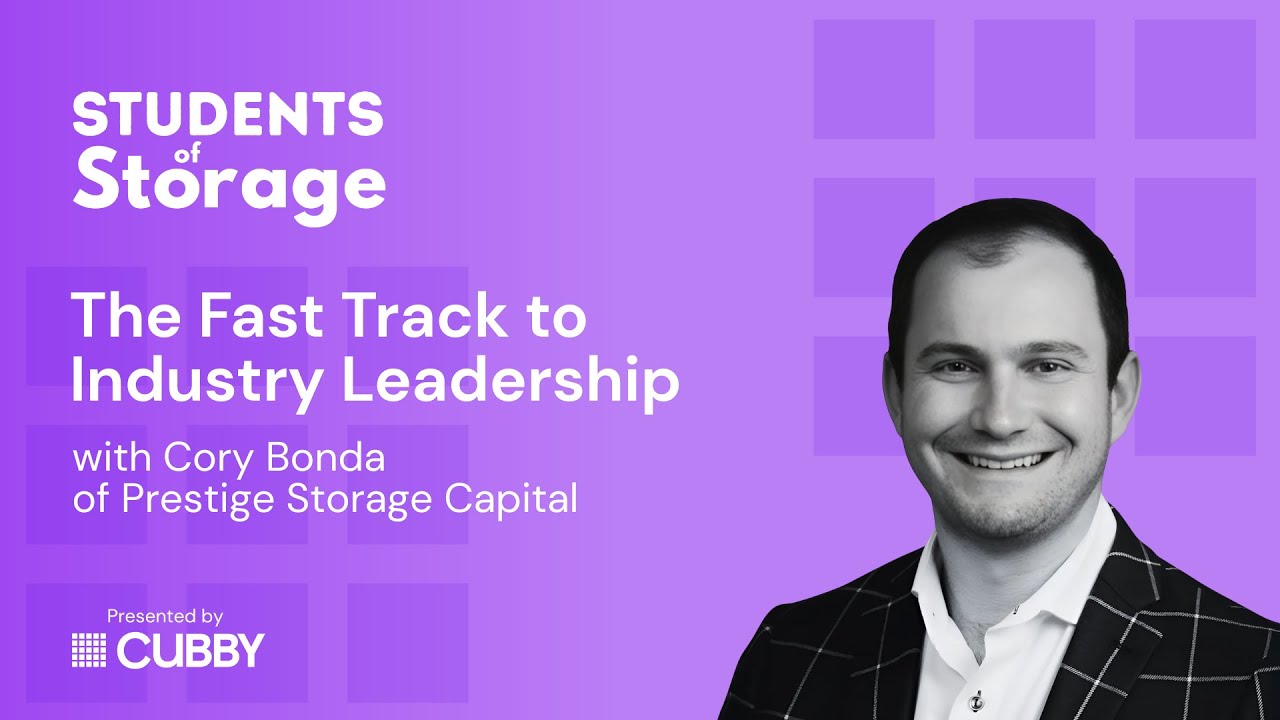
Cory Bonda, Principal of Prestige Storage Capital, joins this episode to discuss how operational decisions and reporting rhythms support sustainable portfolio growth. He shares how Prestige Storage transitioned from opportunistic acquisitions to a regional clustering model, why daily visibility into move-ins and churn is essential, and how lead conversion processes are evolving. We also discuss launching an internal tenant protection plan, managing team development through internal promotion, and handling the realities of early-stage operations.
Key Takeaways:
(00:42) Starting in operations to build a practical foundation for strategic decision-making.
(06:14) Communicating clear growth goals to align and motivate internal teams.
(09:50) Reviewing daily metrics to monitor performance and guide adjustments.
(13:03) Identifying early process gaps through on-the-ground operational challenges.
(16:02) Launching in-house services to improve control and property-level insights.
(19:20) Following up on leads with urgency through multiple communication channels.
(22:23) Enabling online transactions to meet modern customer behavior and demand.
(23:58) Partnering locally to strengthen brand visibility and community engagement.
Transcript
Hello everybody. Welcome to Students of Storage. I'm your host, Tully Hannon, and I'm joined by my co-host, Michael Brevdeh. Our guest today is Corey Bonda, principal over at Prestige Storage. Welcome.
How's it going? Pleasure to be here.
It just feels like last week that I saw you. Probably was. So I figured, Corey, you've got a really interesting story of how you ended up in self storage. Would love to shed a little light on that. Definitely, definitely. So I've been in the storage space since the beginning of 2017.
Prestige Storage now is a 63-property portfolio, mostly in the Midwest — ranked top 50 largest operators in the country, have about 25-26,000 units across the portfolio. I first started, though, out of college.
I was a senior in college looking for a job. I wanted to live in Columbus for a year and then move to New York City, actually.
So I saw a job posting at the time — it was unclear if it was, because it was a good school, it was unclear if "end of the year" meant end of the calendar year or the academic year — but the position was at Marcus & Millichap as a financial analyst. So I applied, ended up getting it, it was to start pretty much immediately.
So I was able to cancel my second semester senior classes at Ohio State and start as a financial analyst. I ended up getting assigned to the self storage team, so I had no idea at the time I'd be doing self storage. Started out just underwriting two to three properties a day — that's all I was pretty much doing, that and the escrow process once a deal got under contract with the brokers.
At the same time, I got connected with a guy in Columbus who owned two self storage properties, was building a third and buying a fourth. So I started moonlighting with him in the spring of 2017, helping him manage the existing properties, do pre-development on the development, and help with the DD process on the acquisition.
July, we close on that property. I handle everything — clearing out units, contacting all the customers, everything. A couple months go by and we start having more conversations about really trying to scale this.
2018, we bought two more properties, still managing everything ourselves — hiring property managers, training, trying to build a self storage management company, going to conferences, talking with as many people as I could.
2019, bought two more properties, started talking with some outside investors and really spreading the word on what we were looking to do. 2020 is when we officially launched Prestige Storage Management and started to really look to scale the company.
COVID happens, we lose out on two deals we were under contract or about to be under contract on, and at the time we probably had a portfolio of eight or nine stores total. Then in the middle of 2020 is when the engine really took off. We got under contract on two small portfolios that we closed at the end of 2020, so we doubled the portfolio from eight to 15 stores.
And then from there, we were under contract on pretty much a store at any given time for a three-year period, from July of 2020 to May of 2023.
So we grew the portfolio about 15 properties a year. We hired — we now have a team, year six, 75 total employees, about 20 corporate staff — district managers, accountants, marketing team, construction — and the rest are property managers spread across the portfolio. So it's been a wild ride. It was fun.
We were growing so quickly you couldn't even appreciate it, for the good and the bad. So it was definitely a pretty intense ride there. 2024 is when things started to slow down. Last year we bought three properties, built a fourth in a JV structure, and really retooled the management company to be able to sustain future growth.
Obviously, you launched Cubby in November 2024 as part of that. Yeah, that's awesome. I think, looking back, being a senior in college, falling into self storage in a way — what are some of the leadership skills you learned along the way? Were there people you found as mentors who had a pretty big impact on you getting where you are today?
Definitely. It just goes to — you always hear it in the self storage industry,
it's the only industry I've been in so I can't attest to others, but it's always an open industry. You can call any operator — we went and visited an operator in Pittsburgh, we hired a consultant who came from — and helped us build processes. It's always an open industry. And from a leadership perspective, we always just try to lead by example —
be the hardest working team out there is kind of what we strive for. You're obviously always going to make mistakes, especially as we grew the portfolio, early on some of the missteps we made — you definitely learn from them. But being growth-oriented and adaptable to change is definitely something we strive for here at Prestige.
Yeah. Yeah, that's evident in my conversations with the manager and the rest of the ops team — certainly got a good group behind you.
What do you do to keep them motivated? Obviously I always think of the "why" being super important behind everything somebody's doing, but I feel like you have a particularly unique way of motivating the team.
Yeah, yeah, it goes back to just being transparent about what we want to be. Our goal is to be a billion-dollar company, have a 125-150-store portfolio — we're very transparent about that. And how do we get there? We obviously have to be able to scale and continue to scale.
So we try to invest in our existing team as much as possible, promoting within — three or four, no, five, of our district managers were hired as property managers, and we've scaled that way — a lot of our team here has grown that way. And we talk about that consistently through the hiring process.
Yeah, that's awesome. I think transparency is something I certainly value here at Cubby — having a shared mindset as to what we're going toward. Is there anything — knowing that your portfolio mix is pretty diverse, right,
you have some hub-and-spoke models, a lot of manned facilities, a couple that are remote — how did that adapt and change over time? Is there something you're eyeing one way or another as you continue to grow?
It's a great question. You're right, we kind of have a whole pool of properties in our portfolio. I'd say initially we were just chasing good deals, especially early on when interest rates were rock bottom in early COVID and competition wasn't quite as fierce as it is now. We went and bought any deal that made sense — that's how we ended up with a deal in Baton Rouge and New Iberia, Louisiana,
that was our ninth and 16th property, and our first out of state was just southern, the Gulf States. That's kind of how we looked to grow the portfolio. But then as we seasoned some of the assets a bit, we've pulled back a little in our mindset and looked toward more Midwest-focused properties,
because you hit on the hub and spoke — I think scalability is incredibly important as we look to continue to compete as a management company, and having five or six properties within 30 minutes to an hour of each other is incredibly important, versus having a one-off that's hard to get to, where you don't really have that scale. And another thing we look for is — the industry is obviously changing incredibly quickly.
It's changed a ton over the last 10 years, you guys are a big portion of it, and something we've always joked about is we never want to be cutting edge, a leader in the industry — but actually working with Cubby was probably the biggest stretch we did, for looking to adapt and change, like we were going to go implement a bunch of kiosks and other things.
But just keeping a pulse on it, and seeing where changes are happening quickly, is incredibly important, because as we look to get more efficient with scalability, utilizing that technology is important.
Yeah. No.
Great background there. When you're running down and looking at your metrics, everybody has their series of reports — I think Matt likes to allude to the fact that he imagines you sitting in a chair with a glass of whiskey going through your consolidated management summary — but what are some of the things you look at from an operational perspective? What are some telltale signs of initial red flags, and what are healthy indicators
that you dive into?
Yeah. The leather chair analogy definitely started on the first visit that Matt and Adam made to Columbus, years ago, four years ago. Every night or every morning, I do try to look at the consolidated management summary or some dashboard to see how many move-ins we had the prior day, because that's definitely the bread and butter — that's what's going to move the dial.
Getting new people in the door is critical, especially in today's world where demand is down versus a couple years ago. So being able to track that quickly — obviously conversion and leads at the higher part of the funnel, and then the lower part of the funnel, churn and how quickly tenants are leaving —
what rate they're moving out at versus what rate new people are coming in at is obviously important to track, especially in today's ECRI and very low standard-rate environment.
Yes, your occupancy might stay consistently flat at 85%, but if the people leaving are paying more than the people coming in, your revenue is going to drop, and that's a definitely unique part of storage — how fluid the tenant base can be. Yeah, and it's totally dependent on what's happening in the market — like right now, not a lot of people are moving, so you have to get a new baseline. Super interesting there. Michael, did you have any thoughts?
Yeah, I'll switch gears a little bit. Would love to hear, Corey, more about why you got into third-party management, and then talk about how you think about the difference between the stores you own versus the ones you just manage, if there is a difference, or if you treat it like your own baby. Yeah, so we have three third-party stores currently, all in Ohio.
But we don't advertise that we offer third-party services currently — we're thinking about it for sure. As we've scaled, obviously, on the management side, we try our best not to cloud district managers' or anyone on the team's idea that this is a third-party managed property, to the best we can. But we really look at it just like one of our own.
Even if the brand name isn't the same, we still try to utilize all the same policies and processes to increase revenue, since we're all incentivized to grow it that way. Yeah, makes a ton of sense. Something else you mentioned early on that's always a fun story on these podcasts is you made some mistakes early on — who hasn't?
Would love for you to share a mistake or two you made early on that's either funny or insightful, illuminating as to what other folks can avoid — or, unfortunately, the NDA — I'd have to kill you if I told — yeah, sure, and you can't reference — what did you say — I said you can't reference working with me, that doesn't count — exactly. We had a couple — the biggest thing is definitely auctions.
That's where you can see the most quick liability, and something really pop up. We unfortunately, really early on, auctioned the wrong unit. Unit 117 was supposed to be auctioned and we auctioned 118, and someone came pretty quickly and found that out.
So I had to go with like five grand in cash to this guy's house — he'd bought a different storage unit with five grand in cash — pay him, and then I got back all the items the previous owner wanted, to rectify the situation. Thankfully we were able to do that.
That's why I had in my car like three taxidermy deer, or stuffed animals, and this piece of medical equipment for eye doctors — it was just a wild situation, and thankfully we were able to rectify it pretty well. It's obviously an incredibly difficult thing to run into. And then, the first time I had to terminate somebody, got a little dicey for sure. I was 22 at the time.
We had a new property manager starting on Tuesday, Monday is when we decided to term the person, my partner couldn't come with me to do the termination like he'd planned. So I was there with some documents she had to sign, and she just did not take it very well.
Coming from a 22-year-old who popped onto the scene after she started — it was the second property at the time. So she chased me, threw a cup of coffee at me, tried to lock me out of the office — didn't realize I had a key, so I was able to fool her with that one pretty quickly. And then called the cops — the police are like, "Is this an emergency?" Me being like, "Tough, but no."
Situation escalates — 10 to 15 minutes later, she's chasing me with a fire extinguisher. I call the cops back —
I'm like, "You gotta — it's getting out of control." So they came and settled her down, or threatened to arrest her. So I've definitely learned from that situation about how to better prepare for terminations. Obviously, scale the company quick enough so I don't have to do that ever again was kind of the thought I had at the time. Great couple of crazy stories there, thanks for sharing.
I'm sure folks will like that one. Yeah. Can't say we've had any experience like that in the office yet, but who knows?
So when they fire Tully someday, it might get dicey, I don't know. It could. Exactly.
I'm not leaving.
Cool. I know, Corey, that you, as a large operator, there's obviously economic efficiencies with bringing insurance or tenant protection in-house — curious how you went about that, how you made that decision. Obviously a ton of awesome vendors in the space, but would love your thoughts behind it. Yeah, so we launched Prestige Protection Plan in February of 2024 — we handle all our protection plan in-house.
As we scaled, we realized, like you said, there would be efficiencies once you reach a certain number of units protected, so we decided to bring that in-house. Launched Prestige Protection Plan in 2024, and this year is when we started to expand it and offer it to non-owned or non-managed properties.
Really, the reason we looked to launch this was control — being able to control our audit and auto-enrollments. We saw our total enrollment increase by like 8-10% in the first eight months after we launched it last year. We've also had better control over our claims —
knowing exactly where the claims are coming from, so we do see exposure on the property side — hey, this property has seen an increase in break-ins, do we need to increase the cameras? This property has a moisture issue, is something wrong with the roof, is there no airflow, different things like that.
And then throughout the claims process, we want to be able to handle it — if we advertise the product, we want to be able to handle the claims process with our tenants, versus just giving it to some third party and saying, "We're sorry,
here you go." So those are the big factors that led us to launch the Prestige Protection Plan, the captive, last year. And we want to definitely offer the services to other owners. It's been great to partner with you guys, coming as an owner —
we understand the economic benefits of a higher enrollment, but also things you need to look out for as you're working through claims and different improvements to the property. So taking an owner's perspective is definitely something we strive for at Prestige, and that flows down through the protection claim. Yeah, makes total sense, appreciate you shedding light on that.
I think controlling insights, having a single source of truth, is super important. I know Michael, at the last show in Orlando, had a chance to hear you and Matt and a few others speak, and would love to talk a little about that experience. Michael, if you've got some thoughts.
Yeah, it was an awesome panel. Obviously Matt, our CEO, is the moderator, but Corey Markpool over at Liberty was on the panel as well, and it was all about lead conversion best practices. Now, obviously we talk about that a lot in our day job, but hearing from the operator side of things in terms of how they're maximizing lead conversion in an often-tough demand environment right now — it's not 2021, 2022 where units are flying off the shelves —
how do we convert as many potential renters into actual renters as possible?
It's really something I think more operators should be even more laser-focused on than I often hear. Corey, if you could just share with our guests maybe one or two nuggets from what you did back in March, or some of the insights on the lead conversion side that might be helpful to the operators listening to this. Absolutely, absolutely. I appreciate you attending that panel. Tully, I guess you didn't have the opportunity —
he did have the opportunity, he just chose not to. Yeah, I remember that. I was fortunate enough — Mark P has a ton of knowledge in this space, I was lucky to share the stage with him, and Matt did a great job leading the panel. Kind of back to what we talked about earlier — the first metric I look at every day is move-ins, and how do you increase them — you look higher up the funnel, you look at where your leads are coming from.
So really the couple biggest things: you need to have a way to track them — a CRM, or your facility management software, needs the ability to track leads, whether that's your property manager entering them or getting it automatically input via your website or other lead generation sources, and being able to track where they're coming from. Is it pay-per-click,
is it organic — understanding the really high end of the funnel. And as you get further down, it's the training and development with your team. It sticks in my head so much — I was calling a furniture moving company last week, called the first number on the list, didn't pick up, I was halfway through a voicemail, the guy calls me back while I'm leaving a voicemail, immediately gives me a quote.
I said, "Hey, I can come help you with that tomorrow." It's those kind of experiences that are critical right now — you get a lead in your system, it has to be called immediately, followed up on. It's not — they gave you that information, they requested to be followed up with, whether it's a reservation or just a normal inquiry. So you need to follow up with them consistently and quickly.
And on top of that, you've got to utilize the different mediums we have today. It's not just Yellow Pages and a phone number.
It's phones, text, emails, chatbots — you have all these mediums available for you to communicate with the tenant. You've got to be able to text them, say, "Hey, appreciate you making that reservation.
Am I still seeing you for your move-in date tomorrow? Here are the things I need." That's a huge part during training. And then obviously making it fun — Mark talked about a Slack channel, that was a great idea — but just setting goals on conversion rates and move-in rates, and having some sort of competition internally, always excites the team.
And just being able to follow through with it. The leads aren't cheap these days — there are fewer of them. So being able to capitalize as quickly as possible is very important. Yeah, 100%, completely agree with all of that. I think one other area we talk about a lot is just your website, right — how easy is it for someone to rent a unit?
Can someone even rent or reserve a unit directly from your website or not? I'm sorry to the listeners out there,
it's unfortunately 2025 —
you need to allow online rentals. We're not going to get eyes on every single person who moves in, or even if you do, you need to allow them to complete the rental online and then meet you in person in the office.
If you're not giving the option for online rentals, you're losing an unknown number of customers, because you can't even track who's there. So I'm always — I'm on a panel tomorrow in Arizona around AI and tech, and lots of cool AI applications — but I think we can take the low-hanging fruit sometimes, right, and apply that. So always something we like to emphasize. Tully, any final thoughts? I know we're wrapping up on time here. No.
For those who don't know, Corey is probably one of the most renowned Ohio State fans. So Corey, I'd love some thoughts on the 2025-2026 season, who you're excited to see play.
What are the big games we should watch out for?
For sure. Yeah, got the national championship last January, appreciate the plug there. Got the spring game — we had the spring game last weekend. We have a new quarterback, so that's always — we're going to have a new quarterback, so that's always a big thing to look out for. Got two great candidates right now, it looks like. And then we play Texas week one in Columbus, so that should be a ton of fun. I think the fan base wants to know, will Prestige be supporting any NIL deals,
and if so, who will you be targeting? We did an NIL deal last year with Sonny Styles, a linebacker for Ohio State — he came and did a — he's a Columbus guy, great guy — came and did a grand opening at an expansion we did. So we're looking to see if we should do something again this year with Sonny or someone else on the team, to showcase our love for Ohio State.
But it's funny, half our portfolio is in Michigan, so we could do a unique little NIL opportunity there.
Awesome, sounds like Tully and I need to make it out for week one.
You're welcome anytime.
I'd have to agree with that. Well, Corey, pleasure as always, looking forward to seeing you soon, and thanks for coming on. I appreciate it, guys, enjoyed it.
Thank you for listening to Students of Storage. Links to any of the resources we chatted about in the episode can be found in the show notes. If you enjoyed the show, please leave a five-star review and subscribe so you don't miss out on any future episodes. Hope to see you back here soon.
Cory Bonda, Principal of Prestige Storage Capital, joins this episode to discuss how operational decisions and reporting rhythms support sustainable portfolio growth. He shares how Prestige Storage transitioned from opportunistic acquisitions to a regional clustering model, why daily visibility into move-ins and churn is essential, and how lead conversion processes are evolving. We also discuss launching an internal tenant protection plan, managing team development through internal promotion, and handling the realities of early-stage operations.
Key Takeaways:
(00:42) Starting in operations to build a practical foundation for strategic decision-making.
(06:14) Communicating clear growth goals to align and motivate internal teams.
(09:50) Reviewing daily metrics to monitor performance and guide adjustments.
(13:03) Identifying early process gaps through on-the-ground operational challenges.
(16:02) Launching in-house services to improve control and property-level insights.
(19:20) Following up on leads with urgency through multiple communication channels.
(22:23) Enabling online transactions to meet modern customer behavior and demand.
(23:58) Partnering locally to strengthen brand visibility and community engagement.
Transcript
Hello everybody. Welcome to Students of Storage. I'm your host, Tully Hannon, and I'm joined by my co-host, Michael Brevdeh. Our guest today is Corey Bonda, principal over at Prestige Storage. Welcome.
How's it going? Pleasure to be here.
It just feels like last week that I saw you. Probably was. So I figured, Corey, you've got a really interesting story of how you ended up in self storage. Would love to shed a little light on that. Definitely, definitely. So I've been in the storage space since the beginning of 2017.
Prestige Storage now is a 63-property portfolio, mostly in the Midwest — ranked top 50 largest operators in the country, have about 25-26,000 units across the portfolio. I first started, though, out of college.
I was a senior in college looking for a job. I wanted to live in Columbus for a year and then move to New York City, actually.
So I saw a job posting at the time — it was unclear if it was, because it was a good school, it was unclear if "end of the year" meant end of the calendar year or the academic year — but the position was at Marcus & Millichap as a financial analyst. So I applied, ended up getting it, it was to start pretty much immediately.
So I was able to cancel my second semester senior classes at Ohio State and start as a financial analyst. I ended up getting assigned to the self storage team, so I had no idea at the time I'd be doing self storage. Started out just underwriting two to three properties a day — that's all I was pretty much doing, that and the escrow process once a deal got under contract with the brokers.
At the same time, I got connected with a guy in Columbus who owned two self storage properties, was building a third and buying a fourth. So I started moonlighting with him in the spring of 2017, helping him manage the existing properties, do pre-development on the development, and help with the DD process on the acquisition.
July, we close on that property. I handle everything — clearing out units, contacting all the customers, everything. A couple months go by and we start having more conversations about really trying to scale this.
2018, we bought two more properties, still managing everything ourselves — hiring property managers, training, trying to build a self storage management company, going to conferences, talking with as many people as I could.
2019, bought two more properties, started talking with some outside investors and really spreading the word on what we were looking to do. 2020 is when we officially launched Prestige Storage Management and started to really look to scale the company.
COVID happens, we lose out on two deals we were under contract or about to be under contract on, and at the time we probably had a portfolio of eight or nine stores total. Then in the middle of 2020 is when the engine really took off. We got under contract on two small portfolios that we closed at the end of 2020, so we doubled the portfolio from eight to 15 stores.
And then from there, we were under contract on pretty much a store at any given time for a three-year period, from July of 2020 to May of 2023.
So we grew the portfolio about 15 properties a year. We hired — we now have a team, year six, 75 total employees, about 20 corporate staff — district managers, accountants, marketing team, construction — and the rest are property managers spread across the portfolio. So it's been a wild ride. It was fun.
We were growing so quickly you couldn't even appreciate it, for the good and the bad. So it was definitely a pretty intense ride there. 2024 is when things started to slow down. Last year we bought three properties, built a fourth in a JV structure, and really retooled the management company to be able to sustain future growth.
Obviously, you launched Cubby in November 2024 as part of that. Yeah, that's awesome. I think, looking back, being a senior in college, falling into self storage in a way — what are some of the leadership skills you learned along the way? Were there people you found as mentors who had a pretty big impact on you getting where you are today?
Definitely. It just goes to — you always hear it in the self storage industry,
it's the only industry I've been in so I can't attest to others, but it's always an open industry. You can call any operator — we went and visited an operator in Pittsburgh, we hired a consultant who came from — and helped us build processes. It's always an open industry. And from a leadership perspective, we always just try to lead by example —
be the hardest working team out there is kind of what we strive for. You're obviously always going to make mistakes, especially as we grew the portfolio, early on some of the missteps we made — you definitely learn from them. But being growth-oriented and adaptable to change is definitely something we strive for here at Prestige.
Yeah. Yeah, that's evident in my conversations with the manager and the rest of the ops team — certainly got a good group behind you.
What do you do to keep them motivated? Obviously I always think of the "why" being super important behind everything somebody's doing, but I feel like you have a particularly unique way of motivating the team.
Yeah, yeah, it goes back to just being transparent about what we want to be. Our goal is to be a billion-dollar company, have a 125-150-store portfolio — we're very transparent about that. And how do we get there? We obviously have to be able to scale and continue to scale.
So we try to invest in our existing team as much as possible, promoting within — three or four, no, five, of our district managers were hired as property managers, and we've scaled that way — a lot of our team here has grown that way. And we talk about that consistently through the hiring process.
Yeah, that's awesome. I think transparency is something I certainly value here at Cubby — having a shared mindset as to what we're going toward. Is there anything — knowing that your portfolio mix is pretty diverse, right,
you have some hub-and-spoke models, a lot of manned facilities, a couple that are remote — how did that adapt and change over time? Is there something you're eyeing one way or another as you continue to grow?
It's a great question. You're right, we kind of have a whole pool of properties in our portfolio. I'd say initially we were just chasing good deals, especially early on when interest rates were rock bottom in early COVID and competition wasn't quite as fierce as it is now. We went and bought any deal that made sense — that's how we ended up with a deal in Baton Rouge and New Iberia, Louisiana,
that was our ninth and 16th property, and our first out of state was just southern, the Gulf States. That's kind of how we looked to grow the portfolio. But then as we seasoned some of the assets a bit, we've pulled back a little in our mindset and looked toward more Midwest-focused properties,
because you hit on the hub and spoke — I think scalability is incredibly important as we look to continue to compete as a management company, and having five or six properties within 30 minutes to an hour of each other is incredibly important, versus having a one-off that's hard to get to, where you don't really have that scale. And another thing we look for is — the industry is obviously changing incredibly quickly.
It's changed a ton over the last 10 years, you guys are a big portion of it, and something we've always joked about is we never want to be cutting edge, a leader in the industry — but actually working with Cubby was probably the biggest stretch we did, for looking to adapt and change, like we were going to go implement a bunch of kiosks and other things.
But just keeping a pulse on it, and seeing where changes are happening quickly, is incredibly important, because as we look to get more efficient with scalability, utilizing that technology is important.
Yeah. No.
Great background there. When you're running down and looking at your metrics, everybody has their series of reports — I think Matt likes to allude to the fact that he imagines you sitting in a chair with a glass of whiskey going through your consolidated management summary — but what are some of the things you look at from an operational perspective? What are some telltale signs of initial red flags, and what are healthy indicators
that you dive into?
Yeah. The leather chair analogy definitely started on the first visit that Matt and Adam made to Columbus, years ago, four years ago. Every night or every morning, I do try to look at the consolidated management summary or some dashboard to see how many move-ins we had the prior day, because that's definitely the bread and butter — that's what's going to move the dial.
Getting new people in the door is critical, especially in today's world where demand is down versus a couple years ago. So being able to track that quickly — obviously conversion and leads at the higher part of the funnel, and then the lower part of the funnel, churn and how quickly tenants are leaving —
what rate they're moving out at versus what rate new people are coming in at is obviously important to track, especially in today's ECRI and very low standard-rate environment.
Yes, your occupancy might stay consistently flat at 85%, but if the people leaving are paying more than the people coming in, your revenue is going to drop, and that's a definitely unique part of storage — how fluid the tenant base can be. Yeah, and it's totally dependent on what's happening in the market — like right now, not a lot of people are moving, so you have to get a new baseline. Super interesting there. Michael, did you have any thoughts?
Yeah, I'll switch gears a little bit. Would love to hear, Corey, more about why you got into third-party management, and then talk about how you think about the difference between the stores you own versus the ones you just manage, if there is a difference, or if you treat it like your own baby. Yeah, so we have three third-party stores currently, all in Ohio.
But we don't advertise that we offer third-party services currently — we're thinking about it for sure. As we've scaled, obviously, on the management side, we try our best not to cloud district managers' or anyone on the team's idea that this is a third-party managed property, to the best we can. But we really look at it just like one of our own.
Even if the brand name isn't the same, we still try to utilize all the same policies and processes to increase revenue, since we're all incentivized to grow it that way. Yeah, makes a ton of sense. Something else you mentioned early on that's always a fun story on these podcasts is you made some mistakes early on — who hasn't?
Would love for you to share a mistake or two you made early on that's either funny or insightful, illuminating as to what other folks can avoid — or, unfortunately, the NDA — I'd have to kill you if I told — yeah, sure, and you can't reference — what did you say — I said you can't reference working with me, that doesn't count — exactly. We had a couple — the biggest thing is definitely auctions.
That's where you can see the most quick liability, and something really pop up. We unfortunately, really early on, auctioned the wrong unit. Unit 117 was supposed to be auctioned and we auctioned 118, and someone came pretty quickly and found that out.
So I had to go with like five grand in cash to this guy's house — he'd bought a different storage unit with five grand in cash — pay him, and then I got back all the items the previous owner wanted, to rectify the situation. Thankfully we were able to do that.
That's why I had in my car like three taxidermy deer, or stuffed animals, and this piece of medical equipment for eye doctors — it was just a wild situation, and thankfully we were able to rectify it pretty well. It's obviously an incredibly difficult thing to run into. And then, the first time I had to terminate somebody, got a little dicey for sure. I was 22 at the time.
We had a new property manager starting on Tuesday, Monday is when we decided to term the person, my partner couldn't come with me to do the termination like he'd planned. So I was there with some documents she had to sign, and she just did not take it very well.
Coming from a 22-year-old who popped onto the scene after she started — it was the second property at the time. So she chased me, threw a cup of coffee at me, tried to lock me out of the office — didn't realize I had a key, so I was able to fool her with that one pretty quickly. And then called the cops — the police are like, "Is this an emergency?" Me being like, "Tough, but no."
Situation escalates — 10 to 15 minutes later, she's chasing me with a fire extinguisher. I call the cops back —
I'm like, "You gotta — it's getting out of control." So they came and settled her down, or threatened to arrest her. So I've definitely learned from that situation about how to better prepare for terminations. Obviously, scale the company quick enough so I don't have to do that ever again was kind of the thought I had at the time. Great couple of crazy stories there, thanks for sharing.
I'm sure folks will like that one. Yeah. Can't say we've had any experience like that in the office yet, but who knows?
So when they fire Tully someday, it might get dicey, I don't know. It could. Exactly.
I'm not leaving.
Cool. I know, Corey, that you, as a large operator, there's obviously economic efficiencies with bringing insurance or tenant protection in-house — curious how you went about that, how you made that decision. Obviously a ton of awesome vendors in the space, but would love your thoughts behind it. Yeah, so we launched Prestige Protection Plan in February of 2024 — we handle all our protection plan in-house.
As we scaled, we realized, like you said, there would be efficiencies once you reach a certain number of units protected, so we decided to bring that in-house. Launched Prestige Protection Plan in 2024, and this year is when we started to expand it and offer it to non-owned or non-managed properties.
Really, the reason we looked to launch this was control — being able to control our audit and auto-enrollments. We saw our total enrollment increase by like 8-10% in the first eight months after we launched it last year. We've also had better control over our claims —
knowing exactly where the claims are coming from, so we do see exposure on the property side — hey, this property has seen an increase in break-ins, do we need to increase the cameras? This property has a moisture issue, is something wrong with the roof, is there no airflow, different things like that.
And then throughout the claims process, we want to be able to handle it — if we advertise the product, we want to be able to handle the claims process with our tenants, versus just giving it to some third party and saying, "We're sorry,
here you go." So those are the big factors that led us to launch the Prestige Protection Plan, the captive, last year. And we want to definitely offer the services to other owners. It's been great to partner with you guys, coming as an owner —
we understand the economic benefits of a higher enrollment, but also things you need to look out for as you're working through claims and different improvements to the property. So taking an owner's perspective is definitely something we strive for at Prestige, and that flows down through the protection claim. Yeah, makes total sense, appreciate you shedding light on that.
I think controlling insights, having a single source of truth, is super important. I know Michael, at the last show in Orlando, had a chance to hear you and Matt and a few others speak, and would love to talk a little about that experience. Michael, if you've got some thoughts.
Yeah, it was an awesome panel. Obviously Matt, our CEO, is the moderator, but Corey Markpool over at Liberty was on the panel as well, and it was all about lead conversion best practices. Now, obviously we talk about that a lot in our day job, but hearing from the operator side of things in terms of how they're maximizing lead conversion in an often-tough demand environment right now — it's not 2021, 2022 where units are flying off the shelves —
how do we convert as many potential renters into actual renters as possible?
It's really something I think more operators should be even more laser-focused on than I often hear. Corey, if you could just share with our guests maybe one or two nuggets from what you did back in March, or some of the insights on the lead conversion side that might be helpful to the operators listening to this. Absolutely, absolutely. I appreciate you attending that panel. Tully, I guess you didn't have the opportunity —
he did have the opportunity, he just chose not to. Yeah, I remember that. I was fortunate enough — Mark P has a ton of knowledge in this space, I was lucky to share the stage with him, and Matt did a great job leading the panel. Kind of back to what we talked about earlier — the first metric I look at every day is move-ins, and how do you increase them — you look higher up the funnel, you look at where your leads are coming from.
So really the couple biggest things: you need to have a way to track them — a CRM, or your facility management software, needs the ability to track leads, whether that's your property manager entering them or getting it automatically input via your website or other lead generation sources, and being able to track where they're coming from. Is it pay-per-click,
is it organic — understanding the really high end of the funnel. And as you get further down, it's the training and development with your team. It sticks in my head so much — I was calling a furniture moving company last week, called the first number on the list, didn't pick up, I was halfway through a voicemail, the guy calls me back while I'm leaving a voicemail, immediately gives me a quote.
I said, "Hey, I can come help you with that tomorrow." It's those kind of experiences that are critical right now — you get a lead in your system, it has to be called immediately, followed up on. It's not — they gave you that information, they requested to be followed up with, whether it's a reservation or just a normal inquiry. So you need to follow up with them consistently and quickly.
And on top of that, you've got to utilize the different mediums we have today. It's not just Yellow Pages and a phone number.
It's phones, text, emails, chatbots — you have all these mediums available for you to communicate with the tenant. You've got to be able to text them, say, "Hey, appreciate you making that reservation.
Am I still seeing you for your move-in date tomorrow? Here are the things I need." That's a huge part during training. And then obviously making it fun — Mark talked about a Slack channel, that was a great idea — but just setting goals on conversion rates and move-in rates, and having some sort of competition internally, always excites the team.
And just being able to follow through with it. The leads aren't cheap these days — there are fewer of them. So being able to capitalize as quickly as possible is very important. Yeah, 100%, completely agree with all of that. I think one other area we talk about a lot is just your website, right — how easy is it for someone to rent a unit?
Can someone even rent or reserve a unit directly from your website or not? I'm sorry to the listeners out there,
it's unfortunately 2025 —
you need to allow online rentals. We're not going to get eyes on every single person who moves in, or even if you do, you need to allow them to complete the rental online and then meet you in person in the office.
If you're not giving the option for online rentals, you're losing an unknown number of customers, because you can't even track who's there. So I'm always — I'm on a panel tomorrow in Arizona around AI and tech, and lots of cool AI applications — but I think we can take the low-hanging fruit sometimes, right, and apply that. So always something we like to emphasize. Tully, any final thoughts? I know we're wrapping up on time here. No.
For those who don't know, Corey is probably one of the most renowned Ohio State fans. So Corey, I'd love some thoughts on the 2025-2026 season, who you're excited to see play.
What are the big games we should watch out for?
For sure. Yeah, got the national championship last January, appreciate the plug there. Got the spring game — we had the spring game last weekend. We have a new quarterback, so that's always — we're going to have a new quarterback, so that's always a big thing to look out for. Got two great candidates right now, it looks like. And then we play Texas week one in Columbus, so that should be a ton of fun. I think the fan base wants to know, will Prestige be supporting any NIL deals,
and if so, who will you be targeting? We did an NIL deal last year with Sonny Styles, a linebacker for Ohio State — he came and did a — he's a Columbus guy, great guy — came and did a grand opening at an expansion we did. So we're looking to see if we should do something again this year with Sonny or someone else on the team, to showcase our love for Ohio State.
But it's funny, half our portfolio is in Michigan, so we could do a unique little NIL opportunity there.
Awesome, sounds like Tully and I need to make it out for week one.
You're welcome anytime.
I'd have to agree with that. Well, Corey, pleasure as always, looking forward to seeing you soon, and thanks for coming on. I appreciate it, guys, enjoyed it.
Thank you for listening to Students of Storage. Links to any of the resources we chatted about in the episode can be found in the show notes. If you enjoyed the show, please leave a five-star review and subscribe so you don't miss out on any future episodes. Hope to see you back here soon.
Latest
Content
From Oil Prices to Storage Units: Building a Business You Control with Karl Graham of Luminus Capital
Cubby Team
・
Read More
Content
The Real Legal Risks for Self-Storage Operators with Jeff Greenberger of Late2Lien
Cubby Team
・
Read More
Content
From Reviews to Rentals: Turning Google Reviews Into Real Growth with Kale Leavitt of StorageReach
Cubby Team
・
Read More